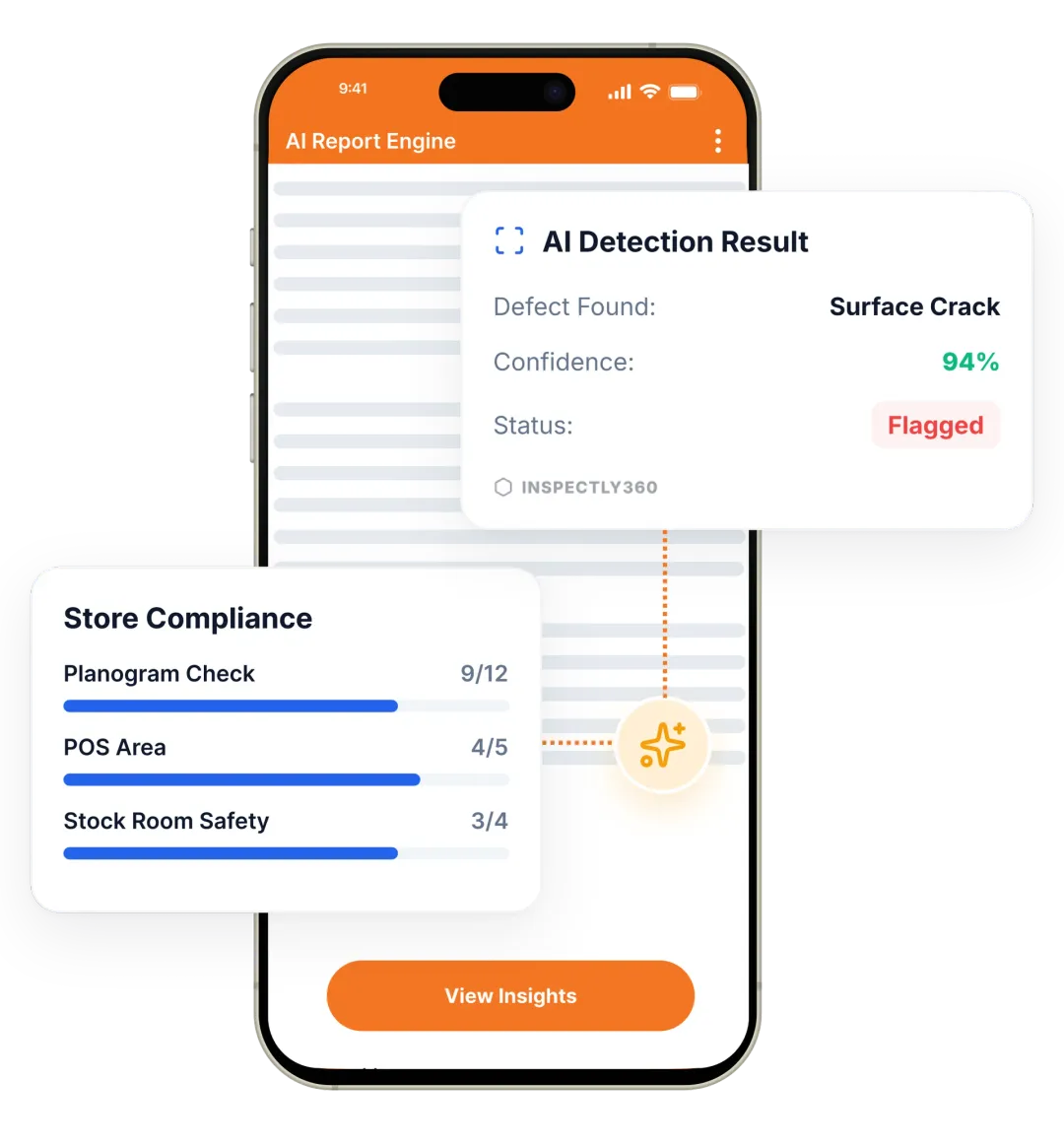
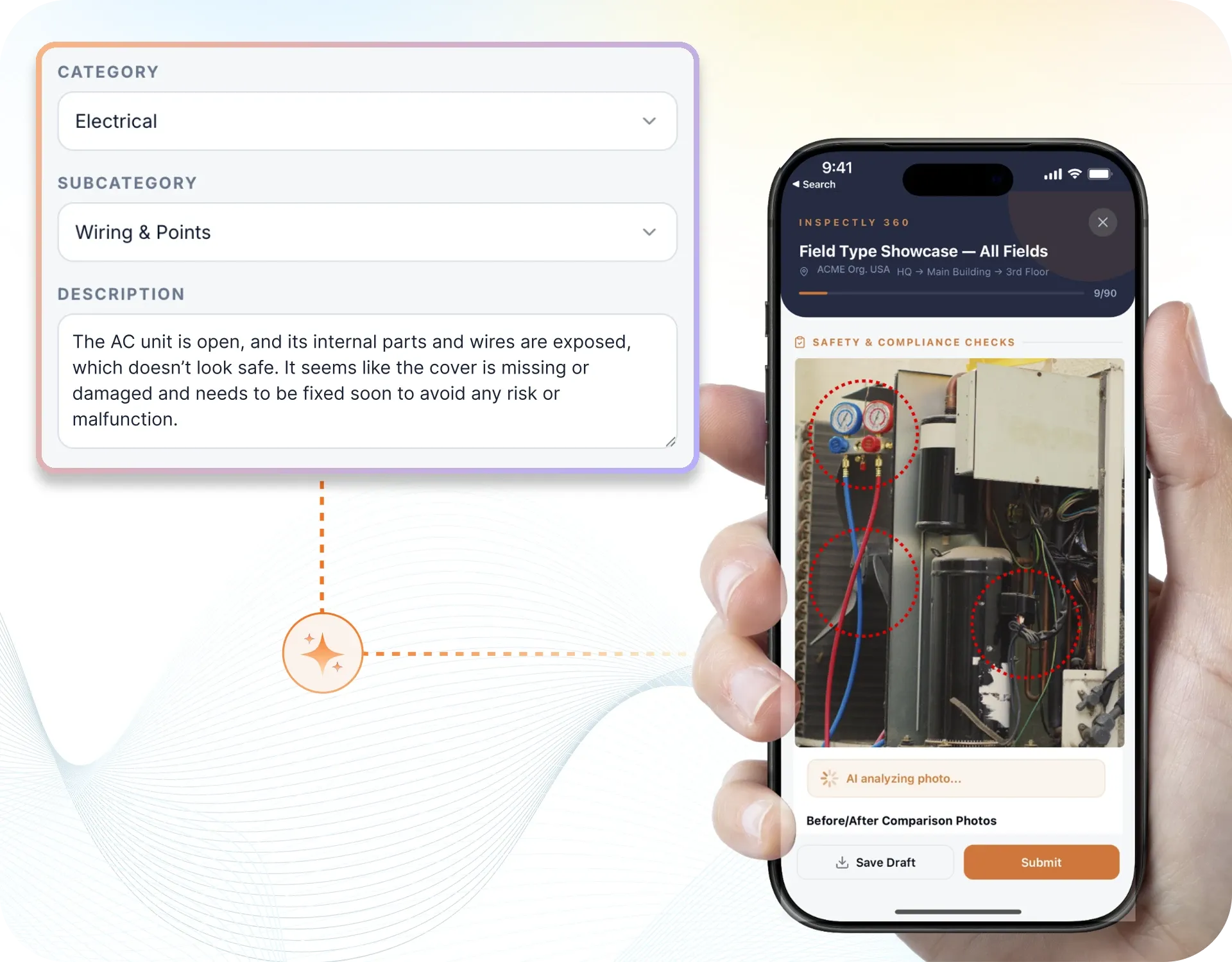
Take a Photo. AI Fills the Form
Your inspector takes a photo of any asset or defect. AI reads it and fills the inspection form automatically. No typing. No manual entry.

Convert your checklist into Mobile App
Furniture and Equipment (School) Safety App helps safety teams catch furniture and equipment (school) hazards before they cause an incident. Field teams log missing PPE, blocked exits, isolation gaps, slip and trip hazards, attach photo evidence, and route every hazard to a named owner with a due date. Safety leads see open furniture and equipment (school) hazards and overdue actions across every site on one dashboard.

Furniture and Equipment (School) Safety App delivers qR-scanned inspection routes, PM scheduling, and work-order creation as the core workflow, ending reactive breakdowns and no visibility of asset condition. Map records to reliability-centred and condition-based maintenance practice and highlight trend analytics that surface risk before it escalates.
Furniture and Equipment (School) Safety App targets the equipment hazards that cause incidents: missing or defeated guards, failed interlocks or e-stops, and no isolation or lock-out. Field teams check fixed and interlocked guards in place, emergency stops and reset, isolation and lock-out points, and moving parts and pinch points, log each hazard with a photo and a severity, and route it to a named owner, so an equipment risk is caught and closed before it becomes an incident. Evidence stays aligned to ISO 12100, and OSHA 1910.212.
A comprehensive inspection for education covers the key areas that affect safety and compliance. Monitor school furniture and equipment safety issues with hazards and corrective action workflows. Your inspection should include sections for furniture and equipment (school) safety condition checks, evidence capture, pass/fail or scoring criteria, corrective action assignment, and sign-off, so that nothing is missed and every inspection finding is traceable.
Catching furniture and equipment (school) hazards early depends on a consistent routine. Follow these steps for each safety inspection:
Furniture and Equipment (School) Safety App covers Asset Health, Failure Codes, Criticality, Inspection Route, and more, with photo evidence, readings, corrective actions, and audit-ready records.
Templates align to ISO 12100, OSHA 1910.212.

Field teams check the work area for missing PPE, blocked exits, isolation gaps, slip and trip hazards.

Each furniture and equipment (school) hazard gets a severity, a named owner, and a due date.

Risk dashboards flag recurring furniture and equipment (school) hazards so root causes get fixed.
Everything your field team does on paper, Inspectly360 does automatically: faster, more accurate, and without the admin.
Your inspector takes a photo of any asset or defect. AI reads it and fills the inspection form automatically. No typing. No manual entry.
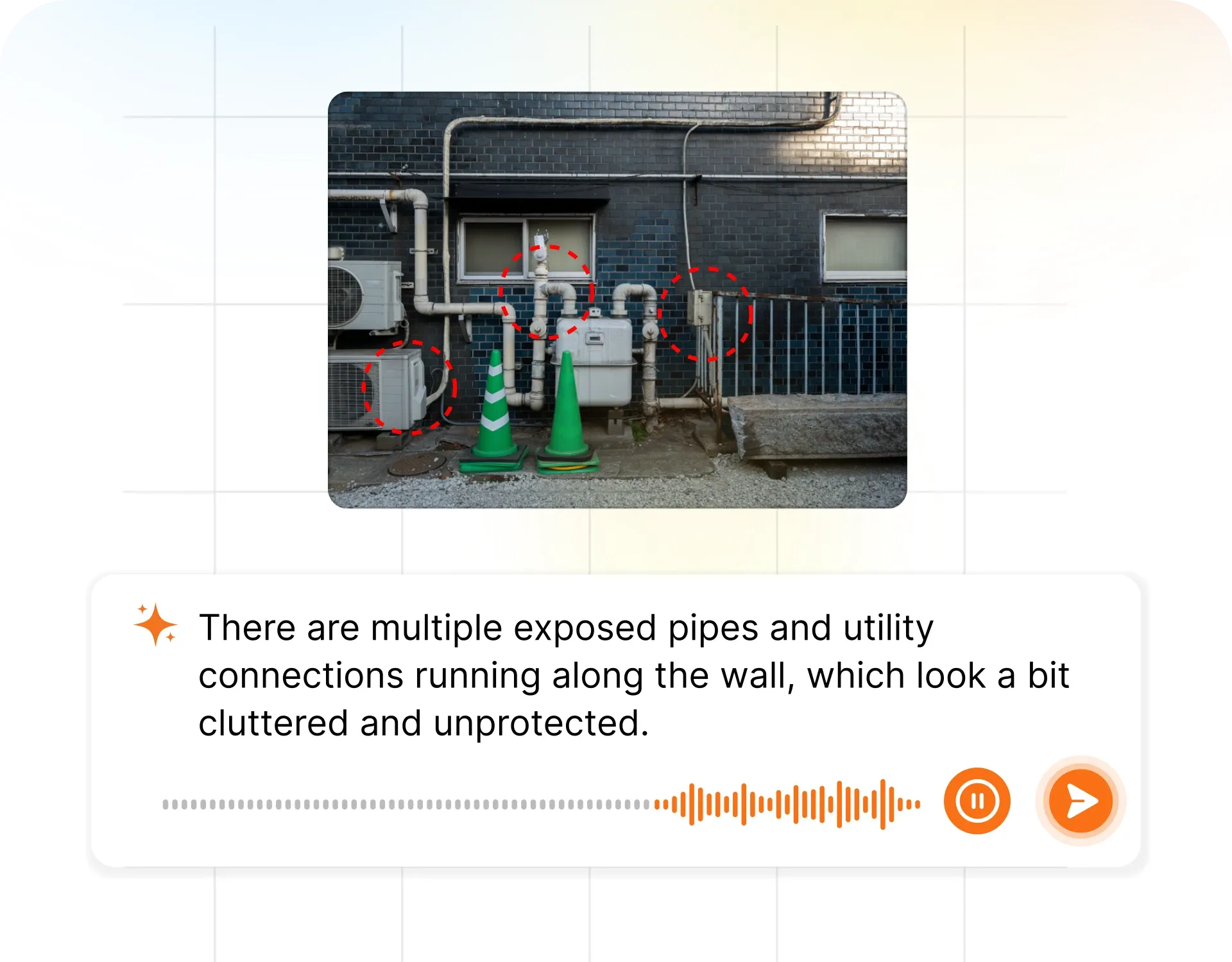
Inspectors speak their observations in any language. AI transcribes and fills the form in real time. Completely hands-free in the field.
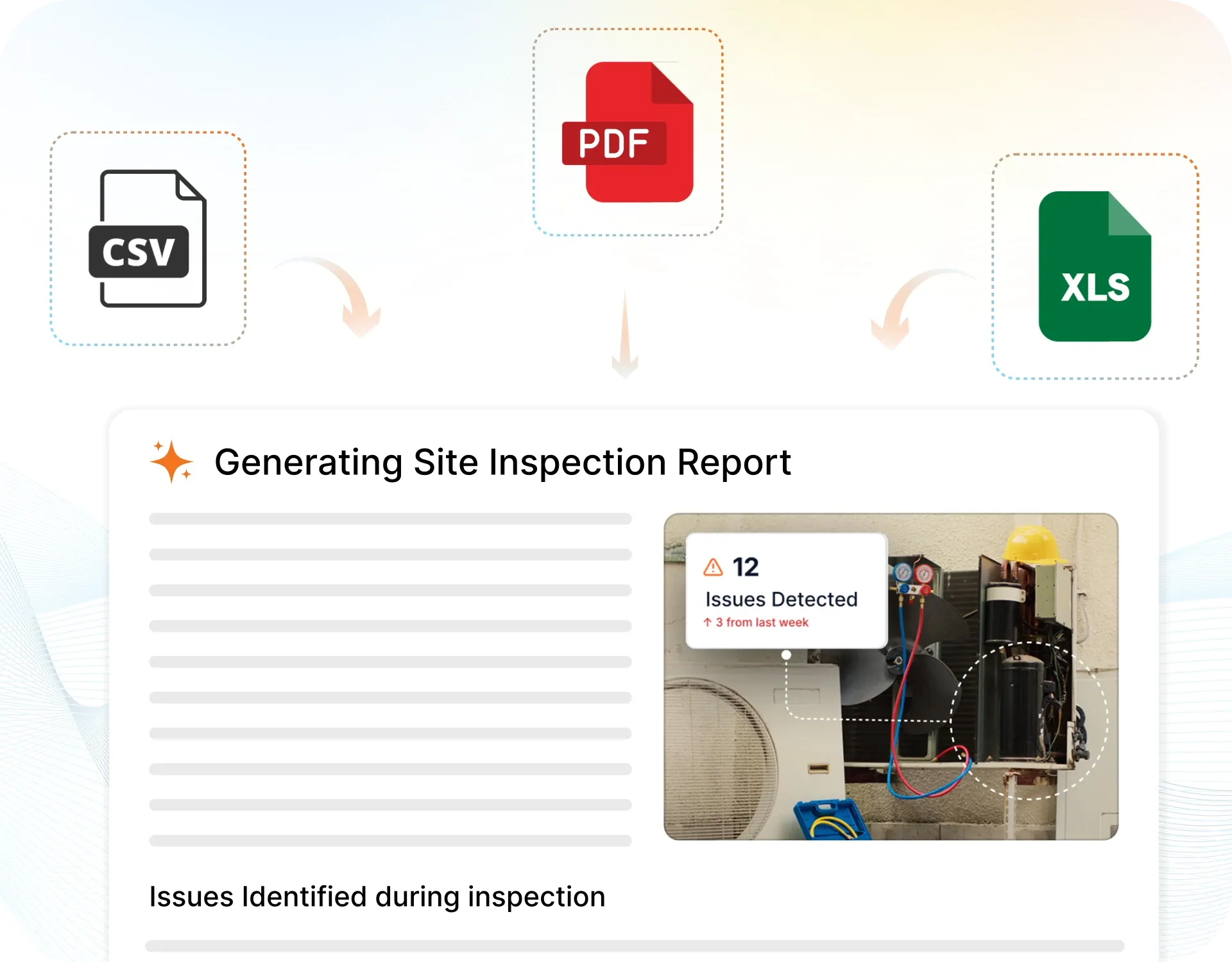
The moment an inspection is submitted, a branded PDF, Excel, or CSV report generates automatically. No manual work. No waiting.
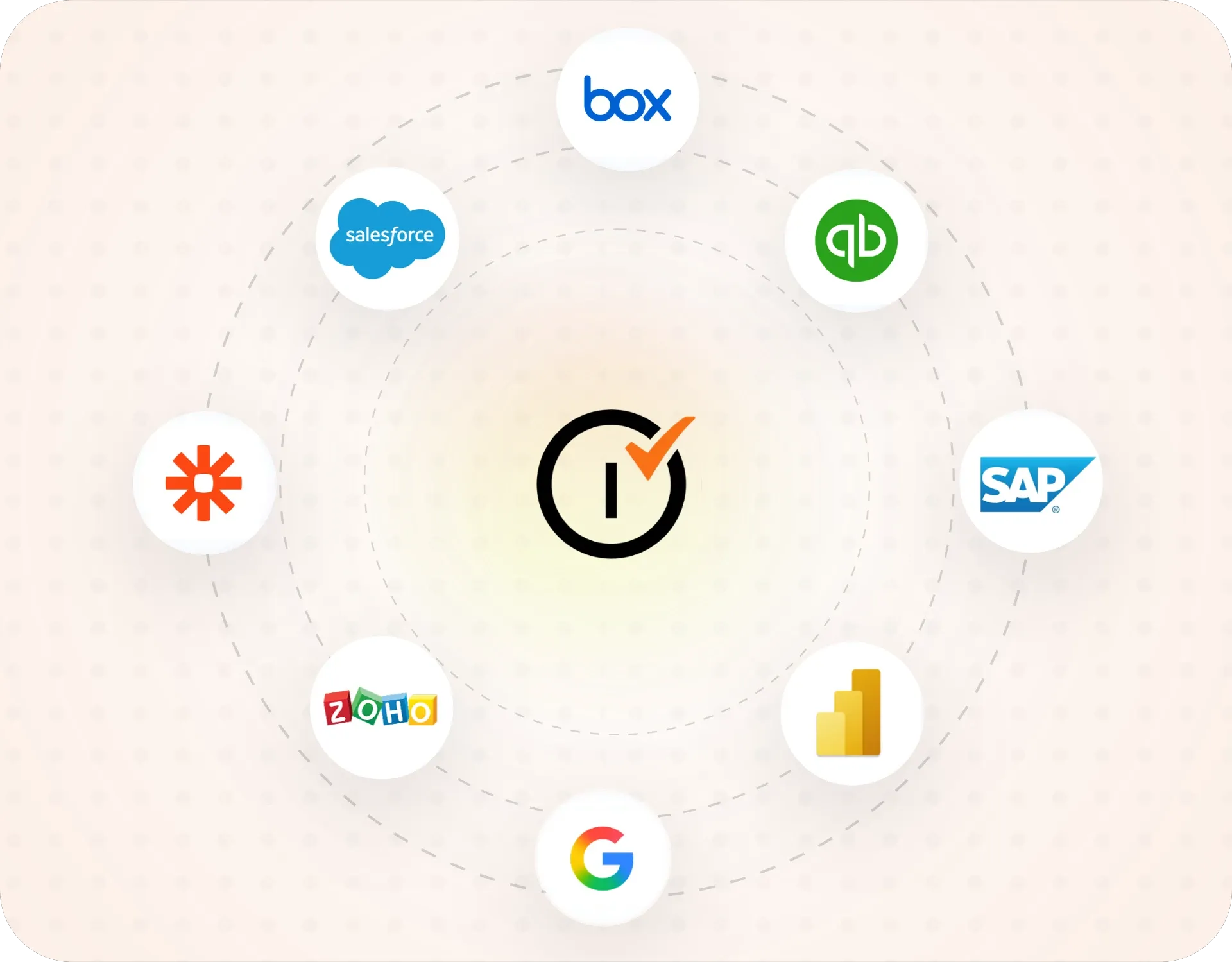
Inspectly360 integrates with the tools your team already uses, including Zoho, Microsoft 365, and SAP. No double entry.
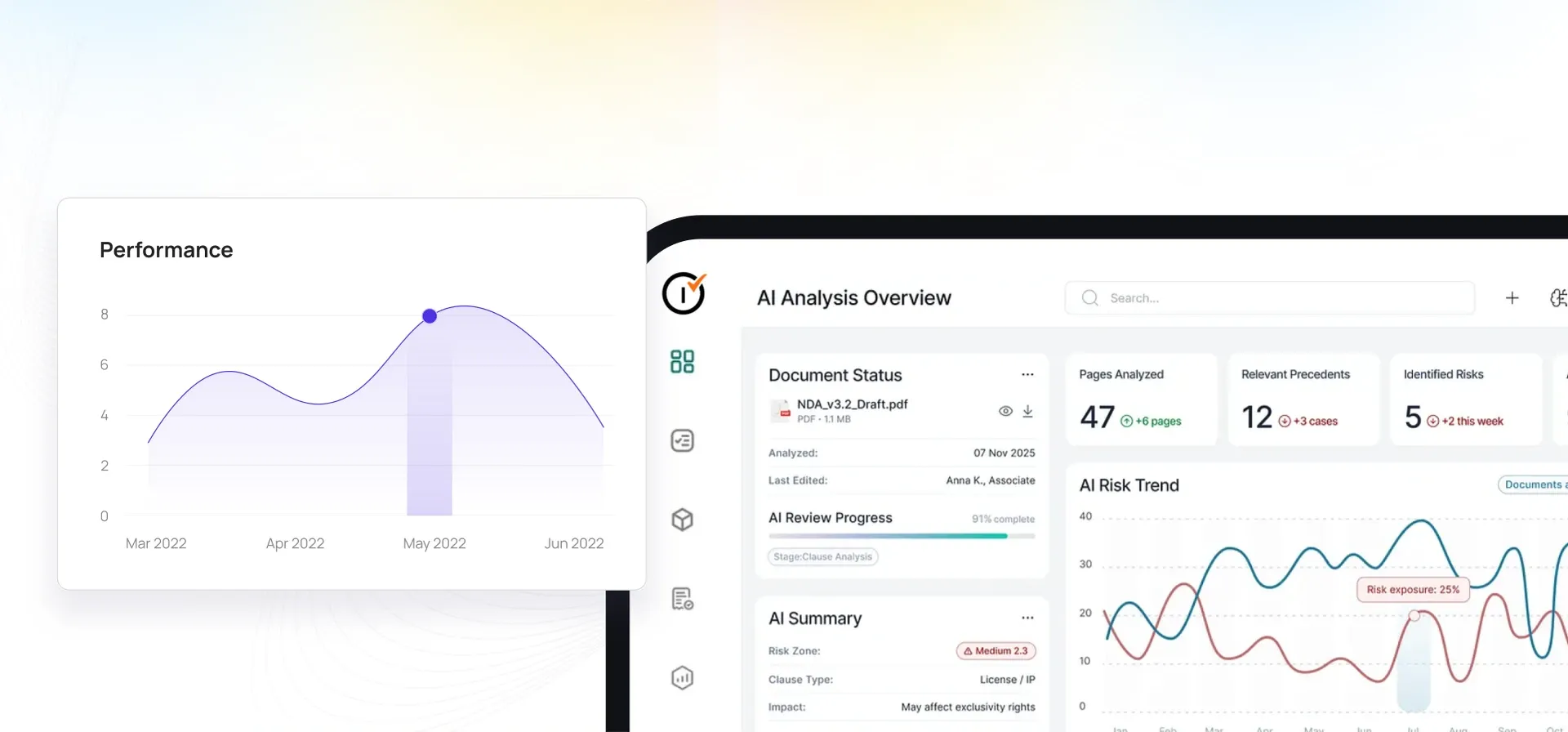
Your operations team sees completion rates, open issues, and compliance scores across all sites in real time. No chasing updates.
From data collection to compliance: see how teams use Inspectly360 for every use case.
Capture field data once with digital forms that work even offline.
Explore use caseRun standardized inspections with photos, scoring, and instant reports.
Explore use caseConduct structured audits with evidence trails and pass or fail scoring.
Explore use caseLog hazards, near misses, and safety checks from any job site.
Explore use caseCatch defects early with repeatable quality checks and sign off.
Explore use caseReport incidents in the moment with photos and follow up actions.
Explore use caseTrack assets, service history, and condition across every location.
Explore use caseRaise work orders and close out repairs with a full audit trail.
Explore use caseStay audit ready with logged checks, timestamps, and shareable reports.
Explore use caseUse it as a digital workflow so your team captures consistent evidence, stays aligned in the field, and produces reports stakeholders can trust without retyping answers from paper.

Someone photographs a hazard and posts it in a group chat. It scrolls away. A few weeks later the same hazard, missing PPE, blocked exits, isolation gaps, slip and trip hazards, causes a near-miss, and nobody connected the two.
Problem
Solution

A defect on the work area is handed to site contractor. A week later the work area defect is marked closed. Whether the work area work was done well, badly, or at all, nobody has verified.
Problem
Solution

There is no live view of furniture and equipment (school) status across sites. The first sign that something failed on the work area is a client call or an incident, by which point the problem is already public.
Problem
Solution
Furniture and Equipment (School) Safety App covers Asset Health, Failure Codes, Criticality, Inspection Route. Furniture and Equipment (School) Safety App delivers qR-scanned inspection routes, PM scheduling, and work-order creation as the core workflow, ending reactive breakdowns and no visibility of asset condition. Map records to reliability-centred and condition-based maintenance practice and highlight trend analytics that surface risk before it escalates. Each Asset Health check is verified against its acceptance criteria, with photos, readings, and a named sign-off captured on the spot. A failed Failure Codes item raises a corrective action with an owner and due date, and the completed Asset Health record is retained and exportable for audit against the applicable standards.
When a Asset Health check fails, Furniture and Equipment (School) Safety App logs it against Asset Health or the relevant item, assigns a corrective action with an owner and due date, and tracks it to closure. Supervisors see open Failure Codes issues, overdue actions, and Criticality completion rates across every site on one dashboard, so problems are fixed and evidenced instead of being lost between visits.
Yes. Teams complete Asset Health and Failure Codes checks on a phone or tablet with no signal, and records sync automatically once back online. Every Asset Health record holds the items checked, the readings, the photos, and the sign-off, giving Furniture and Equipment (School) Safety App a defensible record against the applicable standards for regulators, clients, and incident investigations, without chasing paper across sites.
Every submission carries a timestamp, the inspector's identity, an optional geofenced location, and the full set of answers, photos, and voice notes attached to that campus check. Failed furniture and equipment (school) safety items create issues with severity, owner, and verified closure photos. Reports generate automatically as branded PDFs with the site, the classroom, playground item, or estate zone, and finding details. Because furniture and equipment (school) safety evidence is captured at the point of work rather than written up afterwards, the chain from finding to verified fix stays intact and is hard to dispute later. When an auditor or client asks for proof of a furniture and equipment (school) safety campus check, your team searches by site, asset, or date and produces a complete digital record in seconds. The same evidence supports statutory safeguarding records, fire NOC and emergency planning documentation, and trust board assurance requirements where relevant.
Every failed item can spawn a corrective action with a named owner, due date, severity, and photo proof requirement on closure. Contractors receive notifications, see their open actions in the app, and submit verified closure photos before the action closes. Dashboards show open and overdue actions per site, per contractor, and per audit cycle, so leadership can see whether issues are actually closing or just sitting in a backlog. Contractor performance scoring tracks closure speed and re-open rate over time, so head teachers and estates leads can compare estates contractors and catering partners objectively before assigning the next site.
Yes. A single Inspectly360 instance covers every site in your trust and school estate. Each campus has its own assets, templates, contractors, and campus checks and playground rounds, but the head teacher or trust estates lead sees one live dashboard with completion rates, open issues, and risk score by campus and building. AI-generated daily briefings summarise which sites had problems, which campus checks and playground rounds are overdue, and which need attention today. Natural language dashboard queries let you ask plain questions and get instant answers, replacing the Monday morning task of stitching photos and logbook pages into a governor or LA pack. New sites inherit your standard templates the moment they are added, so the trust and school estate scales without rebuilding the process for each location.
AI handles the paperwork while the inspector handles the physical furniture and equipment (school) safety check. Photo analysis can detect defects such as damaged surfacing, loose fixings, hygiene gaps, trip hazards, missing signage, and pre-fill the form. Voice-to-text lets the inspector speak furniture and equipment (school) safety observations in English, Hindi, or Marathi, and the form fills itself. AI smart suggestions classify the furniture and equipment (school) safety issue type, severity, and location based on what the inspector captures, with a one-tap confirm or override. The qualified inspector stays in control of every classroom, playground item, or estate zone submission. Time on site drops, typing in the field disappears, and data captured is more consistent across teams.
Recurring issue detection in Furniture and Equipment (School) Safety App continuously analyses safety submissions across every site. When the same hazard keeps appearing, the same defect type on the same classroom, playground item, or estate zone or in the same zone, it is flagged as a recurring problem with its frequency, the sites affected, and the trend direction. This is the difference between closing the same hazard ten times and fixing it once. Safety leads see recurring hazards surfaced on the dashboard alongside open and overdue actions, so root-cause work is prioritised by evidence rather than by whoever shouted loudest. Compliance risk scoring then highlights which sites are trending toward a safety failure before an incident or an inspector makes it obvious.
Explore other inspection and audit apps for education teams.
See Inspectly360 in action with a live demo tailored to your needs. No credit card required.

