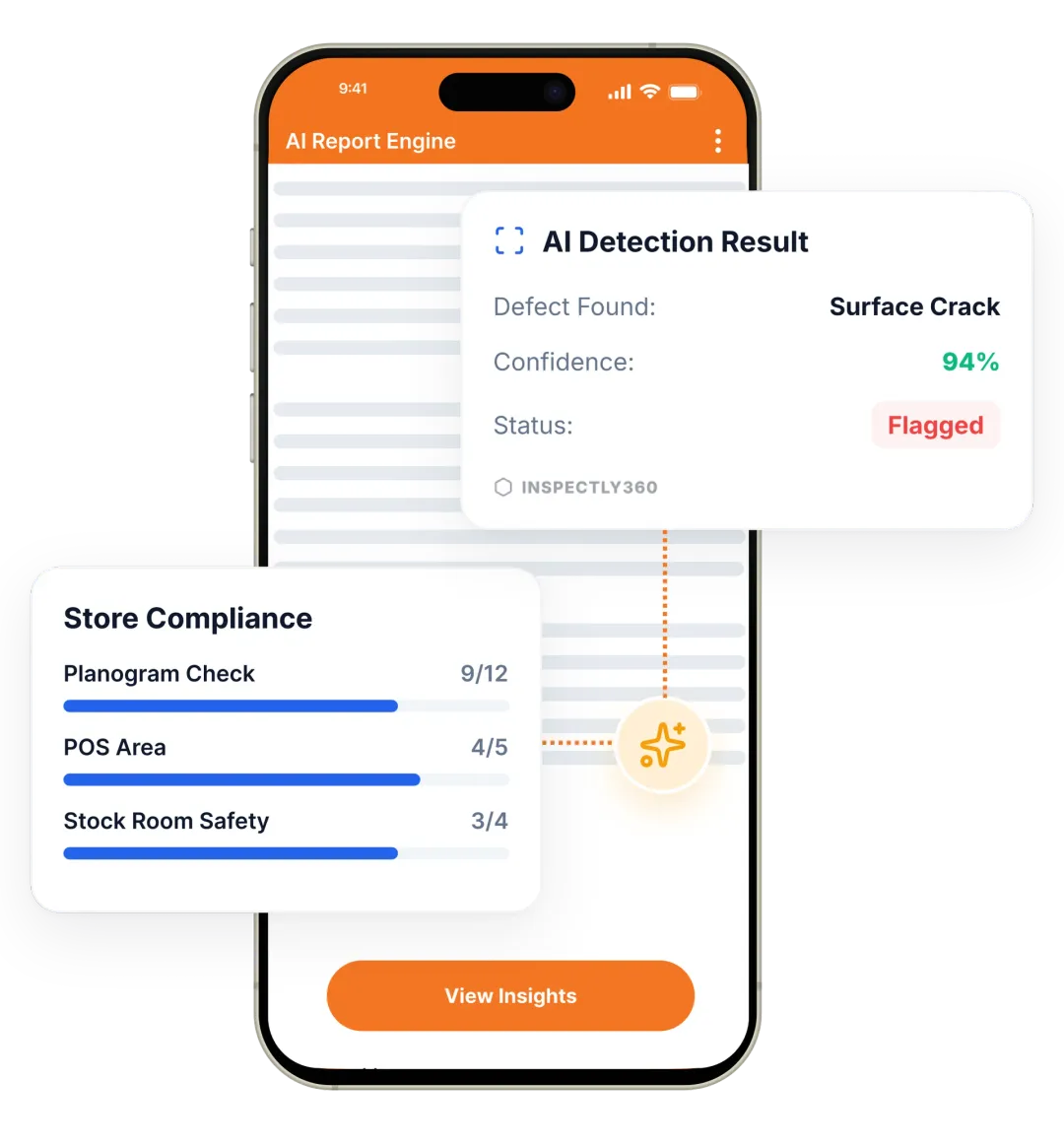
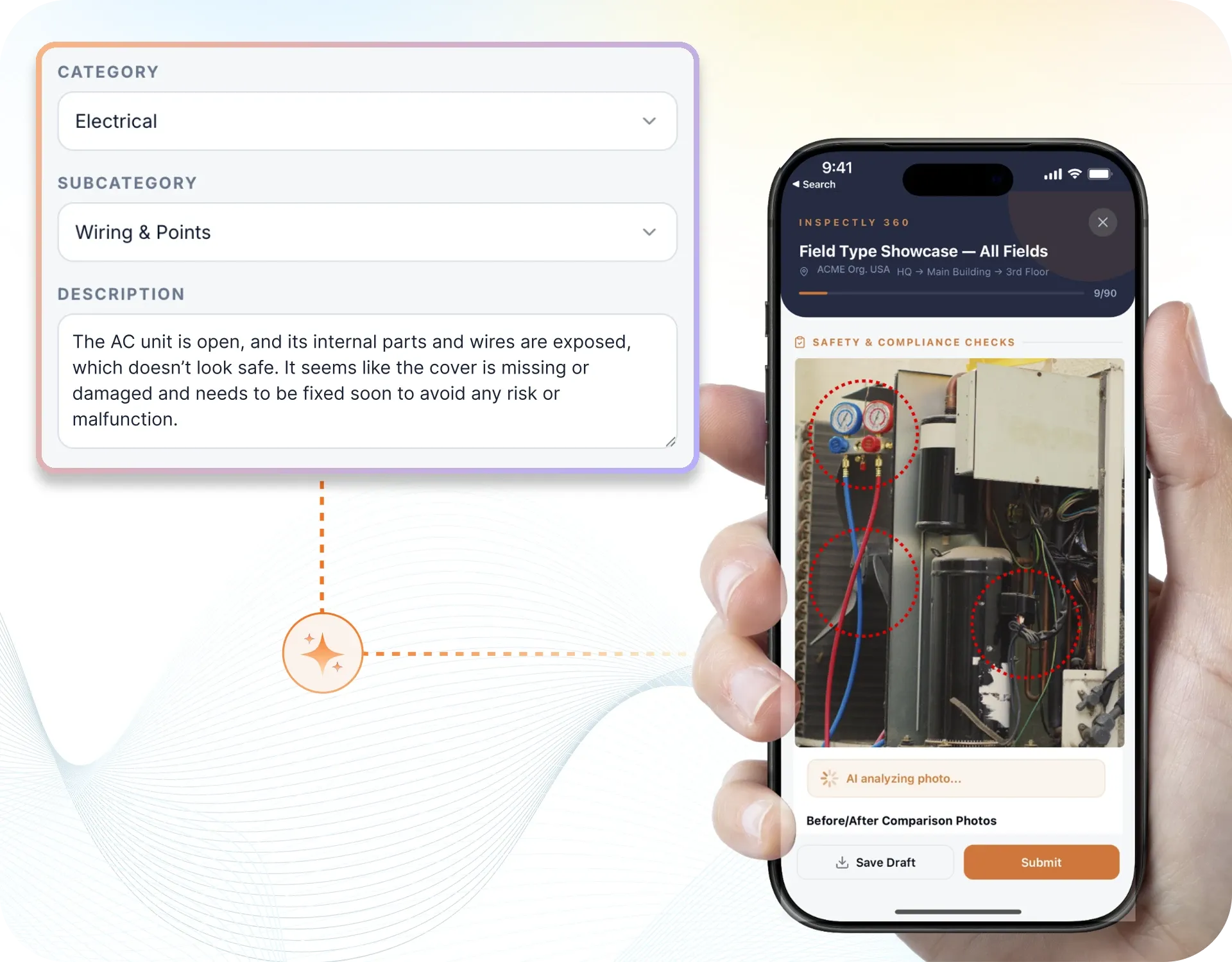
Take a Photo. AI Fills the Form
Your inspector takes a photo of any asset or defect. AI reads it and fills the inspection form automatically. No typing. No manual entry.

Convert your checklist into Mobile App
A facility maintenance app for coworking helps operators route AC noise complaints, access control faults, plumbing leaks, and landlord CAPEX items without losing context between Slack, email, and spreadsheets. Inspectly360 gives centre managers one place to log issues, assign vendors or internal CE staff, attach photos, and verify closure with an audit trail your enterprise clients expect.

A facility maintenance app for coworking is operations software that tracks reactive and small-project maintenance across flex locations where members, landlords, and vendors share responsibility. Inspectly360 is an AI-powered inspections and audits platform: issues start as structured records with evidence, move through assignment and SLA tracking, and close only after verification, which reduces he-said-she-said disputes in fast-moving buildings. It works offline in basements, plant rooms, and risers, and replaces email threads and spreadsheets with one mobile-first record per issue across every flex location.
The app complements your access control, billing, and community tools by owning the proof layer for physical infrastructure problems.
Capture reporter, location, category, severity, photos, vendor reference, landlord ticket IDs, permit needs, and member impact. Require verification photos or reinspection when closing high-severity items. Link recurring failures to assets when you manage QR-coded equipment.
Start every ticket with enough context that a vendor can act without a second phone call.

Centre staff log issues with photos, severity, and member impact in under a minute.

Vendors and internal CE update status in the same record; landlords get exports when needed.

Leadership sees mean time to close, repeat faults, and SLA breaches across cities.
Everything your field team does on paper, Inspectly360 does automatically: faster, more accurate, and without the admin.
Your inspector takes a photo of any asset or defect. AI reads it and fills the inspection form automatically. No typing. No manual entry.
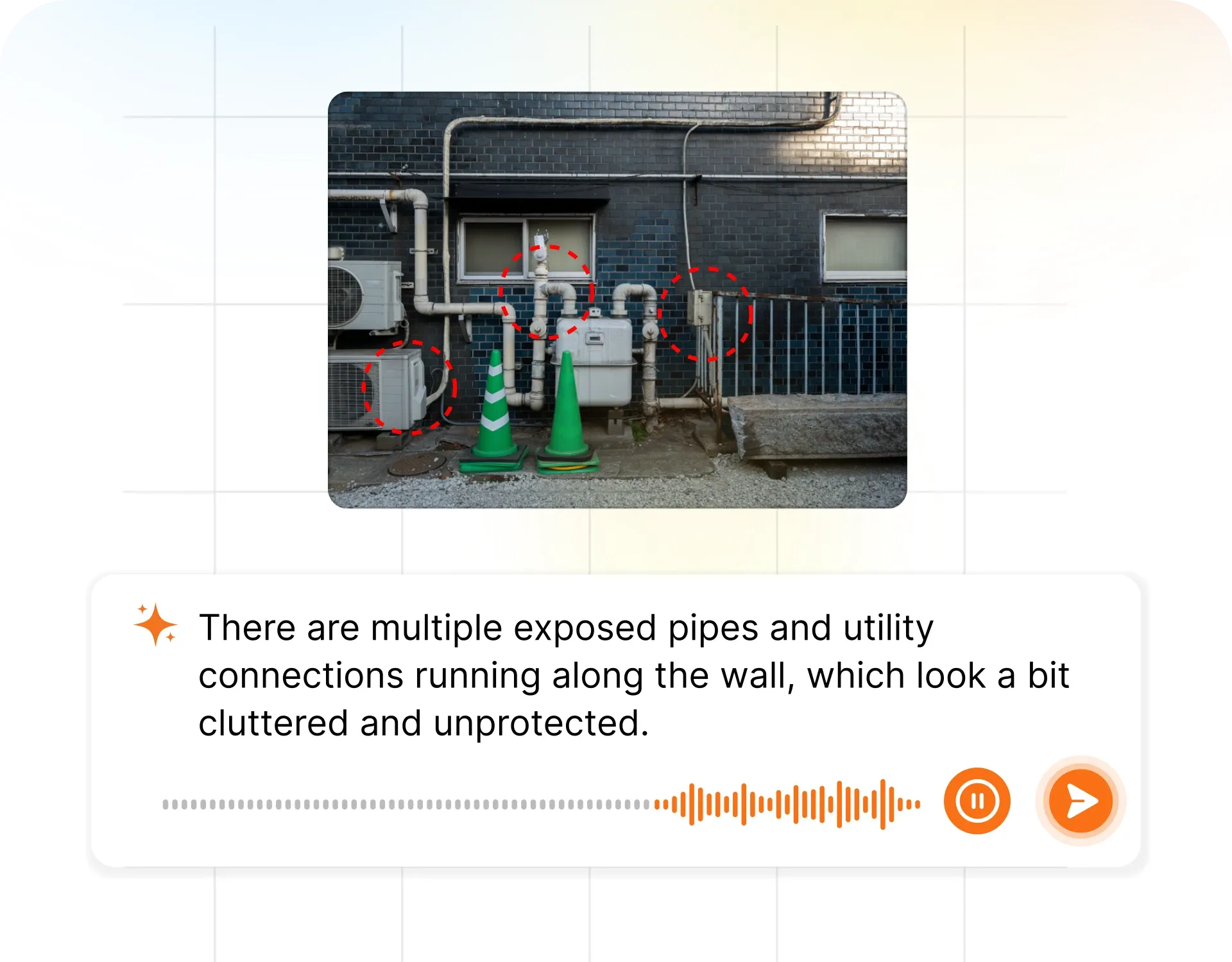
Inspectors speak their observations in any language. AI transcribes and fills the form in real time. Completely hands-free in the field.
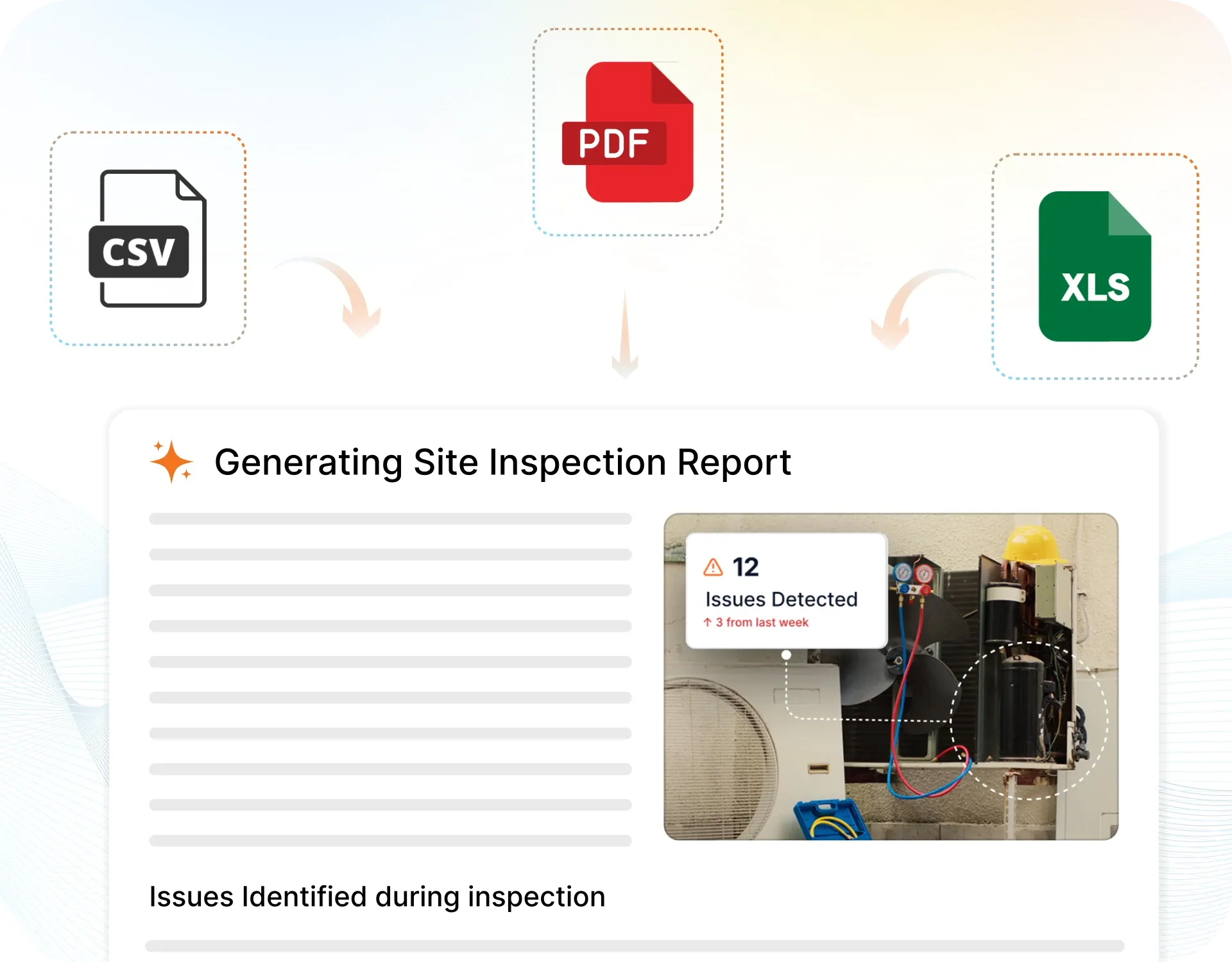
The moment an inspection is submitted, a branded PDF, Excel, or CSV report generates automatically. No manual work. No waiting.
Inspectly360 integrates with the tools your team already uses, including Zoho, Microsoft 365, and SAP. No double entry.
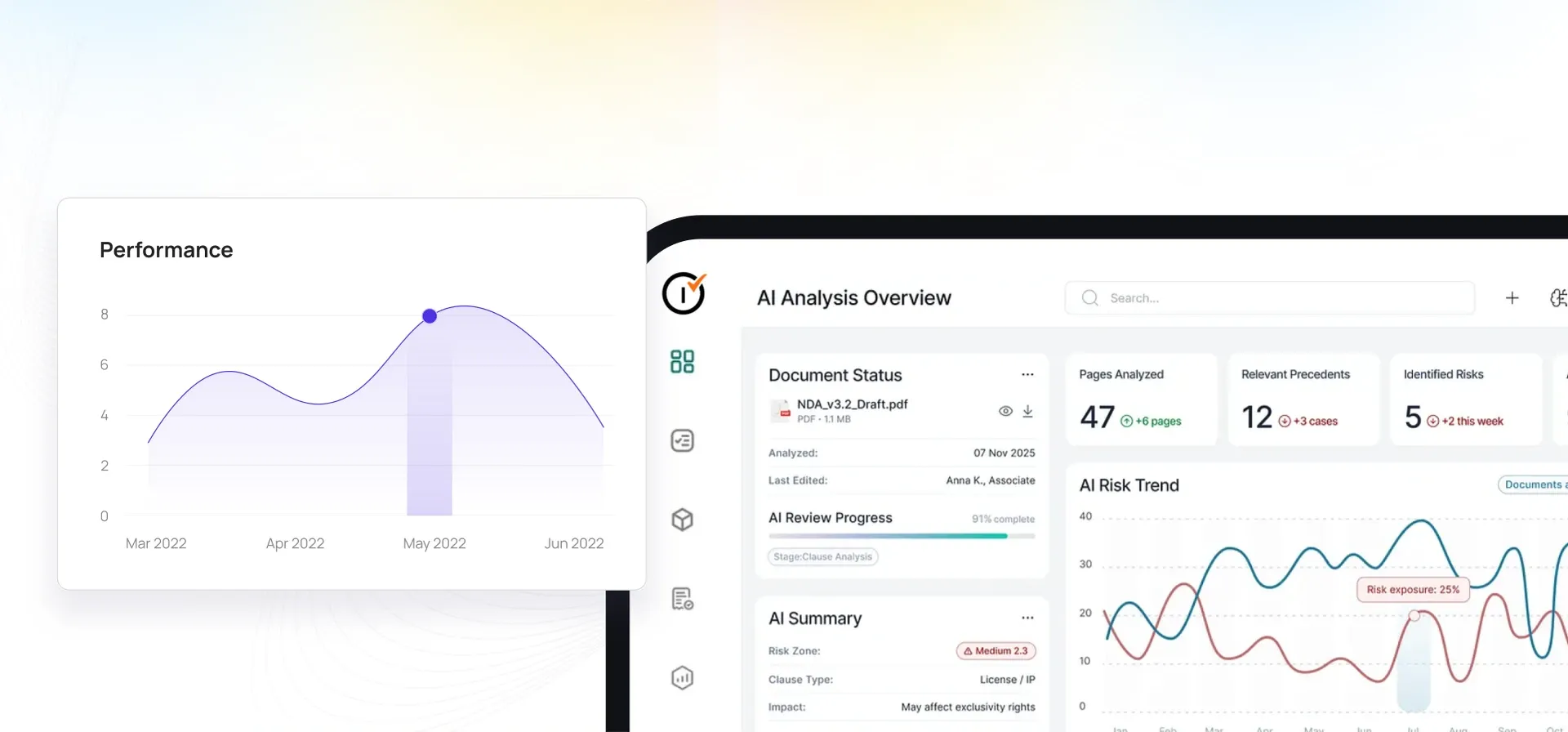
Your operations team sees completion rates, open issues, and compliance scores across all sites in real time. No chasing updates.
From data collection to compliance: see how teams use Inspectly360 for every use case.
Capture field data once with digital forms that work even offline.
Explore use caseRun standardized inspections with photos, scoring, and instant reports.
Explore use caseConduct structured audits with evidence trails and pass or fail scoring.
Explore use caseLog hazards, near misses, and safety checks from any job site.
Explore use caseCatch defects early with repeatable quality checks and sign off.
Explore use caseReport incidents in the moment with photos and follow up actions.
Explore use caseTrack assets, service history, and condition across every location.
Explore use caseRaise work orders and close out repairs with a full audit trail.
Explore use caseStay audit ready with logged checks, timestamps, and shareable reports.
Explore use caseUse it as a digital workflow so your team captures consistent evidence, stays aligned in the field, and produces reports stakeholders can trust without retyping answers from paper.

WhatsApp, email, and a spreadsheet each hold part of the story. Nobody sees SLA risk early.
Problem
Solution

Anchor tenants want to know you manage risk seriously, not ad hoc.
Problem
Solution

Without trend insight you renew vendors on anecdotes.
Problem
Solution
Ticketing tools track tickets; they often lack inspection-grade evidence, structured field forms, and portfolio analytics tuned to FM. Inspectly360 combines maintenance execution with inspections DNA: photos, geotagged context, recurring issue detection, and verified closure. That matters when landlords or enterprise clients ask how you know work was done correctly. You can still integrate with Zoho Desk or Microsoft 365 for notifications while keeping Inspectly360 as the system of record for onsite proof. Recurring issue detection links repeat faults to the asset, so a chronic problem becomes a tracked project instead of a fifth identical ticket nobody owns.
Yes. Role-based access scopes vendors to locations, categories, or tickets you assign. They update status and upload closure proof without seeing unrelated member data. Your internal team retains oversight and can reject a closure that lacks evidence. This reduces risk in multi-tenant buildings where data boundaries matter. Assignments can require photo proof, a completion checklist, and a timestamped sign-off before a closure is accepted, and every vendor action is attributed and logged, so a multi-party building keeps clear accountability without exposing one tenant's data to another.
Use categories, custom fields, or parallel templates to tag ownership. Dashboards can filter by responsible party so you do not mix CAPEX timelines with operator SLA metrics. Exports help monthly landlord meetings show what you logged, what you closed, and what is waiting on the owner. Clear ownership fields prevent duplicate spend and speed escalations. Items can carry a responsible-party field that drives separate SLA timers and escalation paths, so an operator fix and a landlord CAPEX item never share a deadline and the monthly review starts from the same agreed numbers.
Yes. You can run planned inspections and PPM rounds in the same platform as reactive issues. Assets can link to both schedules and open tickets. This is useful when a monthly walk reveals a fault that becomes a work order immediately. Leadership sees planned versus unplanned workload in one operational picture. A failed planned check can spawn a reactive work order on the same asset in one tap, carrying its photos and history forward, so leadership sees a single timeline from inspection to fault to verified closure rather than two disconnected systems.
Technicians may lose signal in plant rooms or parking levels. Offline capture ensures they still log findings and photos, then sync when online. Validation reduces incomplete submissions. For coworking, that reliability increases adoption because staff are not blamed for app failures caused by connectivity. It also preserves timestamps that matter in SLA disputes. Rounds can be pre-downloaded before a shift, large photo sets upload in the background as coverage returns, and each submission shows a synced or pending state, so a plant-room dead spot never costs the team a record or an SLA timestamp.
AI can suggest categories from a photo or voice note, draft summaries for managers, and flag unusual closure patterns for review. Inspectors and vendors still confirm details. The goal is faster, more complete records, not automated approval of safety-critical work. Your governance rules decide when AI assists and when human sign-off is mandatory. AI runs on-device so it works offline and keeps photos private, and every accepted or overridden suggestion is logged with the user and time, so the audit trail shows exactly what a person decided rather than what software assumed.
Explore other inspection and audit apps for real estate & property management teams.
See Inspectly360 in action with a live demo tailored to your needs. No credit card required.

