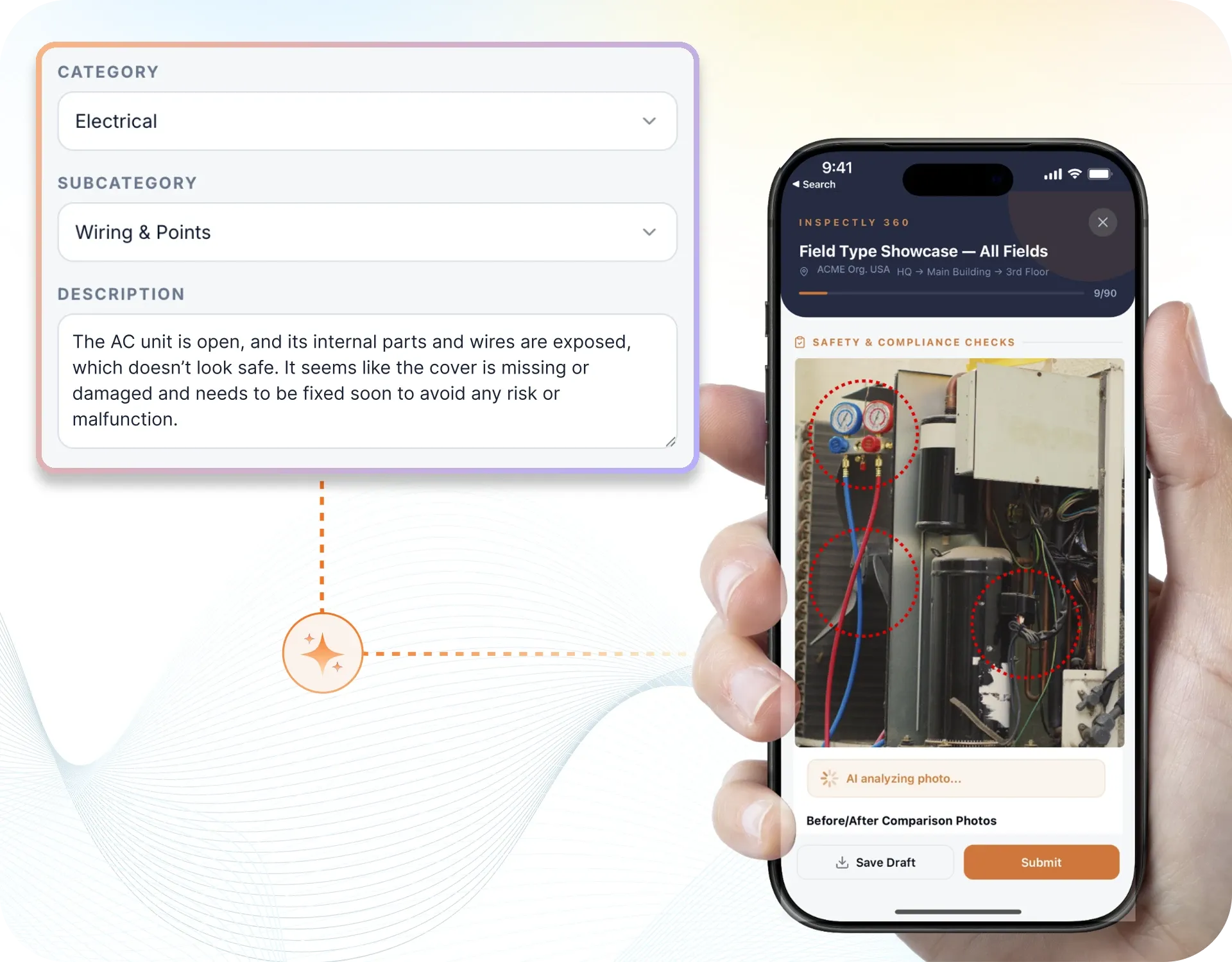
Take a Photo. AI Fills the Form
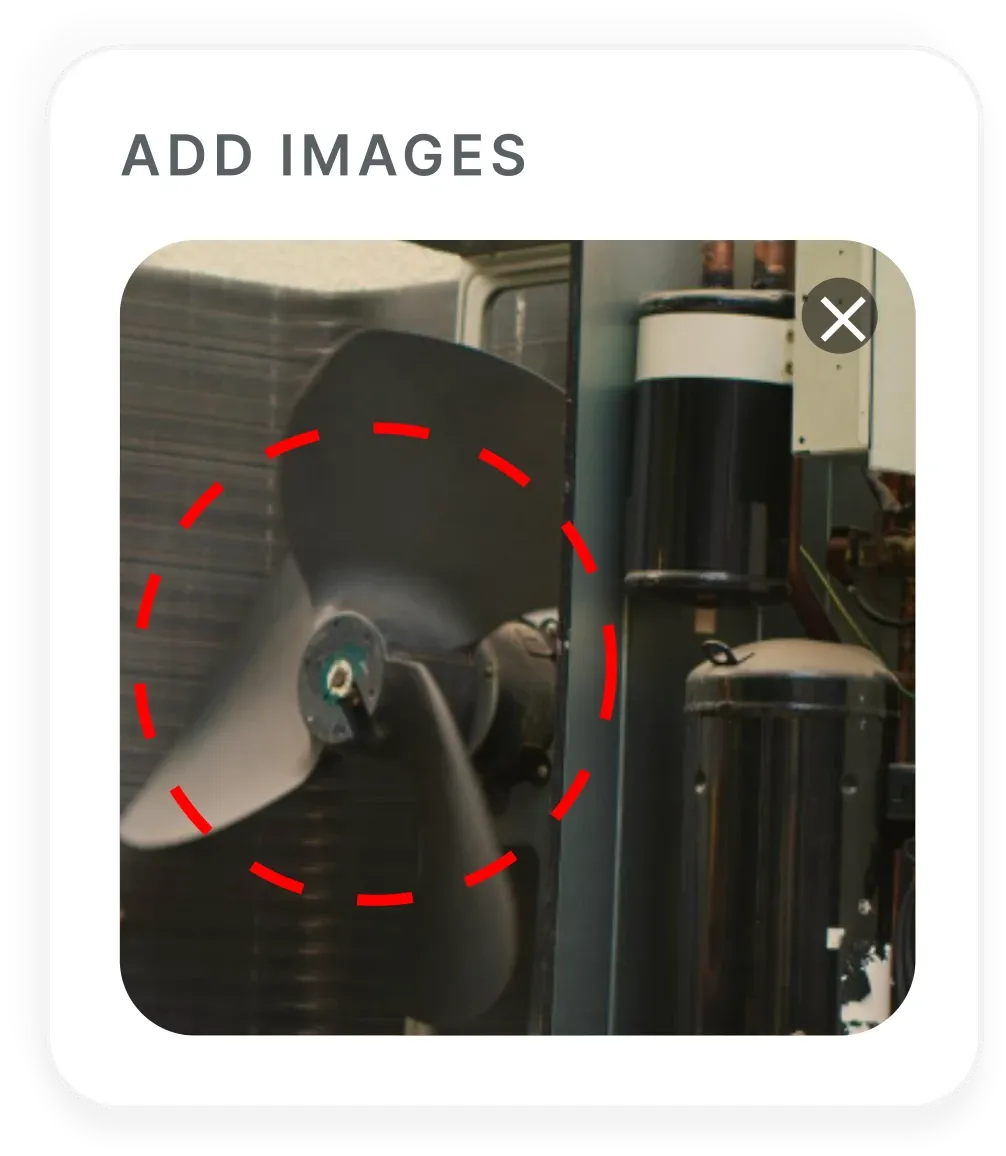
Your inspector takes a photo of any asset or defect. AI reads it and fills the inspection form automatically. No typing. No manual entry.

Convert your checklist into Mobile App
Centered on structured inspection software & app hub (2026) checks, corrective actions, and clear reporting. AI inspection software is the platform category that multi-site operations teams adopt when one record must serve audit, compliance, safety, quality, facilities, construction, and property inspection workflows across the same portfolio.
Available on Mobile
Inspect on iOS and Android with no internet required. Capture photos, let AI flag defects, and generate audit-ready reports in the field.
The pain it solves is the cross-vertical scaling cliff that operations teams hit between 10 and 50 sites: separate tools per inspection type each maintaining their own templates, RBAC, dashboards, and integrations; photos and observations scattered across personal phones and WhatsApp groups by vertical team; capital and risk decisions made on isolated vertical recollections rather than condition history; and weekly status assembly that consumes Friday afternoon in every region and every function. COOs and Group Operations leaders running multi-industry portfolios see the same failure in retail, manufacturing, facilities, and energy operations alike: vertical tools that worked at a single site break under cross-vertical reporting demands.
What changes once ai inspection software runs on one mobile-first platform.
Vertical solution pages extend this loop with industry-specific phrasing. The cross-vertical mechanics stay consistent so adding a new vertical does not mean retraining the field.
AI Audit Software for internal audit, AI Compliance Software for regulated branch operations, AI Safety Inspection Software for EHS, AI Quality Inspection Software for QC and store audit, AI Facilities Inspection Software for portfolio FM, Site Inspection Software for capital projects, Property Inspection Software for tenancy lifecycles.
Build conditional logic, scoring, and required evidence in /features/checklists; templates publish to every site in every vertical from one central library so cross-vertical operations run consistent.
Ship iOS and Android builds with offline sync, MDM (Intune, Jamf, Workspace ONE) compatibility, and SSO via SAML or OIDC as described in /features/mobile-app.
Teams photograph findings; Edge AI accelerates review per /features/ai-inspections; cross-vertical findings route through the appropriate workflow (audit CAPA, safety hazard, quality NCR, FM work order) while humans approve every classification.
Dashboards show completion, issues, and risk concentration across audit, safety, quality, FM, construction, and property in one view; PDFs distribute to stakeholders per role through /features/automated-reports.
AI-assisted inspection coverage checks AI photo defect detection on assets and surfaces, voice-captured field observations, safety and housekeeping rounds, compliance and document currency, corrective-action verification, and recurring-issue detection. Operations and quality teams capture a photo and a reading on each point, offline where signal is poor, and a named reviewer signs the round off, so every multi-site record proves what was checked, when, and by whom, and stays aligned to ISO 9001, and ISO 45001.
Templates align to ISO 9001, ISO 45001.
Everything your field team does on paper, Inspectly360 does automatically: faster, more accurate, and without the admin.
Your inspector takes a photo of any asset or defect. AI reads it and fills the inspection form automatically. No typing. No manual entry.
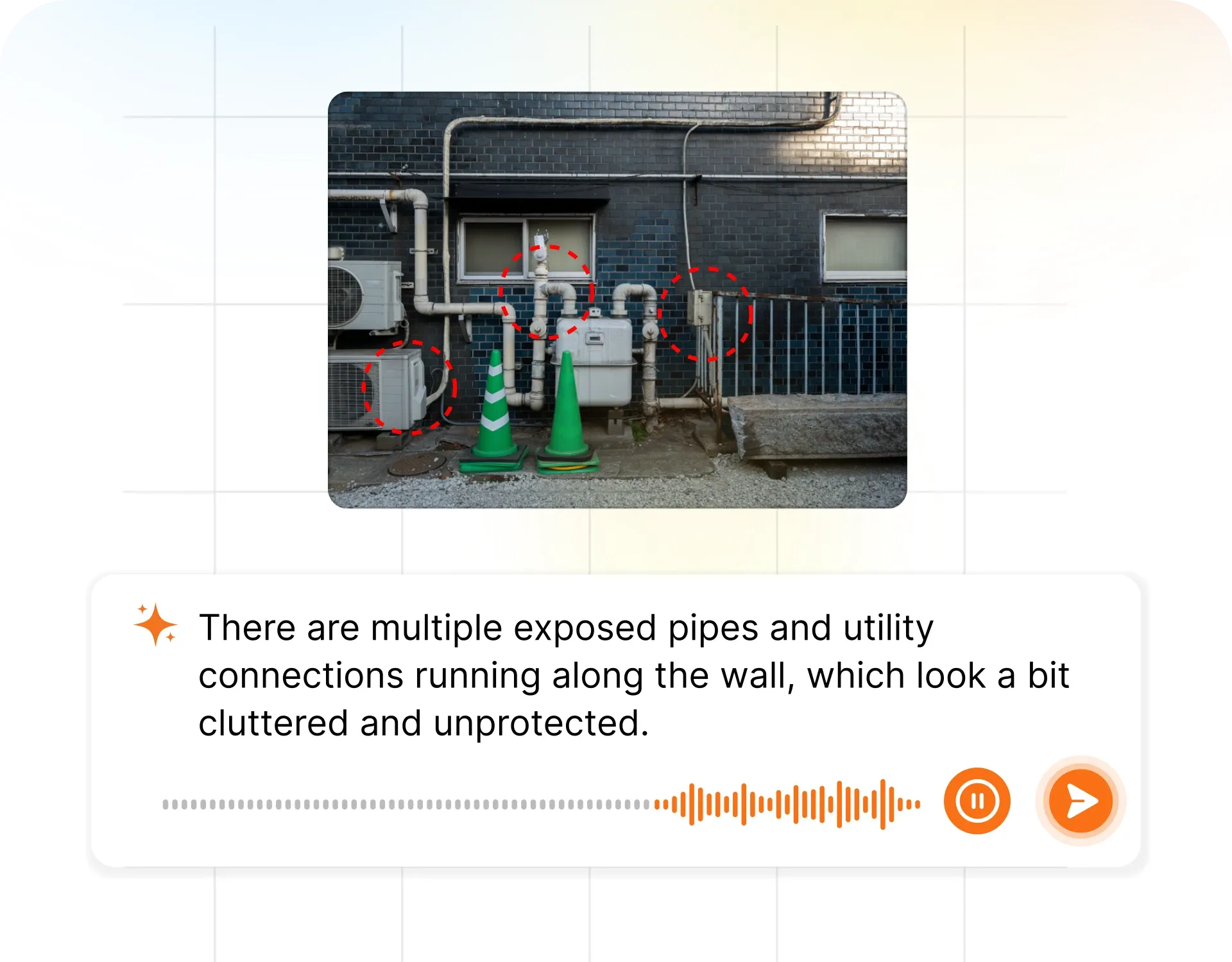
Inspectors speak their observations in any language. AI transcribes and fills the form in real time. Completely hands-free in the field.
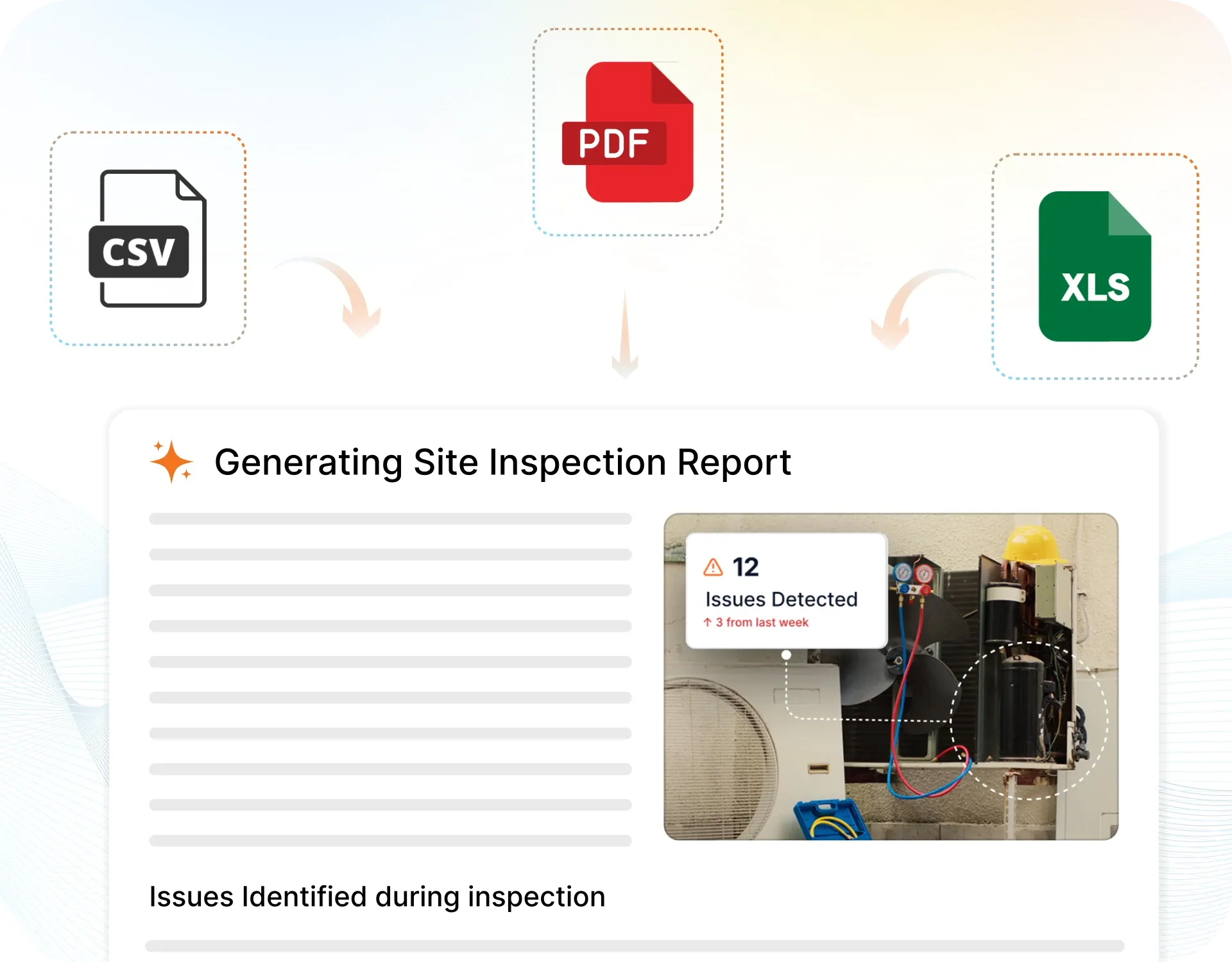
The moment an inspection is submitted, a branded PDF, Excel, or CSV report generates automatically. No manual work. No waiting.
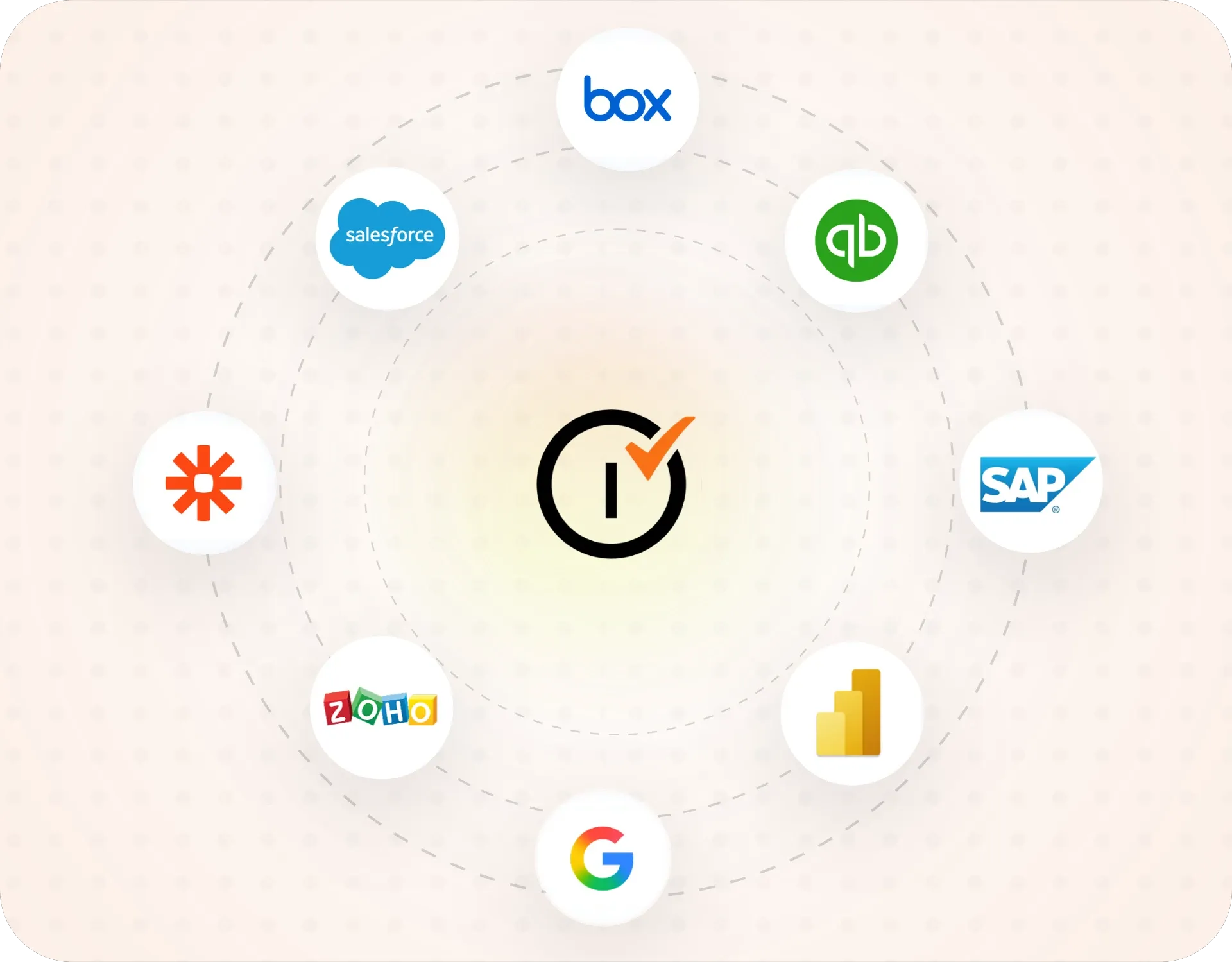
Inspectly360 integrates with the tools your team already uses, including Zoho, Microsoft 365, and SAP. No double entry.
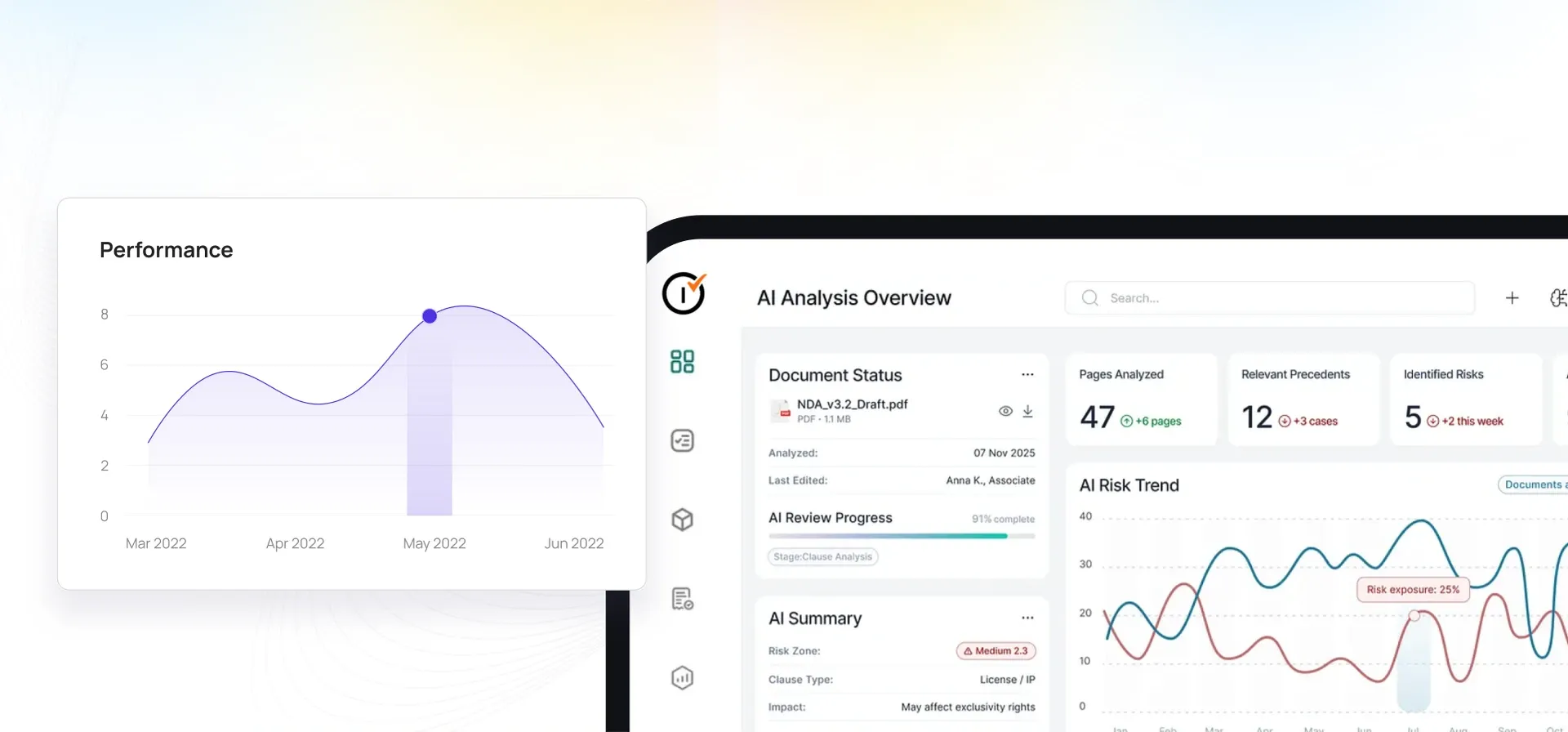
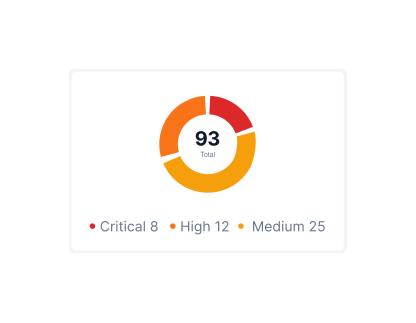
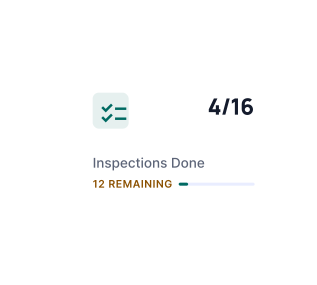
Your operations team sees completion rates, open issues, and compliance scores across all sites in real time. No chasing updates.
Manage every checklist in one connected workspace, capture evidence on mobile at the point of work, and let AI turn field inputs into clear, stakeholder-ready reports in minutes.

See which checklists your team has in progress across every site, jump into the same inspection with one tap, and keep field, supervisor, and back-office views in sync without sending screenshots on WhatsApp.


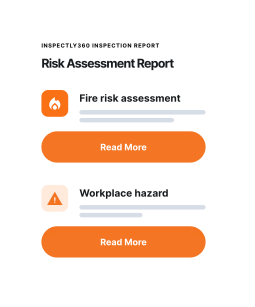
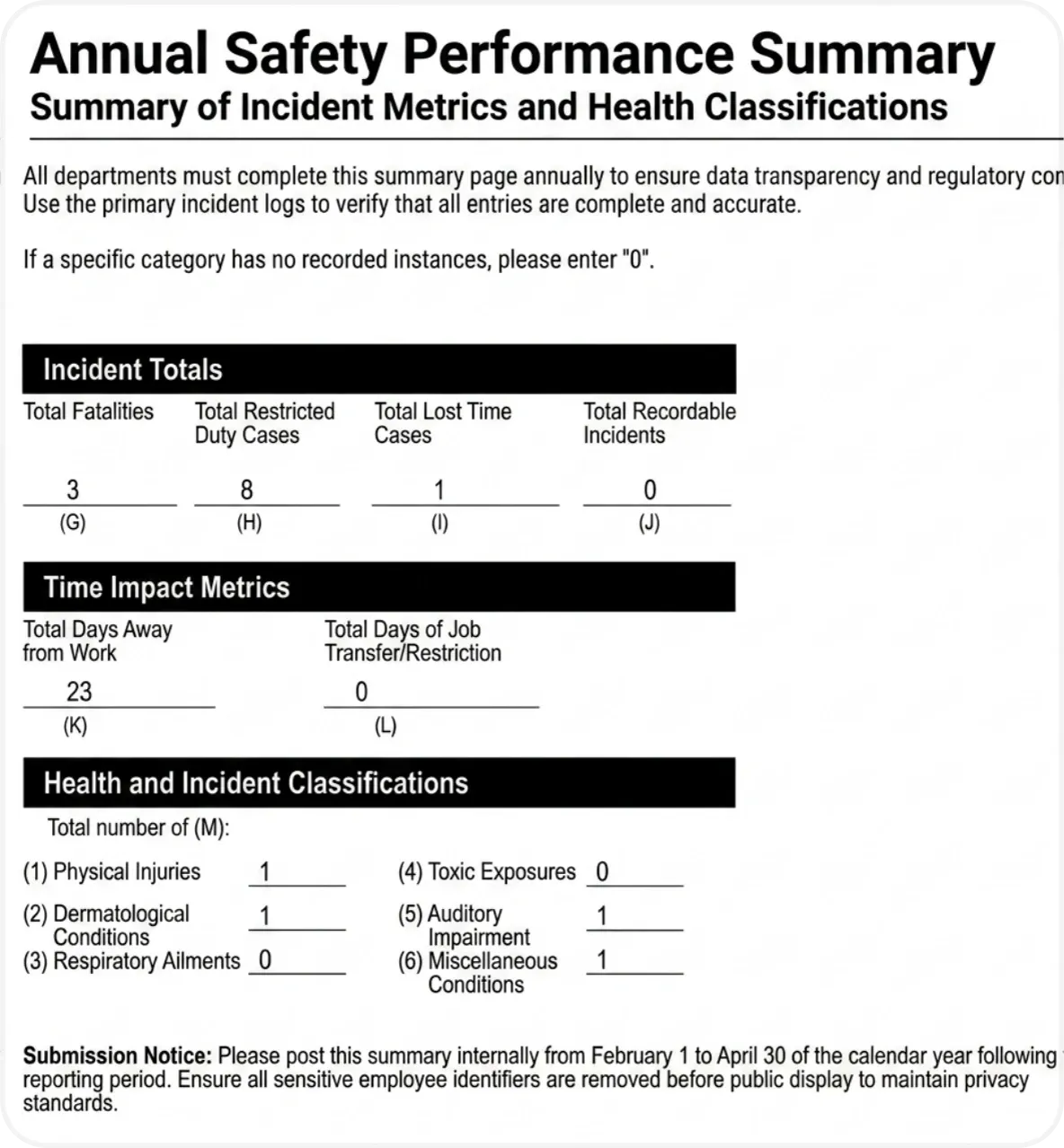


Every team reports differently. Build the report your operations, quality, or compliance leads actually want to read, share it as a branded PDF, and schedule delivery to the stakeholders who need it.

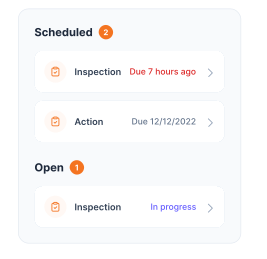

See completion, pass rate, and recurring findings across every checklist and every site, without pulling spreadsheets together at the end of the month.
What changes once ai inspection software is standardised on Inspectly360.





“Inspectly360 transformed how we manage site safety inspections. The offline capability alone saved us countless hours. Our compliance rate jumped from 72% to 96% in just three months.”
Sarah Mitchell
Meridian Construction Group
“The AI-powered defect detection has changed how we work. Our inspectors capture photos and the system flags issues we'd have missed. It's like having an expert reviewer on every site visit.”
James Chen
Pacific Manufacturing Co.
“Rolling out digital checklists across multiple projects gave us instant visibility into recurring safety issues. We now resolve critical findings in hours instead of days.”
Olivia Carter
Northbridge Infrastructure
Get started with inspection and audit checklist templates.

Catch defects before handover and generate punch list reports in minutes. Room-by-room finish checks, evidence, and corrective actions.

Pre-handover snagging for new build apartments. Room-by-room finish checks, MEP, and defect tracking before keys.

Utilize this Scaffolding Safety Inspection Checklist to spot hazards, verify stability, and ensure compliance with safety standards before work begins.

Capture job details, measurements, work performed, photos, and sign-offs in one structured field service report form.
Use these apps to run inspections and audits.

by Inspectly360
Mobile-first inspection app with offline forms and evidence.

by Inspectly360
Inspection forms with pass/fail, photos, and sign-off.

by Inspectly360
Field inspections on mobile with offline support and sync.

by Inspectly360
Audits and inspections with scoring, evidence, and reports.

by Inspectly360
Simplify facilities inspections with forms, photos, and reports.
Start with the vertical solution page that matches the buying conversation. If the audience is the Head of Internal Audit, start with AI Audit Software. If the audience is the Head of EHS, start with AI Safety Inspection Software. The vertical pages carry vertical-specific language, authority references, FAQs, and workflow detail. This hub is for the buyer who has already concluded that one cross-vertical platform beats four point solutions and needs to validate platform-level capabilities (RBAC breadth, integration breadth, Edge AI behaviour, AI maturity, residency model) before vertical-specific procurement. The two contexts are complementary, not redundant: a procurement evaluator typically reads one vertical page and this hub side by side.
Cross-vertical reporting aggregates from the same underlying record set the field captures across every vertical. A retail site appears in brand-standard audit, food safety inspection, fire safety walk, and statutory FM cycle simultaneously; the cross-vertical dashboard rolls up all four against one site identity. Cross-vertical analytics then surface where signals correlate: safety leading-indicator data predicting quality customer complaint risk, FM condition trends predicting statutory exposure, audit findings predicting compliance escalation. The cross-vertical pack the COO or group operations leader sees is one report feeding from one record, not four reports reconciled monthly. Vertical heads still see their vertical-specific view with the vertical-appropriate rubric.
Multi-industry portfolios (a private equity operator running real estate plus retail plus light manufacturing, for example, or a conglomerate spanning facilities plus construction plus utilities) operate on one platform with industry-specific template libraries per business unit. Each business unit maintains the templates, authority references, and reporting cadences appropriate to its industry; the cross-portfolio rollup operates at the group level for the operator or investor. The platform supports industry-specific terminology (FM uses PPM and AMC; manufacturing uses QC and NCR; construction uses snags and punch lists; property uses move-in and dilapidations) without forcing one industry's vocabulary onto another. Group reporting normalises where needed and preserves industry-specific detail where required.
Cross-vertical platforms win when the same site, asset, or business unit appears in multiple inspection programmes (almost always in retail, FM, hospitality, energy, and most manufacturing), when the same field team inspects across verticals (typical in FM and capital projects), when leadership needs cross-vertical operating posture (typical at COO and Group Operations level), and when procurement or infosec wants one vendor review across the operations function. Point solutions can still win for narrow specialised programmes with deep regulator-specific depth that no cross-vertical platform attempts (computer-system-validated GMP release inspection in pharma, for example). Most operations functions land on the cross-vertical platform with one or two point solutions for the narrowest regulated programmes alongside.
The AI maturity model has five levels: paper checklists (Level 1), digital forms without AI (Level 2), cross-vertical platform with Edge AI suggestions and human confirmation (Level 3), predictive analytics across vertical signals (Level 4), and closed-loop autonomous workflows (Level 5). Most operations functions are between Level 1 and Level 2 today. Inspectly360 supports a credible jump to Level 3 in weeks with Edge AI suggestions on photos that humans confirm, and a clear pathway to Level 4 as cross-vertical data accumulates. Adopting an AI inspection platform does not require existing AI maturity; the platform brings the maturity with it. Level 5 stays roadmap with named limitations because regulated workflows still require human accountability.
Inspectly360 offers multi-tenant SaaS hosting in regional clusters (US, UK, EU, MENA, India, APAC) for most customers. Single-tenant deployment is available for organisations whose regulator or data sovereignty model requires it, typically banking, defence, certain healthcare, and government operators. Multi-tenant customers benefit from continuous platform updates without internal release cycles and shared infrastructure cost. Single-tenant customers benefit from dedicated infrastructure with the same platform feature set and configurable update cadence. Procurement should validate hosting model and update cadence during the security review; for most operations functions, multi-tenant SaaS is the right answer and single-tenant adds cost without benefit.
See Inspectly360 in action with a live demo tailored to your needs. No credit card required.