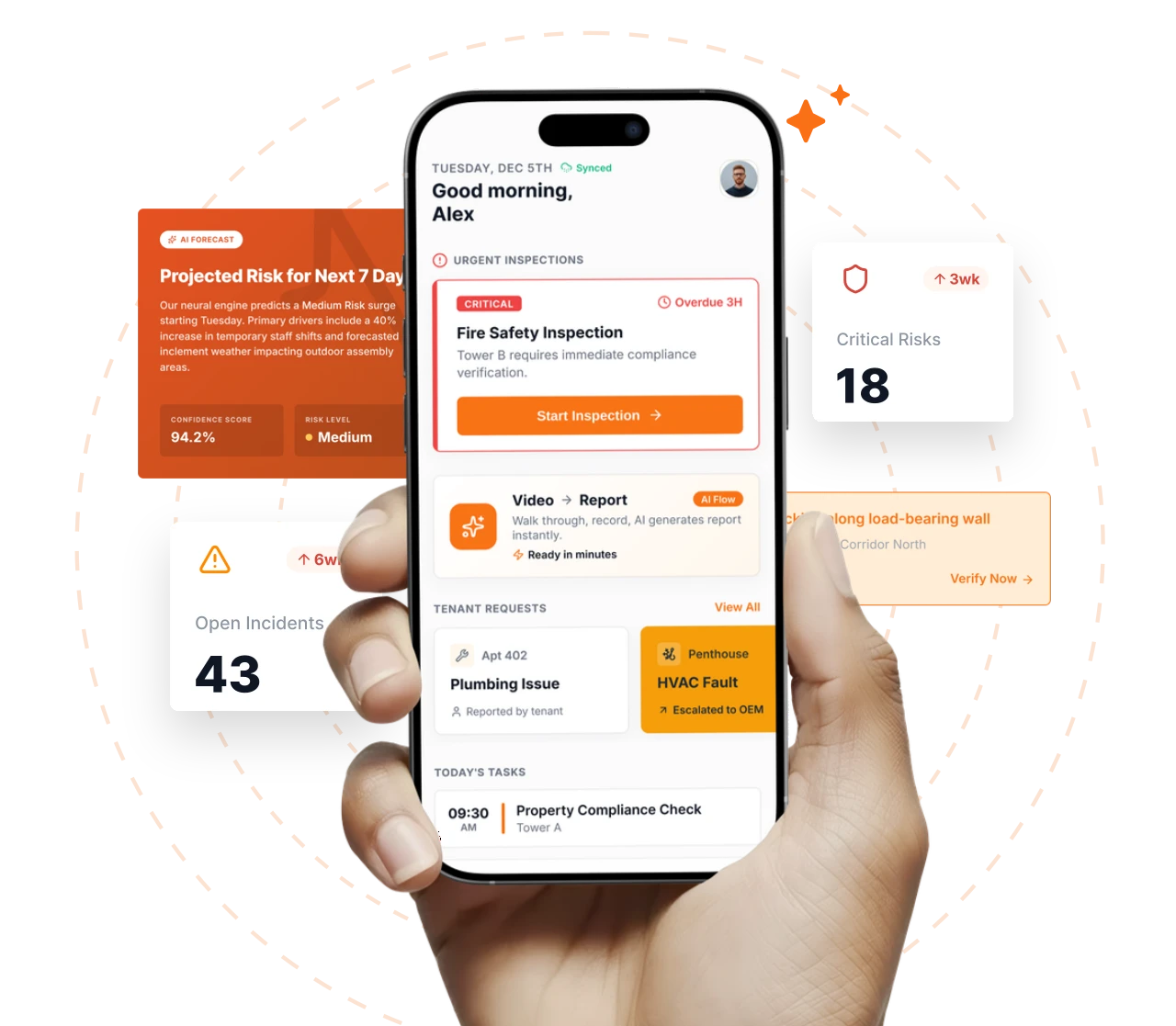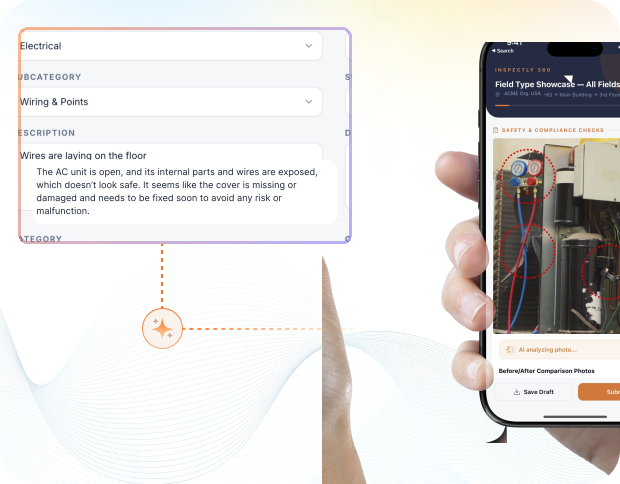
Take a Photo. AI Fills the Form
Your inspector takes a photo of any asset or defect. AI reads it and fills the inspection form automatically. No typing. No manual entry.

Convert your checklist into Mobile App
Apron checklist software is the platform ramp operations teams use to run digital self-inspection checklists and keep defensible records across the ramp. Inspectly360 turns the apron check into a standard mobile checklist covering pavement condition, stand and limit-line markings, apron lighting, fuel and oil spills, FOD, drainage, and GSE staging discipline, with each completed round stored in one record aligned to ICAO Annex 14 and FAA 14 CFR Part 139.
Everything your field team does on paper, Inspectly360 does automatically: faster, more accurate, and without the admin.
Your inspector takes a photo of any asset or defect. AI reads it and fills the inspection form automatically. No typing. No manual entry.
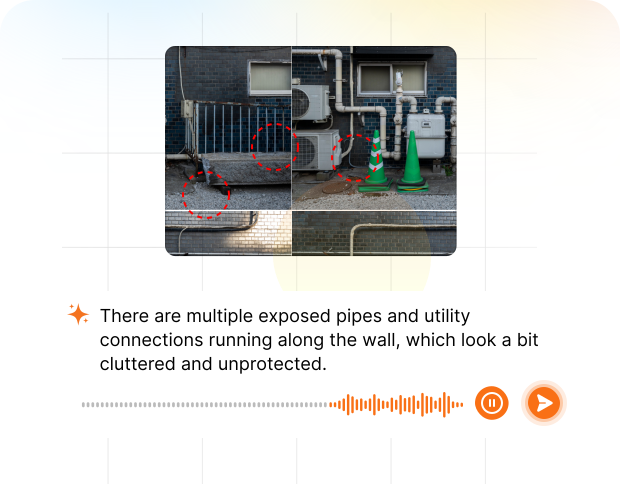
Inspectors speak their observations in any language. AI transcribes and fills the form in real time. Completely hands-free in the field.
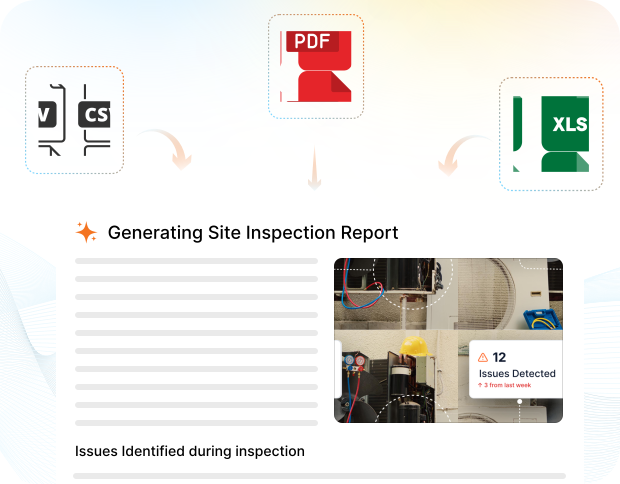
The moment an inspection is submitted, a branded PDF, Excel, or CSV report generates automatically. No manual work. No waiting.

Inspectly360 integrates with the tools your team already uses, including Zoho, Microsoft 365, and SAP. No double entry.
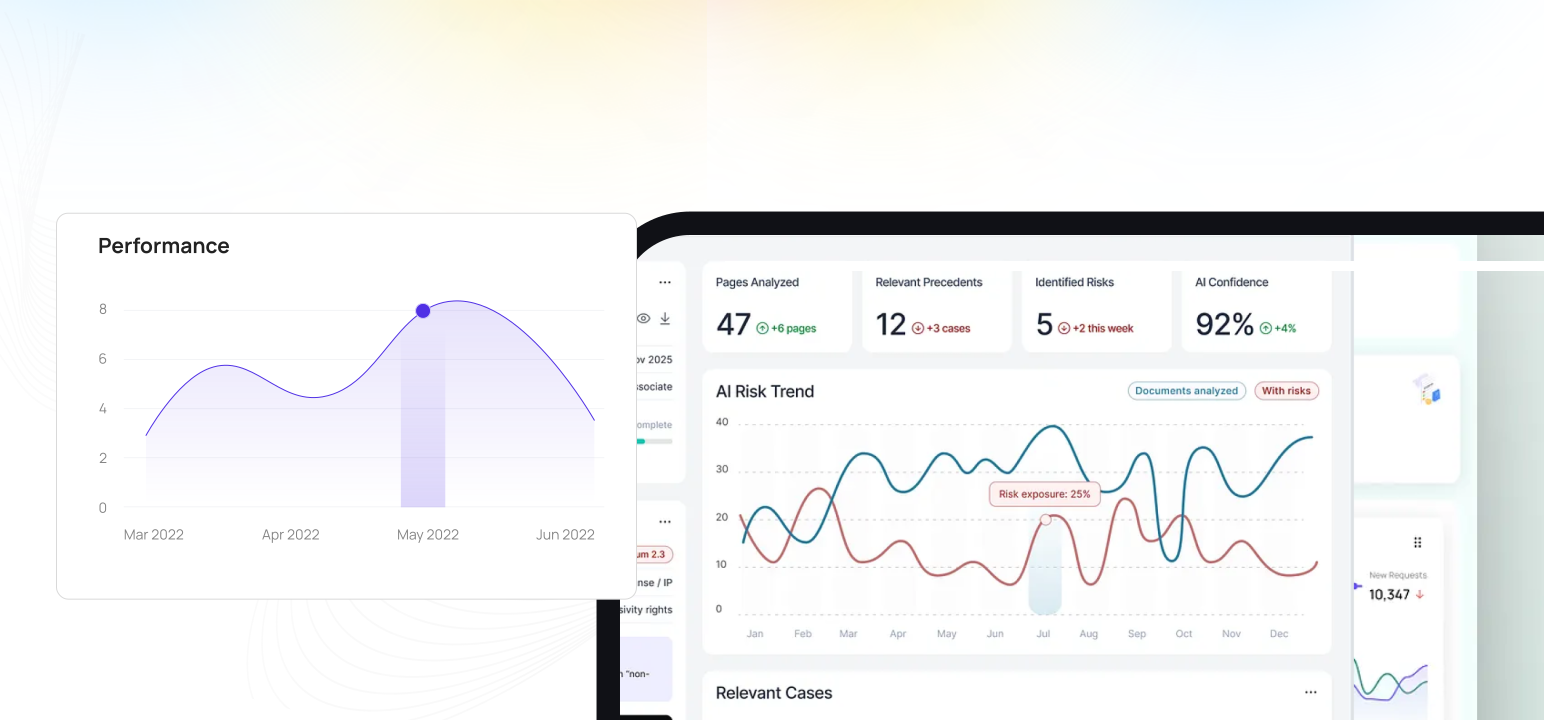
Your operations team sees completion rates, open issues, and compliance scores across all sites in real time. No chasing updates.
What changes once apron checklist software runs on one mobile-first platform with photo proof and live dashboards.
Apron checklist software is the platform ramp operations teams use to run digital self-inspection checklists and keep defensible records across the ramp. Inspectly360 turns the apron check into a standard mobile checklist covering pavement condition, stand and limit-line markings, apron lighting, fuel and oil spills, FOD, drainage, and GSE staging discipline, with each completed round stored in one record aligned to ICAO Annex 14 and FAA 14 CFR Part 139.327.
Today the apron check is a paper checklist that each duty officer runs slightly differently, a failed item is noted in words with no photo, and the completed sheets pile up in a folder. When an item is skipped under turnaround pressure, a spill or FOD note never reaches the responder, or someone needs to prove the check happened, the paper trail does not answer quickly. Across duty shifts, coverage is assumed rather than shown, so the operations manager cannot confirm every scheduled check was actually completed.
Inspectly360 replaces that with mobile capture on iOS and Android: a standard checklist guides every round so items are not skipped, a failed item requires a photo and becomes a routed defect with an owner, and each scheduled checklist shows complete, late, or missed. Completed checklists are stored, timestamped, and searchable per stand and date when a record is needed.
Ramp operations teams follow this loop for apron self-inspection checklists, defect routing, and the record.
Set a standard self-inspection checklist covering pavement, stand and limit-line markings, lighting, spills, FOD, and GSE staging so every round is consistent.
Duty staff work through the checklist on mobile, passing or failing each item, even offline across the apron.
Where apron checklist evidence has to hold up, A failed item requires a photo, so the condition is evidenced and the severity can be judged rather than guessed.
Each failed item becomes a routed defect with an owner and deadline so it reaches maintenance or cleaning, not just the page.
For Aviation teams running apron checklist, each completed checklist is stored and timestamped, and the schedule shows complete, late, or missed at a glance.
Answers to common long-tail questions, kept on one canonical page to avoid thin duplicate URLs.
Start with one apron area or pier so the checklist items, fail-evidence rules, and defect routing are validated against the airport's real self-inspection routine before rollout to the rest of the apron, taxiways, and runways.
Duty staff get checklist capture, maintenance and cleaning get the routed defects, and the operations manager gets the completion and coverage view per stand through role-based access.
The platform capabilities that power apron checklist software across every site.
A consistent self-inspection checklist covers pavement, markings, lighting, spills, FOD, and GSE staging. Why it matters: a standard checklist stops items being skipped under turnaround pressure on a busy stand.
Across multi-site apron checklist rounds, A failed item requires a photo before the round can continue. Why it matters: a defect described in words alone cannot be triaged for severity the way a photo allows.
Each failed item becomes a routed defect with an owner and deadline. Why it matters: a defect that stays on the checklist page never gets fixed, while a routed one reaches maintenance or cleaning.
Each scheduled checklist shows complete, late, or missed. Why it matters: assumed coverage is the gap a self-inspection audit exposes across a busy apron.
Checklists run fully offline and sync on reconnection. Why it matters: an apron round cannot wait for signal between piers, so the check must work in low-coverage areas.
Completed checklists are stored, timestamped, and searchable per stand and date. Why it matters: a record found in seconds replaces a folder of paper sheets nobody can search.
Ramp operations teams comparing Inspectly360 to paper checklists, spreadsheet forms, and WhatsApp photo trails see the difference fastest on consistent self-inspection items, mandatory photo capture, defect routing from a checklist, completion tracking, and digital record-keeping aligned to ICAO Annex 14 and FAA 14 CFR Part 139.327.
| Topic | Typical Gaps | With Inspectly360 |
|---|---|---|
| Consistent self-inspection items | Each duty officer runs the apron check differently, so items get skipped under turnaround pressure. | A standard digital checklist guides every round so markings, spills, FOD, and GSE staging are always covered. |
| Mandatory photo capture | A failed item is noted in words with no photo, so the severity is impossible to judge later. | A failed checklist item requires a photo, so the condition is evidenced, not just described. |
| Defect routing from a checklist | A defect found on a paper round is written down but may never reach maintenance or cleaning. | A failed item becomes a routed defect with an owner and deadline straight from the checklist. |
| Completion tracking | Whether the apron check was actually done is assumed until a gap is found later. | Each scheduled checklist shows complete, late, or missed so the duty manager sees coverage at a glance. |
| Digital record-keeping | Completed paper checklists pile up in a folder and are hard to search when records are needed. | Every completed checklist is stored, timestamped, and searchable per stand and date in seconds. |
What changes once apron checklist software is standardised on Inspectly360.
Get started with inspection and audit checklist templates.

Use this template to perform a comprehensive safety inspection of light vehicles. This check ensures all critical components are checked ...
Use these apps to run inspections and audits.

by Inspectly360
Streamline facilities inspections with forms, photos, and reports.

by Inspectly360
Building condition and compliance inspections with evidence and follow-ups.

by Inspectly360
Digitize building inspection apps workflows with forms, evidence capture, and automated reporting.

by Inspectly360
Run building inspections on phones and tablets with offline forms, photo evidence, and instant reports.

by Inspectly360
Audit buildings with structured scoring, photo evidence, and corrective action tracking across portfolios.
It turns the apron self-inspection from a paper checklist into a standard mobile workflow. The checklist covers the items a duty officer checks on every round: pavement condition, stand and limit-line markings, apron lighting, fuel and oil spills, FOD, drainage, and GSE staging discipline. Each item is passed or failed on the phone, a failed item requires a photo, and the completed round is stored and timestamped against the stand. This means the same items are covered every time rather than each officer running the check slightly differently. The value is consistency and a searchable record: instead of a folder of paper sheets, the airport has every completed apron checklist stored per date and ready to produce when a self-inspection record is needed.
The checklist guides the duty officer through every item in order, so nothing is left to memory under turnaround pressure on the apron. Where an item is critical, such as a spill check or an equipment limit line, the checklist can require a response before the round can be completed, which prevents a skipped item passing unnoticed. A failed item requires a photo, so it cannot be glossed over. This matters because the point of a self-inspection is consistency: an apron check that covers spills one day and forgets FOD the next is exactly the inconsistency a Part 139.327 program is meant to remove. A guided digital checklist makes every round cover the same ground regardless of how busy the stand is.
Yes. Checklists run fully offline on iOS and Android, because an apron round cannot wait for signal between piers and structures or during night operations. Duty staff complete the checklist and capture photos while offline, and the completed round syncs automatically once the device reconnects. The timestamp reflects when the round was actually done, not when it synced, which keeps the self-inspection record accurate. Nothing is lost when a check is completed in a no-coverage area. This reliability is essential, because a checklist that fails when signal drops would push staff back to paper and defeat the purpose of digitising the round, especially around large structures on a busy apron.
A failed item requires a photo and then becomes a routed defect with an owner and a deadline, so it leaves the checklist and reaches maintenance or cleaning as a tracked action. This closes the common gap where a defect is written on a paper round but never turns into work that someone owns. The duty officer can add a note on severity and stand location, and the defect carries its photo evidence so the responder can act without a second visit. The result is that an apron checklist is not just a record that a check happened; it is the start of a defect's lifecycle, with every failed item, including a spill or a marking fault, followed from the round to a verified fix rather than left on the page.
Each scheduled checklist shows as complete, late, or missed, so the operations manager sees coverage across the apron at a glance rather than assuming a round happened. If a round is missed, it is visible immediately rather than discovered later when a problem surfaces. This completion view matters for a self-inspection program, because the regulator expects evidence not just that checks are defined but that they are actually being done on schedule. Instead of leafing through a folder to confirm a round took place, the manager has a live picture of which apron checks are current and which need attention, which makes coverage a fact rather than a hope across every duty shift on a busy ramp.
Yes. The checklist is built around the airport's own apron self-inspection items and structure rather than a fixed template, so it reflects how the ramp actually runs its rounds. You set the items, the order, which ones require a photo or a mandatory response, and how failed items route to maintenance or cleaning. During the pilot on one apron area, these are validated against the real self-inspection routine before rollout to other surfaces. This means staff recognise the digital checklist as their own check, just faster and with evidence and routing built in, rather than a generic form imposed on them. Familiarity drives adoption, and adoption is what makes the record complete and trustworthy.
Apron Checklist Software on Inspectly360 connects directly to the inspection apps, checklist templates, forms, industries, and adjacent solutions linked below.
See Inspectly360 in action with a live demo tailored to your needs. No credit card required.