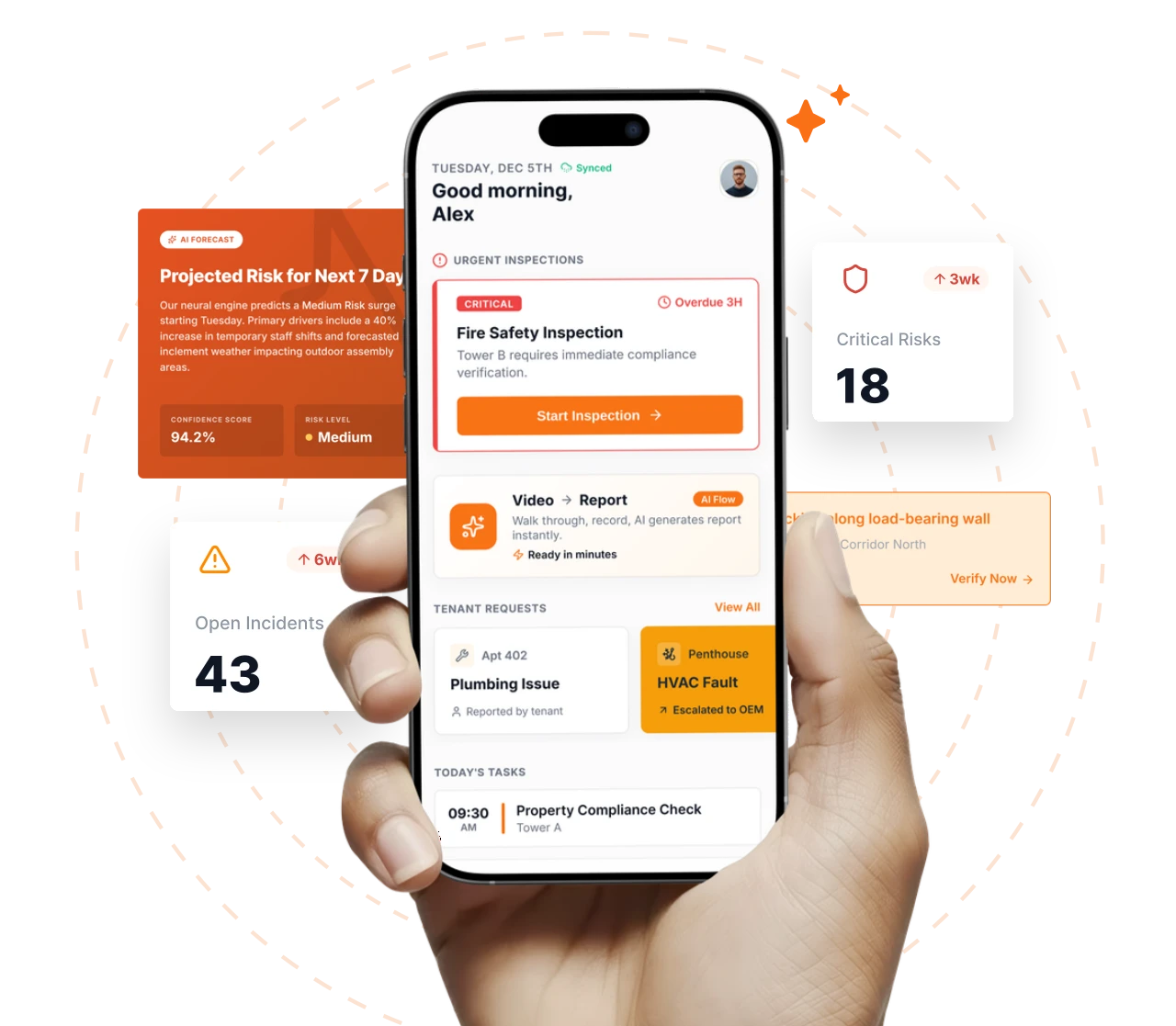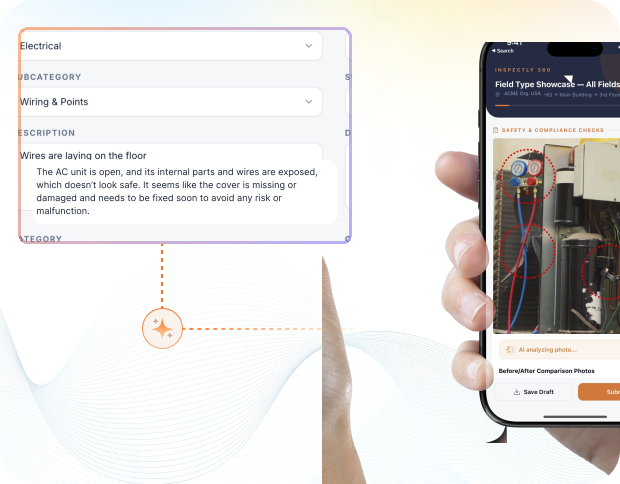
Take a Photo. AI Fills the Form
Your inspector takes a photo of any asset or defect. AI reads it and fills the inspection form automatically. No typing. No manual entry.

Convert your checklist into Mobile App
Fire extinguishers safety software is the platform cabin safety managers, SMS teams, and cabin crew use to manage hazards, risk, and reporting around cabin hand fire extinguishers across a fleet. Inspectly360 captures hazard reports, rates risk, links discharge and damage events to the asset, and tracks corrective actions to closure, supporting the operator's safety management system alongside FAA 14 CFR 121.
Everything your field team does on paper, Inspectly360 does automatically: faster, more accurate, and without the admin.
Your inspector takes a photo of any asset or defect. AI reads it and fills the inspection form automatically. No typing. No manual entry.
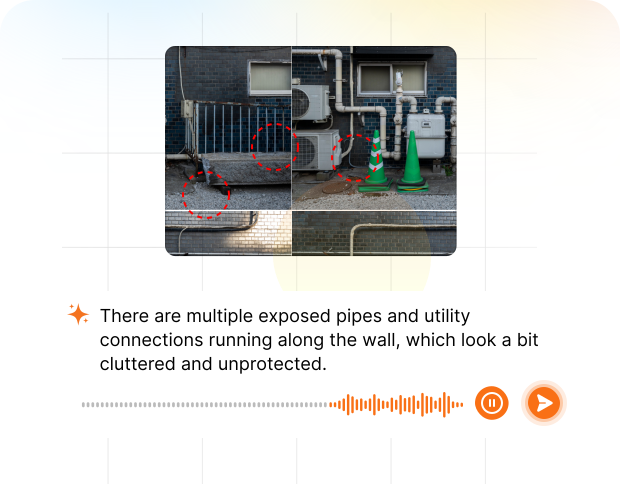
Inspectors speak their observations in any language. AI transcribes and fills the form in real time. Completely hands-free in the field.
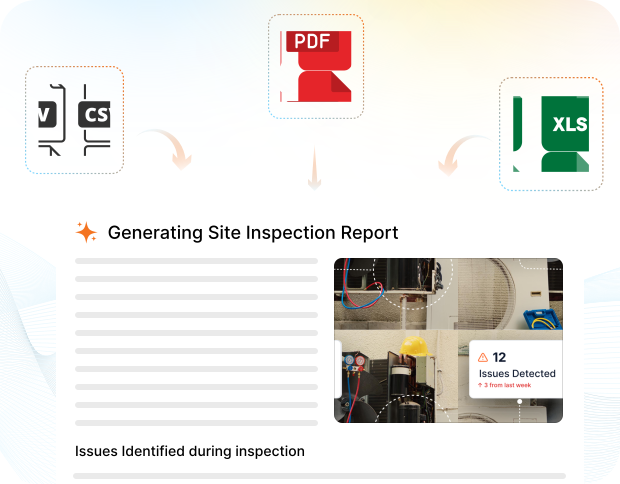
The moment an inspection is submitted, a branded PDF, Excel, or CSV report generates automatically. No manual work. No waiting.

Inspectly360 integrates with the tools your team already uses, including Zoho, Microsoft 365, and SAP. No double entry.
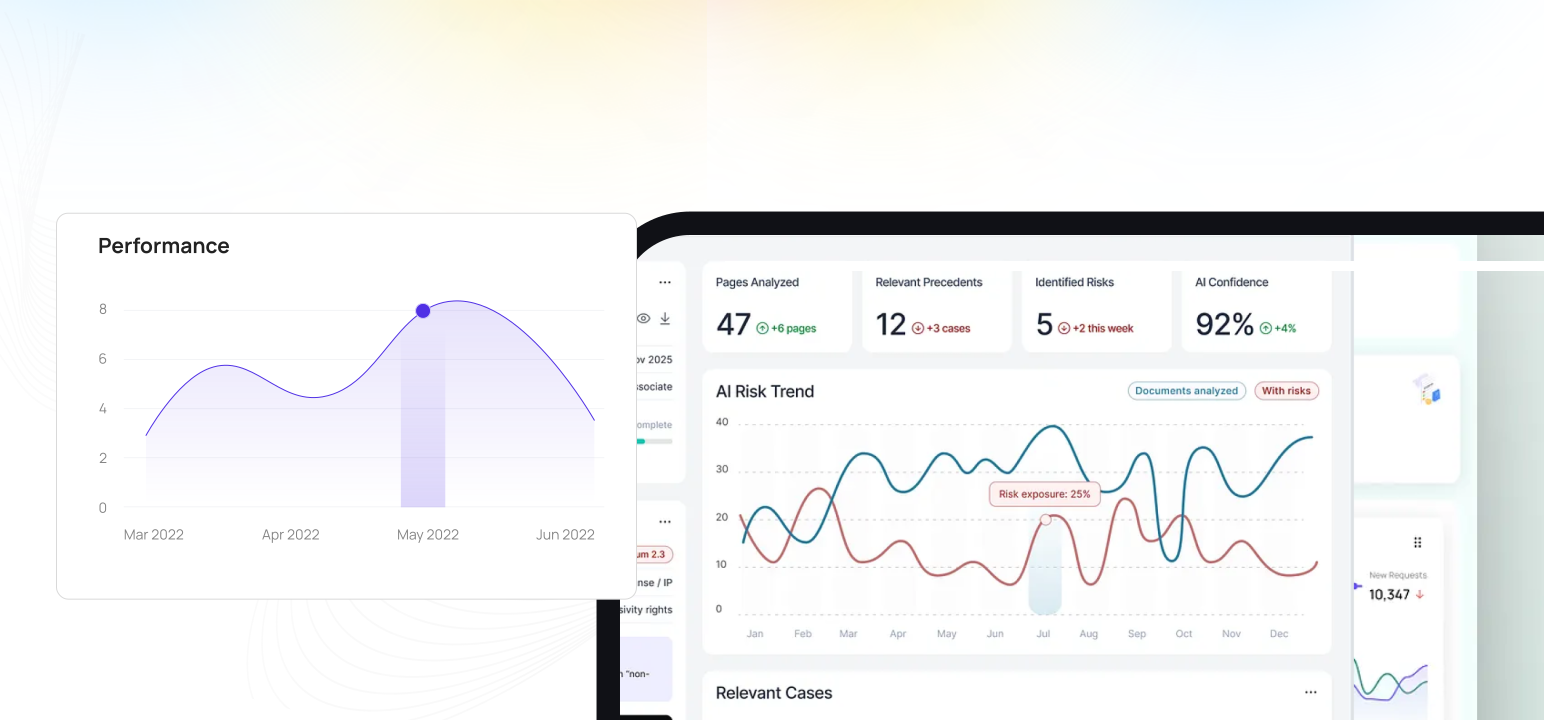
Your operations team sees completion rates, open issues, and compliance scores across all sites in real time. No chasing updates.
What changes once fire extinguishers safety software runs on one mobile-first platform with photo proof and live dashboards.
Fire extinguishers safety software is the platform cabin safety managers, SMS teams, and cabin crew use to manage hazards, risk, and reporting around cabin hand fire extinguishers across a fleet. Inspectly360 captures hazard reports, rates risk, links discharge and damage events to the asset, and tracks corrective actions to closure, supporting the operator's safety management system alongside FAA 14 CFR 121.309 and EASA CAT.IDE.A.250.
Today a blocked stowage, a missing extinguisher, or a Halon discharge is reported on a paper form or by email that may never reach the safety team in a usable form. Risk is judged informally, corrective actions are agreed in a meeting with no owner, and the safety manager has no consolidated view of open extinguisher hazards across the fleet. When a hazard recurs on several tails, nobody connects the pattern because the reports live in scattered inboxes and folders.
Inspectly360 replaces that with structured safety capture on iOS and Android: cabin crew report a hazard with photo, location, and severity in seconds, each hazard carries a risk rating so the team triages consistently, and a discharge or damage event links to the extinguisher serial number with cause and corrective action. Actions get an owner, a deadline, and verified closure, and a fleet view shows open hazards and overdue actions so safety trends are visible, not buried.
Cabin safety and SMS teams follow this loop from hazard report through risk assessment to corrective action and SMS evidence.
Cabin crew report a blocked stowage, missing unit, broken seal, or low gauge on mobile with a photo, the station location, and a severity in seconds.
Each hazard carries a structured risk rating so the safety team triages by likelihood and consequence rather than informal judgement.
A Halon discharge, an impact, or a damaged unit links to the extinguisher serial number with cause captured, so the asset history is complete.
Each action gets a named owner and a deadline, and closure is verified with evidence rather than agreed in a meeting and forgotten.
Open hazards, risk ratings, and overdue actions roll up across the fleet, so recurring cabin extinguisher risks are visible and reportable.
Answers to common long-tail questions, kept on one canonical page to avoid thin duplicate URLs.
Start with a single fleet type so the hazard categories, risk ratings, and corrective action workflow are validated against real cabin extinguisher events before rollout to mixed types and other bases.
Cabin crew get hazard reporting, the safety team gets risk assessment and action assignment, and quality assurance gets read access to the full SMS trail per tail number through role-based access.
The platform capabilities that power fire extinguishers safety software across every site.
Crew report a blocked stowage, missing unit, broken seal, or low gauge with photo, location, and severity. Why it matters: a hazard report that never reaches the safety team is a risk left unmanaged.
Each hazard is rated by likelihood and consequence for consistent triage. Why it matters: informal judgement lets a serious risk sit behind a minor one.
A Halon discharge or damaged unit links to the serial number with cause and corrective action. Why it matters: an event with no asset link breaks the unit's safety history.
Each action carries an owner, a deadline, and verified closure. Why it matters: an action with no owner is the recurring hazard a later audit finds.
Open hazards, risk ratings, and overdue actions roll up across tail numbers. Why it matters: a pattern across tails is only visible when reports are in one place.
A branded safety pack exports per aircraft or per event for the safety review. Why it matters: SMS evidence requests become an export, not an inbox search.
Cabin safety and SMS teams comparing Inspectly360 to paper hazard forms, spreadsheet risk logs, and email trails see the difference fastest on hazard reporting, risk assessment, discharge event capture, corrective action tracking, and fleet-wide safety visibility aligned to FAA 14 CFR 121.309 and EASA CAT.IDE.A.250.
| Topic | Typical Gaps | With Inspectly360 |
|---|---|---|
| Hazard reporting from the cabin | Crew note a blocked or missing extinguisher on a paper form that may never reach the safety team. | Crew report a cabin extinguisher hazard on mobile with photo, location, and severity in seconds. |
| Risk assessment and rating | Risk judged informally with no consistent rating across hazards or bases. | Each hazard carries a structured risk rating so the safety team triages consistently. |
| Discharge and damage events | A Halon discharge or damaged unit reported by email with no link to the asset or follow-up. | A discharge or damage event links to the serial number with photo, cause, and corrective action. |
| Corrective action tracking | Actions agreed in a meeting with no owner, deadline, or proof of closure. | Each action has an owner, deadline, and verified closure tracked to completion. |
| Fleet safety visibility | Safety manager has no consolidated view of open extinguisher hazards across the fleet. | Live view of open hazards, risk ratings, and overdue actions across every tail. |
What changes once fire extinguishers safety software is standardised on Inspectly360.
Get started with inspection and audit checklist templates.

Use this template to perform a comprehensive safety inspection of light vehicles. This check ensures all critical components are checked ...
Use these apps to run inspections and audits.

by Inspectly360
Streamline facilities inspections with forms, photos, and reports.

by Inspectly360
Building condition and compliance inspections with evidence and follow-ups.

by Inspectly360
Digitize building inspection apps workflows with forms, evidence capture, and automated reporting.

by Inspectly360
Run building inspections on phones and tablets with offline forms, photo evidence, and instant reports.

by Inspectly360
Audit buildings with structured scoring, photo evidence, and corrective action tracking across portfolios.
Cabin crew report a hazard on iOS or Android in seconds: a blocked or obstructed extinguisher stowage, a missing unit, a broken tamper seal, or a low gauge reading. The report carries a photo, the station location, and a severity, and it routes straight to the safety team rather than sitting on a paper form that may never reach them. Because the report can link to the extinguisher serial number, the hazard joins that unit's history. This turns a vague verbal concern into a structured, traceable record that the safety team can triage, act on, and close, which is exactly what an effective cabin safety management system depends on.
Each hazard carries a structured risk rating based on likelihood and consequence, so the safety team triages every cabin extinguisher report the same way regardless of which base raised it. This replaces informal judgement, where a serious risk can sit behind a minor one simply because of who logged it. The rating drives prioritisation, so the highest-risk hazards, such as a blocked extinguisher on a high-density cabin, surface first. Because the rating method is the same across the fleet, the safety manager can compare risk across tails and bases and report a consistent picture, rather than reconciling different scoring habits from each station's paperwork.
Yes. A discharge event, an impact, or a damaged unit is captured against the extinguisher serial number with the cause, photos, and a corrective action. This keeps the asset's safety history complete, so a unit that was discharged or damaged carries that record into its maintenance and compliance picture. Linking the event to the serial number also lets the safety team spot if a particular station or unit type sees repeated events. An email report with no asset link breaks that history and makes patterns invisible. Here the event feeds both the SMS trail and the continuing airworthiness record for the affected cylinder.
Each corrective action gets a named owner and a deadline, and closure is verified with evidence rather than agreed in a meeting and forgotten. The safety manager sees which actions are open, due, or overdue across the fleet, so nothing quietly lapses. When an action is closed, the proof, such as a photo of cleared stowage or a replaced unit, is attached to the record. This is the gap most paper and email processes leave: an action with no owner becomes the recurring hazard a later audit finds. Tracking ownership and verified closure turns the SMS loop into something provable rather than a list of good intentions.
Yes. Hazard capture works fully offline on iOS and Android, which matters on the aircraft and at remote stands where signal is weak. Cabin crew report a blocked stowage or damaged extinguisher with photos while offline, and the report syncs automatically once the device reconnects. Nothing is lost if the hazard is logged in an area with no coverage, and the timestamp reflects when it was actually seen, not when it synced. This means a hazard noticed mid-turnaround is captured immediately rather than remembered later or dropped, which keeps the cabin safety reporting culture honest and the SMS evidence accurate.
Open hazards, risk ratings, and overdue corrective actions roll up across every tail number into one safety dashboard. This is what scattered paper forms and email threads cannot do: when the same cabin extinguisher hazard, such as obstructed stowage, recurs on several tails, the pattern is visible and reportable. The safety team can filter by base, aircraft type, hazard category, and risk rating to focus a safety review where the data points. A recurring hazard becomes a systemic action rather than a series of one-off fixes, which is the difference between reacting to individual reports and managing cabin extinguisher risk across the fleet.
Fire Extinguishers Safety Software on Inspectly360 connects directly to the inspection apps, checklist templates, forms, industries, and adjacent solutions linked below.
See Inspectly360 in action with a live demo tailored to your needs. No credit card required.