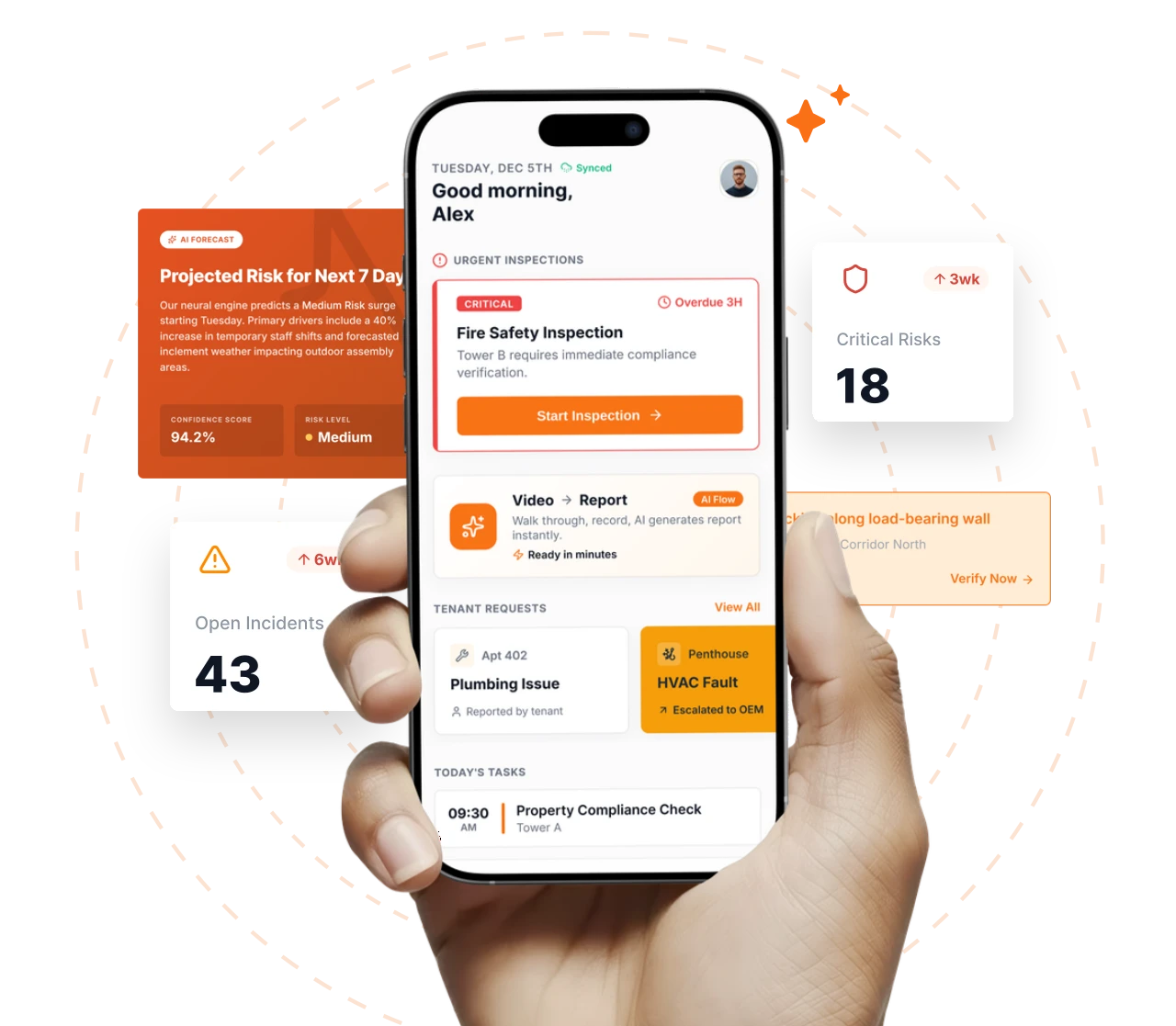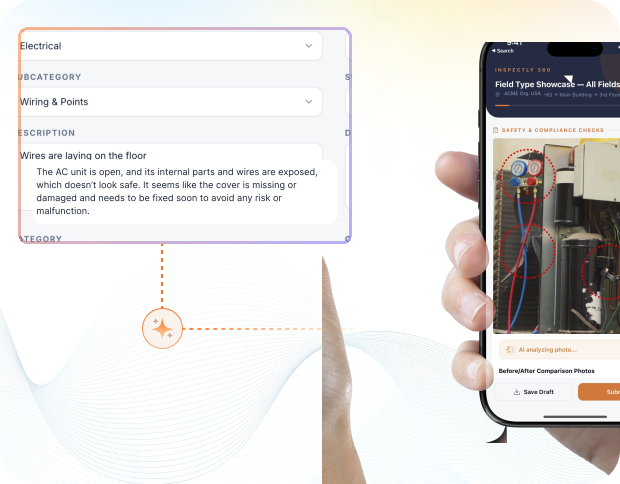
Take a Photo. AI Fills the Form
Your inspector takes a photo of any asset or defect. AI reads it and fills the inspection form automatically. No typing. No manual entry.

Convert your checklist into Mobile App
Ground support equipment (GSE) compliance software is the platform airside operations managers, ground handling supervisors, and compliance leads use to hold regulatory evidence and serviceability clocks for the GSE fleet in one defensible record. Inspectly360 digitises airside permit and driver authorisation tracking, pre-use and service serviceability clocks, and the evidence that maps to IATA IGOM, ISAGO, and local CAA airside rules.
Everything your field team does on paper, Inspectly360 does automatically: faster, more accurate, and without the admin.
Your inspector takes a photo of any asset or defect. AI reads it and fills the inspection form automatically. No typing. No manual entry.
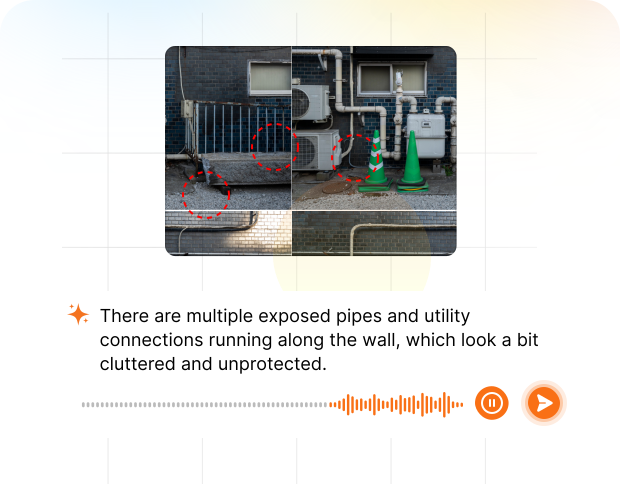
Inspectors speak their observations in any language. AI transcribes and fills the form in real time. Completely hands-free in the field.
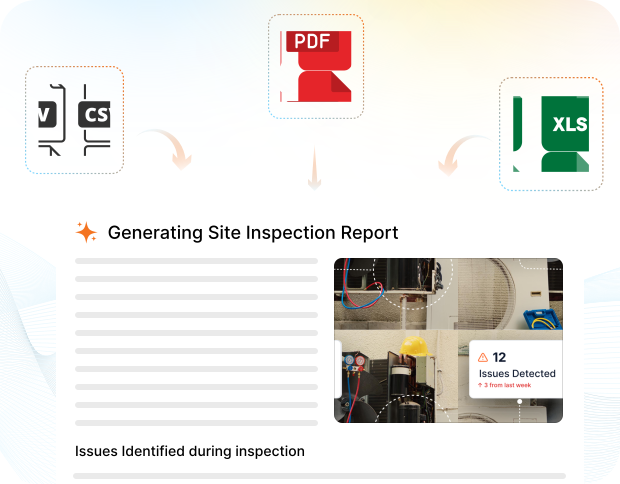
The moment an inspection is submitted, a branded PDF, Excel, or CSV report generates automatically. No manual work. No waiting.

Inspectly360 integrates with the tools your team already uses, including Zoho, Microsoft 365, and SAP. No double entry.
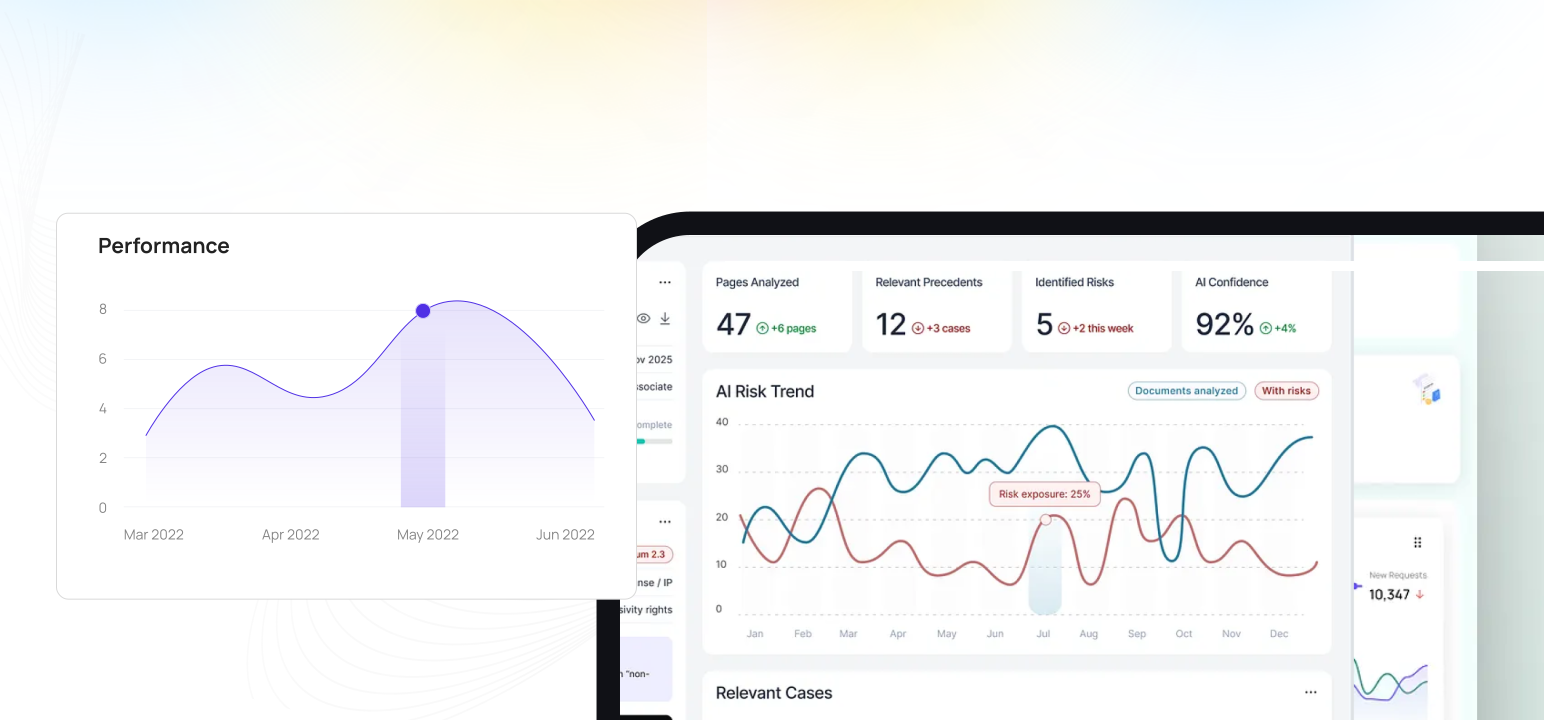
Your operations team sees completion rates, open issues, and compliance scores across all sites in real time. No chasing updates.
What changes once ground support equipment (gse) compliance software runs on one mobile-first platform with photo proof and live dashboards.
Ground support equipment (GSE) compliance software is the platform airside operations managers, ground handling supervisors, and compliance leads use to hold regulatory evidence and serviceability clocks for the GSE fleet in one defensible record. Inspectly360 digitises airside permit and driver authorisation tracking, pre-use and service serviceability clocks, and the evidence that maps to IATA IGOM, ISAGO, and local CAA airside rules.
Today the driver airside permits sit in a file, the question of whether a unit is cleared to operate is a verbal judgement, and the evidence for an ISAGO requirement is scattered across phones and email. When a permit lapses, a unit operates past a serviceability clock, or an evidence item cannot be found, nobody sees it until a CAA inspection or an ISAGO audit finds the gap. Across several bases every supervisor holds compliance a little differently, so the airside manager cannot state fleet status with confidence.
Inspectly360 replaces that with mobile capture on iOS and Android: permits and authorisations carry expiry clocks, pre-use and service results determine whether a unit is cleared to operate, and each regulatory requirement carries timestamped, photo-backed evidence against the unit and the driver. Gaps raise alerts before they bite, and a branded evidence pack exports per unit or driver when a CAA inspector or ISAGO auditor asks.
Airside compliance teams follow this loop for permit tracking, serviceability clearance, and regulatory evidence.
Attach IGOM, ISAGO, and local CAA airside requirements to each GSE unit and each authorised driver as tracked items.
Driver airside permits and unit authorisations carry expiry clocks with staged alerts before they lapse.
Pre-use and service serviceability clocks determine whether each unit is cleared to operate airside today.
Each requirement carries timestamped, photo-backed evidence against the unit or driver for the compliance trail.
A scoped, branded evidence pack exports per unit or driver for a CAA inspector or ISAGO auditor in minutes.
Answers to common long-tail questions, kept on one canonical page to avoid thin duplicate URLs.
Start with a single base so the requirement map, permit clocks, and serviceability rules are validated against real units and drivers before rollout to other stations and contracted handlers.
Supervisors get evidence capture and clearance, the compliance lead gets requirement control, and the airside manager gets read access to the full compliance trail per unit and driver through role-based access.
The platform capabilities that power ground support equipment (gse) compliance software across every site.
Driver airside permits and unit authorisations carry expiry dates with staged alerts. Why it matters: a lapsed airside permit operating on the apron is an immediate CAA compliance breach.
Pre-use and service results determine whether a unit is cleared to operate airside today. Why it matters: a unit operating past a serviceability clock is the gap an ISAGO audit and a safety event both expose.
Each IGOM, ISAGO, and CAA requirement carries timestamped, photo-backed evidence. Why it matters: an auditor wants the requirement and the proof side by side, not a scattered email search.
Each authorised driver carries their permits, training, and unit authorisations on one record. Why it matters: an unauthorised driver on a powered unit is a direct airside rule breach.
Permit, clock, and evidence status roll up across units and drivers. Why it matters: the airside manager states fleet compliance without asking each base.
A branded compliance pack exports per unit or driver for the regulator. Why it matters: a CAA or ISAGO request becomes a minutes-long export, not a file search.
Airside operations managers and ground handling supervisors comparing Inspectly360 to paper permit files, spreadsheet expiry logs, and email evidence trails see the difference fastest on airside permit tracking, serviceability clocks, regulatory evidence capture, driver authorisation records, and fleet-wide compliance status aligned to IATA IGOM, ISAGO, and local CAA airside rules.
| Topic | Typical Gaps | With Inspectly360 |
|---|---|---|
| Airside permit and authorisation tracking | Driver airside permits and unit authorisations sit in a file that nobody checks against expiry. | Each permit and authorisation carries its expiry with staged alerts before it lapses. |
| Serviceability clocks | Whether a unit is compliant to operate airside today is a verbal judgement, not a record. | Pre-use and service clocks determine whether a unit is cleared to operate, with the status on one record. |
| Regulatory evidence capture | Evidence for an IGOM or ISAGO requirement is scattered across phones, drives, and email. | Each requirement carries timestamped, photo-backed evidence against the unit and the driver. |
| Fleet-wide compliance status | The airside manager cannot say which units or drivers are out of compliance without asking each base. | A live dashboard shows permit, clock, and evidence status across the GSE fleet and drivers. |
| Evidence pack for the regulator | Records are gathered by hand when a CAA inspector or ISAGO auditor asks for GSE compliance proof. | A scoped, timestamped evidence pack exports per unit or driver in minutes. |
What changes once ground support equipment (gse) compliance software is standardised on Inspectly360.
Get started with inspection and audit checklist templates.

Use this template to perform a comprehensive safety inspection of light vehicles. This check ensures all critical components are checked ...
Use these apps to run inspections and audits.

by Inspectly360
Streamline facilities inspections with forms, photos, and reports.

by Inspectly360
Building condition and compliance inspections with evidence and follow-ups.

by Inspectly360
Digitize building inspection apps workflows with forms, evidence capture, and automated reporting.

by Inspectly360
Run building inspections on phones and tablets with offline forms, photo evidence, and instant reports.

by Inspectly360
Audit buildings with structured scoring, photo evidence, and corrective action tracking across portfolios.
Each driver airside permit and each unit authorisation is held as a tracked item with its expiry date. The platform raises staged alerts before a permit or authorisation lapses, so the supervisor renews it during a planned window rather than discovering it expired when a CAA inspector challenges a driver on the apron. The permit, the training behind it, and the units a driver is authorised on stay on one record. When the regulator asks which drivers or units are out of authorisation across the operation, the dashboard answers in seconds instead of a manual file check, which matters when several handlers share the airside.
Serviceability clearance is driven by the unit's pre-use walkaround and service status. If a pre-use check is missed, an open defect is safety-critical, or a service interval is overdue, the unit shows as not cleared to operate until the issue is resolved. This turns a verbal judgement into a recorded rule, so a supervisor does not have to remember which unit had a brake fault yesterday. The clearance status sits on the unit record with the evidence behind it, so an ISAGO auditor can see both the rule and the proof that a unit operating airside met it.
Yes. Capture works fully offline on iOS and Android, which matters on the apron, at remote stands, and at outstations where signal is weak. Supervisors capture evidence, check serviceability clearance, and record permit checks while offline, and records sync automatically once the device reconnects. Nothing is lost if a check is done in a dead spot, and the timestamp reflects when the work was done, not when it synced. This keeps the compliance trail accurate for the airside manager and for a CAA inspector or ISAGO auditor reviewing evidence across the fleet and the driver pool.
Each IGOM, ISAGO, and local CAA airside requirement is set up as a tracked item against the relevant units and drivers. As checks, permits, and services are completed, their timestamped, photo-backed records attach to the matching requirement. The result is a requirement and its proof held side by side, rather than evidence scattered across phones, drives, and email. When an auditor walks a requirement, you show the requirement, the units and drivers it applies to, and the evidence that satisfies it. This is the structure ISAGO assessments expect, and it removes the scramble of assembling proof after the request lands.
Every permit, serviceability clearance, requirement, and piece of evidence is stored with a timestamp, the named person, and a photo against the specific unit or driver. When a CAA inspector or ISAGO auditor asks for GSE compliance proof, you export a scoped, branded evidence pack per unit or driver covering the audit window in minutes. The trail shows current permits, serviceability clearance, requirement-by-requirement evidence, and the closure of any gap with verified sign-off. This replaces the gather-from-everywhere routine that paper files and email trails force, and the evidence is consistent across every base in the operation.
Yes. Role-based access scopes each user to the units, drivers, and requirements they are responsible for. A contracted handler sees only its own fleet numbers and drivers, while the airport or airline keeps combined visibility across the whole airside operation. Supervisors get evidence capture and clearance, the compliance lead controls requirements, and the airside manager gets read access to the full trail. This prevents a contractor seeing another handler's compliance records, while still giving the operator one consolidated view. Access changes are logged, so the audit trail shows who could see and sign off on what, and when.
GSE Compliance Software on Inspectly360 connects directly to the inspection apps, checklist templates, forms, industries, and adjacent solutions linked below.
See Inspectly360 in action with a live demo tailored to your needs. No credit card required.