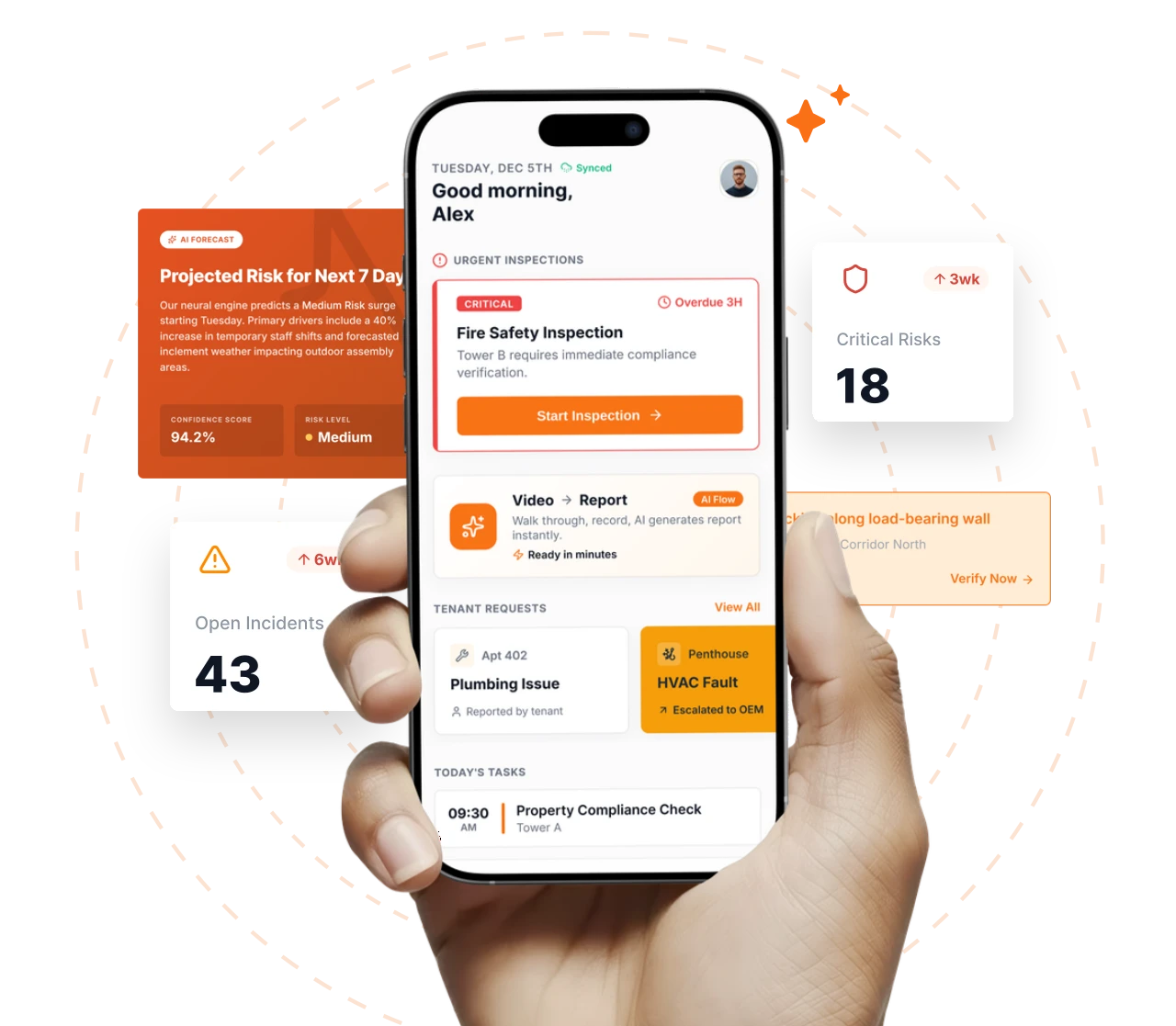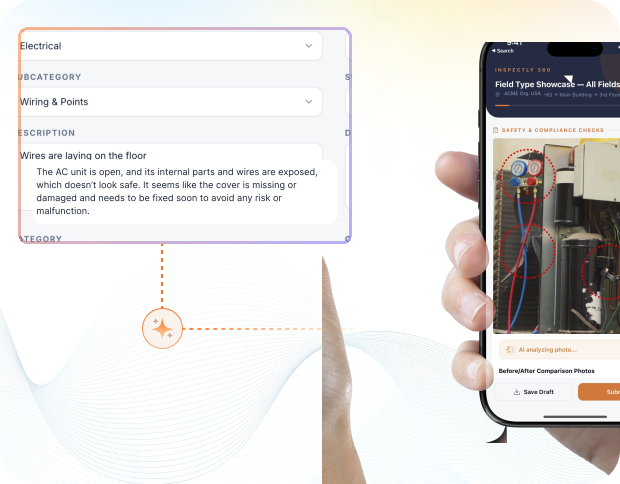
Take a Photo. AI Fills the Form
Your inspector takes a photo of any asset or defect. AI reads it and fills the inspection form automatically. No typing. No manual entry.

Convert your checklist into Mobile App
Baggage conveyor safety software is the platform ramp safety managers, ground handling supervisors, and belt loader operators use to log belt loader hazards and near-misses and to track risk controls in a safety management system. Inspectly360 digitises hazard reporting, near-miss capture, risk control tracking, and the pinch-point and aircraft-door-strike prevention evidence that maps to ISO 45001 and IATA IGOM across the ramp.
Everything your field team does on paper, Inspectly360 does automatically: faster, more accurate, and without the admin.
Your inspector takes a photo of any asset or defect. AI reads it and fills the inspection form automatically. No typing. No manual entry.
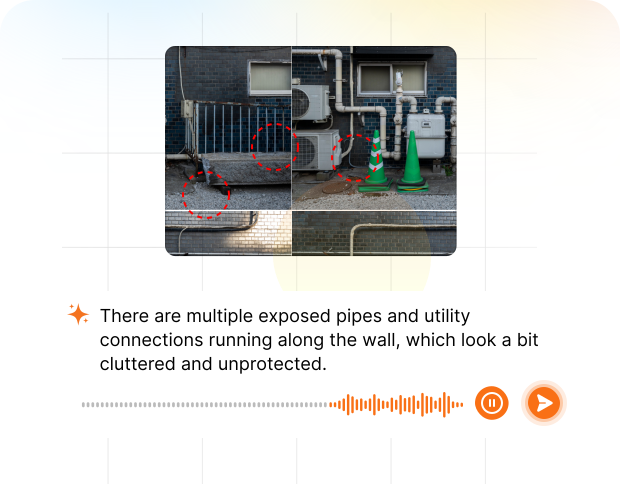
Inspectors speak their observations in any language. AI transcribes and fills the form in real time. Completely hands-free in the field.
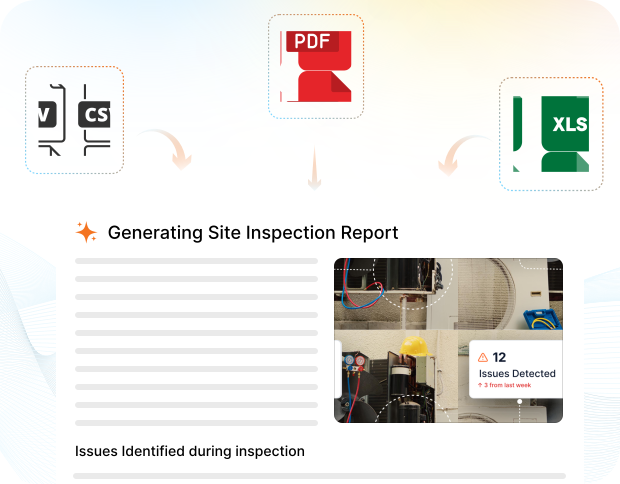
The moment an inspection is submitted, a branded PDF, Excel, or CSV report generates automatically. No manual work. No waiting.

Inspectly360 integrates with the tools your team already uses, including Zoho, Microsoft 365, and SAP. No double entry.
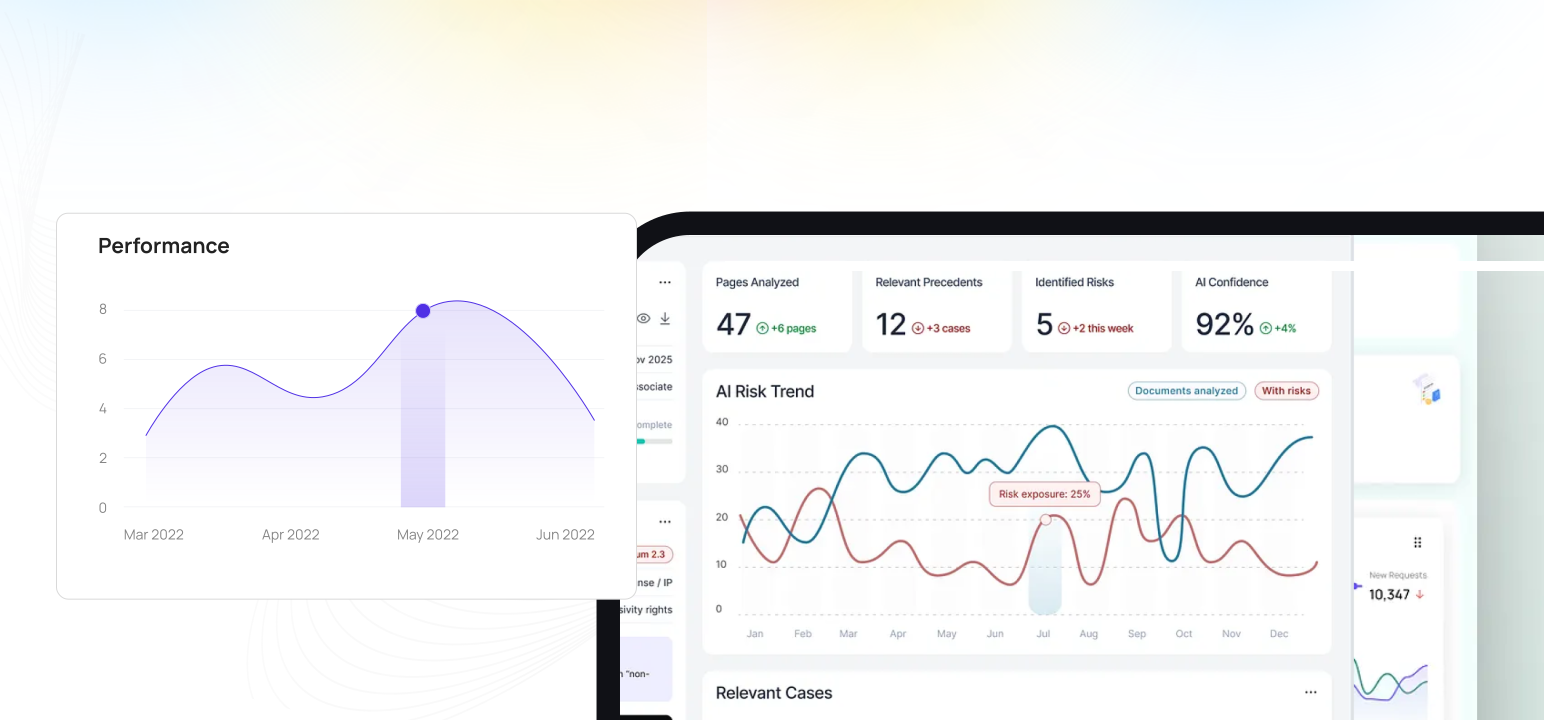
Your operations team sees completion rates, open issues, and compliance scores across all sites in real time. No chasing updates.
What changes once baggage conveyor safety software runs on one mobile-first platform with photo proof and live dashboards.
Baggage conveyor safety software is the platform ramp safety managers, ground handling supervisors, and belt loader operators use to log belt loader hazards and near-misses and to track risk controls in a safety management system. Inspectly360 digitises hazard reporting, near-miss capture, risk control tracking, and the pinch-point and aircraft-door-strike prevention evidence that maps to ISO 45001 and IATA IGOM across the ramp.
Today a pinch-point hazard is mentioned at handover, a near-miss where a boom nearly strikes an aircraft door is reported verbally if at all, and the proof a control was applied is a memory. When a frayed belt keeps catching hands, a near-miss goes unrecorded, or a control has no owner, nobody sees the pattern until a hand injury at a pinch point or a belt-entanglement event makes it public. Across a busy ramp every shift handles safety reporting a little differently, so the safety manager cannot see where hazards cluster by unit, stand, or shift.
Inspectly360 replaces that with mobile capture on iOS and Android: operators and supervisors log hazards and near-misses with photo, location, and severity against the SMS, each risk control carries an owner and a deadline, and recurring hazards such as belt jams and door-strike near-misses surface by unit and stand. Controls close with verified sign-off, and a branded SMS evidence pack exports per belt loader or stand when an ISAGO or SMS auditor asks for the ramp safety trail.
Ramp safety teams follow this loop for belt loader hazard reporting, near-miss capture, and risk control closure.
Operators and supervisors log a belt loader hazard or near-miss on mobile with photo, location, the unit, and severity.
The report is assessed against the SMS risk matrix so the severity and likelihood of a pinch-point injury or door strike drive the right response.
Across the baggage conveyor safety portfolio, each control is assigned with an owner and a deadline so an agreed action is tracked, not just discussed.
Repeat hazards such as belt entanglement and boom door-strike near-misses surface by unit, stand, and shift to fix the root cause.
For baggage conveyor safety field teams, controls close with verified sign-off, and a branded SMS evidence pack exports per unit or stand for the auditor.
Answers to common long-tail questions, kept on one canonical page to avoid thin duplicate URLs.
Start with the belt loaders at a single base so the hazard form, risk matrix, and control routing are validated against real units and stands before rollout to other stations and contracted handlers.
Operators get hazard and near-miss capture, supervisors get risk assessment and control assignment, and the ramp safety manager gets read access to the full SMS trail per unit and stand through role-based access.
The platform capabilities that power baggage conveyor safety software across every site.
Operators log a pinch-point, belt, or boom hazard on mobile with photo, location, and severity in seconds. Why it matters: a hazard captured the moment it is seen is acted on, rather than mentioned at handover and lost.
Each near-miss, including a boom nearly striking an aircraft door, is recorded with the unit and circumstances. Why it matters: a near-miss is the warning before a door strike or a hand injury, and an unrecorded one teaches nobody.
Each control for a pinch point or belt-entanglement risk carries an owner, a deadline, and verified closure. Why it matters: a control agreed after an injury but assigned to nobody is the gap an SMS audit exposes.
Boom-to-door positioning hazards and controls are tracked against the unit and stand. Why it matters: a boom strike on an aircraft door is a costly and avoidable event the safety trail must show was managed.
Hazards, near-misses, and open controls roll up across belt loaders, stands, and shifts. Why it matters: the safety manager sees where pinch-point and door-strike risk clusters without chasing each shift.
A branded SMS evidence pack exports per belt loader or stand for the auditor. Why it matters: an ISAGO or SMS request becomes a minutes-long export, not a hazard-form search.
Ramp safety managers and ground handling supervisors comparing Inspectly360 to paper hazard forms, spreadsheet logs, and verbal near-miss reports see the difference fastest on belt loader hazard capture, near-miss reporting, pinch-point and belt-entanglement risk controls, aircraft-door-strike prevention evidence, and fleet-wide SMS visibility aligned to ISO 45001 and IATA IGOM.
| Topic | Typical Gaps | With Inspectly360 |
|---|---|---|
| Belt loader hazard reporting | A pinch-point or belt hazard is mentioned at handover and lost before anyone records or acts on it. | A belt loader hazard is logged on mobile with photo, location, and severity against the SMS in seconds. |
| Near-miss capture | A near-miss where a boom nearly strikes an aircraft door is reported verbally, if at all, with no record. | Each near-miss is captured with the belt loader, the circumstances, and a photo for the safety review. |
| Risk control tracking | A control agreed after a hand injury is not assigned, so nobody owns it or proves it was applied. | Each risk control carries an owner, a deadline, and verified closure on the SMS record. |
| Fleet-wide SMS visibility | The safety manager cannot see where pinch-point hazards cluster across units, stands, or shifts. | A live dashboard shows hazards, near-misses, and open controls across the belt loader fleet and the ramp. |
| Evidence for the safety auditor | Hazard forms are searched by hand when an ISAGO or SMS auditor asks for belt loader safety records. | A scoped, timestamped SMS evidence pack exports per unit or stand in minutes. |
What changes once baggage conveyor safety software is standardised on Inspectly360.
Get started with inspection and audit checklist templates.

Use this template to perform a comprehensive safety inspection of light vehicles. This check ensures all critical components are checked ...
Use these apps to run inspections and audits.

by Inspectly360
Streamline facilities inspections with forms, photos, and reports.

by Inspectly360
Building condition and compliance inspections with evidence and follow-ups.

by Inspectly360
Digitize building inspection apps workflows with forms, evidence capture, and automated reporting.

by Inspectly360
Run building inspections on phones and tablets with offline forms, photo evidence, and instant reports.

by Inspectly360
Audit buildings with structured scoring, photo evidence, and corrective action tracking across portfolios.
An operator or supervisor logs a belt loader hazard or near-miss on mobile in seconds, recording a photo, the location, the unit, and the severity against the SMS. A frayed belt catching a hand at a pinch point, a missing side guard, or a boom that nearly strikes an aircraft door is captured the moment it is seen rather than mentioned at handover and lost. The report opens against the specific belt loader and stand, so the safety manager can later see where the same hazard repeats. This replaces the verbal report that teaches nobody with a recorded event that drives a tracked control and feeds the SMS trail.
Pinch points, rollers, and belt entanglement are common belt loader injury sources, so the platform treats them as explicit hazard categories. When an operator reports a hand injury risk at a pinch point or a belt that keeps catching, the report is assessed against the SMS risk matrix and each control is assigned with an owner and a deadline. The control stays open until it is applied and signed off. Because repeat hazards surface by unit and stand, the team can see whether a specific belt loader or a particular bay drives the injuries, and fix the root cause rather than treating each report as a one-off.
Boom raise and lower against the aircraft hold height is where a belt loader can strike an aircraft door, which is a costly and avoidable event. The platform tracks boom-to-door positioning hazards and near-misses against the unit and stand, so a near-miss where a boom came close to a door is recorded rather than brushed off. Each agreed control, whether a procedure change, extra training, or a unit defect, carries an owner and a deadline. The safety manager sees whether door-strike near-misses cluster on a particular stand or aircraft type, and the SMS trail shows an auditor the risk was identified and managed, not ignored.
Yes. Capture works fully offline on iOS and Android, which matters on the apron, at remote stands, and at outstations where signal is weak. Operators and supervisors log hazards, capture near-misses with photos, and update controls while offline, and records sync automatically once the device reconnects. Nothing is lost if a report is made in a dead spot, and the timestamp reflects when the event happened, not when it synced. This keeps the SMS trail accurate for the ramp safety manager and for an ISAGO or SMS auditor reviewing belt loader safety across the fleet, the stands, and the shifts.
Every control agreed after a hazard or near-miss is assigned with an owner and a deadline, so an action discussed in a safety meeting is tracked rather than forgotten. The control stays open and visible on the SMS dashboard until the owner applies it and a supervisor verifies and signs off the closure. Overdue controls surface so they are chased before the next incident. Because the control links back to the hazard, the unit, and the stand, the safety manager can show an auditor the full chain from a reported pinch-point risk or door-strike near-miss to the control that closed it, with the evidence attached at each step.
Every hazard, near-miss, risk assessment, control, and closure is stored with a timestamp, the named person, and photo evidence against the specific belt loader or stand. When an ISAGO or SMS auditor asks for belt loader safety records, you export a scoped, branded SMS evidence pack per unit or stand covering the audit window in minutes. The trail shows reported pinch-point and door-strike hazards, near-misses, the controls assigned against them, and verified closures. This replaces the search-the-hazard-forms routine that paper records force, and the evidence is consistent across every shift and base, which matters when several handlers share one apron.
Baggage Conveyor Safety Software on Inspectly360 connects directly to the inspection apps, checklist templates, forms, industries, and adjacent solutions linked below.
See Inspectly360 in action with a live demo tailored to your needs. No credit card required.