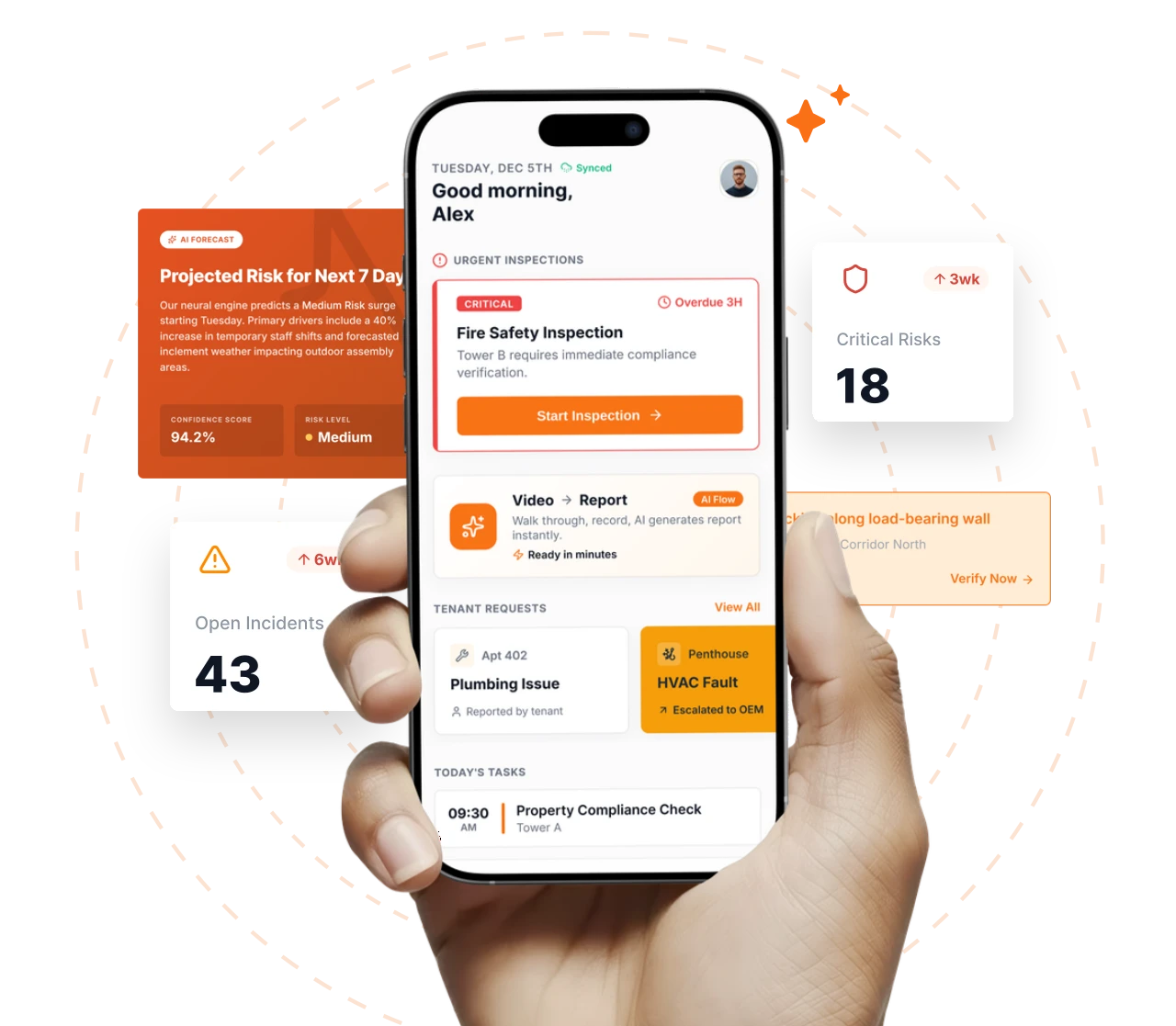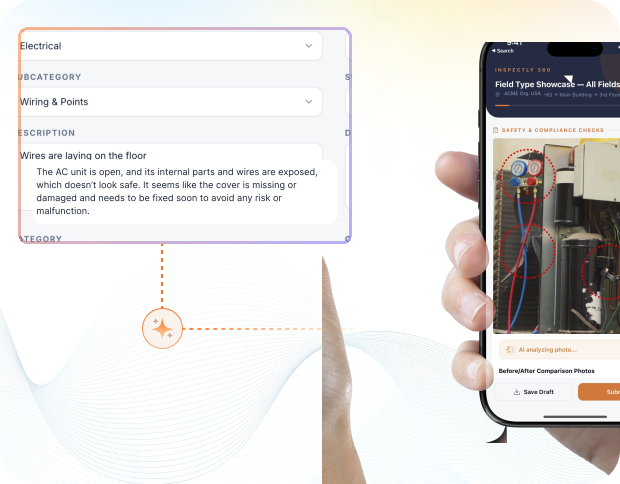
Take a Photo. AI Fills the Form
Your inspector takes a photo of any asset or defect. AI reads it and fills the inspection form automatically. No typing. No manual entry.

Convert your checklist into Mobile App
Airport operations audit software is the platform airside safety managers, compliance leads, and contract oversight teams use to run safety self-audits and oversee contractors across the airport. Inspectly360 digitises Part 139 safety self-audits, contractor and ground-handler oversight, vehicle and driver permit checks, finding management, and corrective action in one record aligned to FAA 14 CFR Part 139 and ICAO Annex 14.
Everything your field team does on paper, Inspectly360 does automatically: faster, more accurate, and without the admin.
Your inspector takes a photo of any asset or defect. AI reads it and fills the inspection form automatically. No typing. No manual entry.
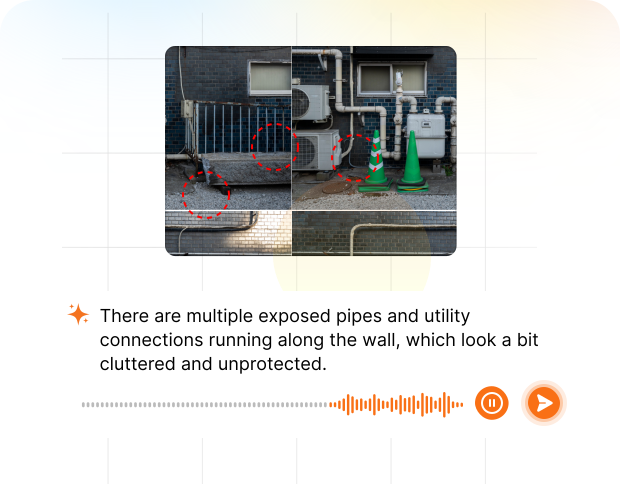
Inspectors speak their observations in any language. AI transcribes and fills the form in real time. Completely hands-free in the field.
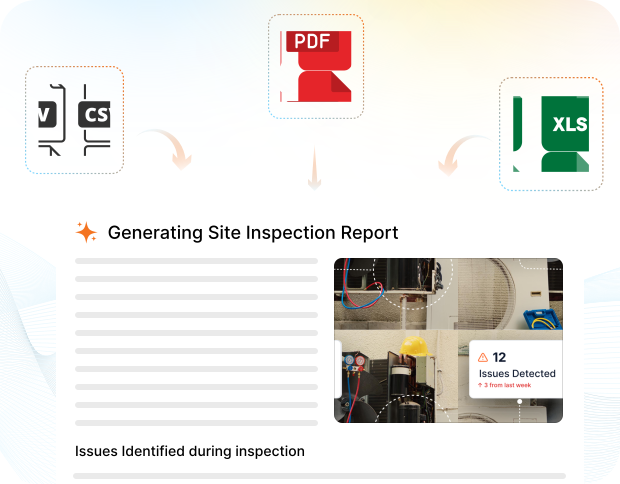
The moment an inspection is submitted, a branded PDF, Excel, or CSV report generates automatically. No manual work. No waiting.

Inspectly360 integrates with the tools your team already uses, including Zoho, Microsoft 365, and SAP. No double entry.
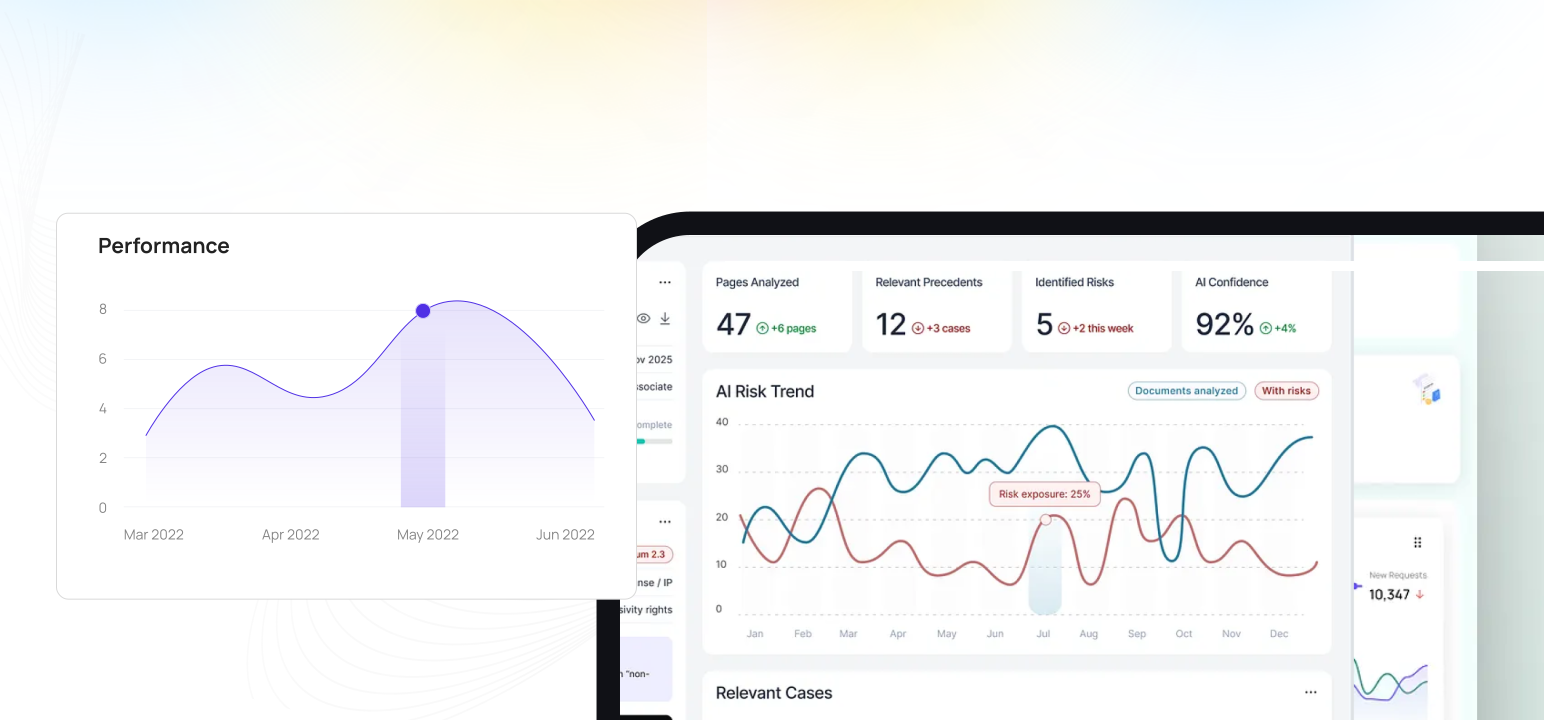
Your operations team sees completion rates, open issues, and compliance scores across all sites in real time. No chasing updates.
What changes once airport operations audit software runs on one mobile-first platform with photo proof and live dashboards.
Airport operations audit software is the platform airside safety managers, compliance leads, and contract oversight teams use to run safety self-audits and oversee contractors across the airport. Inspectly360 digitises Part 139 safety self-audits, contractor and ground-handler oversight, vehicle and driver permit checks, finding management, and corrective action in one record aligned to FAA 14 CFR Part 139 and ICAO Annex 14.
Today the self-audit plan sits in a spreadsheet that drifts, contractor oversight happens by email with no consistent record per provider, and a finding is emailed with no root cause and no tracked corrective action. When a vehicle permit lapses, or a corrective action slips past its deadline, nobody sees it until a Part 139 certification review or an internal audit surfaces the gap. Across an airport with many contractors, handlers, and operational areas, audit and oversight records live in different formats, so the safety manager cannot see true status in one place.
Inspectly360 replaces that with structured audit and oversight on iOS and Android: auditors run safety self-audits against the relevant standard on mobile, each contractor and handler is audited on a shared template with findings tracked per provider, and permit checks carry expiry tracking. Findings carry root cause, a corrective action, an owner, and a deadline, and a branded evidence pack exports per audit when the Part 139 inspector asks, with the same structure across every area and provider.
Safety and oversight teams follow this loop for safety self-audits, contractor oversight, and corrective action closure.
Define the self-audit scope by area, process, or provider against the relevant Part 139 requirement, and schedule it with reminders.
Auditors complete the safety self-audit or contractor audit against each requirement on mobile, capturing photos and conformity status.
Vehicle and driver permits and contractor conformity are checked, with expiry tracked so a lapsing permit is flagged early.
Each finding records root cause and a corrective action with a named owner and a closure deadline tied to the provider or area.
Open findings and overdue actions roll up airport-wide, and a branded evidence pack exports per audit for the Part 139 inspector.
Answers to common long-tail questions, kept on one canonical page to avoid thin duplicate URLs.
Start with one program, such as airside safety self-audit or ground-handler oversight, so the audit template, permit checks, and corrective action workflow are validated against real audits before extending across the airport.
Auditors get audit execution, contractors get their findings and corrective actions, and the airside safety manager gets airport-wide audit status through role-based access.
The platform capabilities that power airport operations audit software across every site.
Safety self-audits are scheduled per area and process with reminders so the plan stays on track. Why it matters: a missed self-audit is itself a finding at a Part 139 certification review.
Each contractor and ground handler is audited on a shared template with findings tracked per provider. Why it matters: consistent oversight across providers is hard to prove from scattered emails.
Airside vehicle and driver permits are checked with expiry tracking. Why it matters: an out-of-permit vehicle or untrained driver airside is a real safety and certification risk.
Each finding records root cause and a corrective action with an owner and deadline. Why it matters: a finding emailed with no corrective action stays open until the next review.
Open findings, overdue actions, and audit completion roll up across areas and providers. Why it matters: the safety manager sees true status without chasing auditors and contractors.
A branded evidence pack exports per audit and provider. Why it matters: a Part 139 inspector request becomes a minutes-long export, not a drive search.
Airside safety managers and compliance leads comparing Inspectly360 to Word audit reports, spreadsheet finding logs, and email oversight see the difference fastest on safety self-audit scheduling, contractor and permit checks, finding to corrective action, closure verification, and airport-wide audit status aligned to FAA 14 CFR Part 139 and ICAO Annex 14.
| Topic | Typical Gaps | With Inspectly360 |
|---|---|---|
| Safety self-audit scheduling | The self-audit plan lives in a spreadsheet that drifts as areas and auditors change. | Self-audits are scheduled per area and process with reminders so the plan stays on track. |
| Contractor and ground-handler oversight | Contractor oversight happens by email with no consistent audit record per provider. | Each contractor and handler is audited on a shared template with findings tracked per provider. |
| Vehicle and driver permit checks | Airside vehicle and driver permits are checked on paper with no central expiry view. | Permit checks are logged with expiry tracking so an out-of-permit vehicle is flagged early. |
| Finding to corrective action | A finding is emailed with no root cause field and no tracked corrective action or deadline. | Each finding carries root cause, an owner, a corrective action, and a closure deadline. |
| Evidence for the Part 139 inspector | Audit reports and closure proof are searched across drives when the FAA inspector asks. | A scoped, timestamped evidence pack exports per audit and provider in minutes. |
What changes once airport operations audit software is standardised on Inspectly360.
Get started with inspection and audit checklist templates.

Use this template to perform a comprehensive safety inspection of light vehicles. This check ensures all critical components are checked ...
Use these apps to run inspections and audits.

by Inspectly360
Streamline facilities inspections with forms, photos, and reports.

by Inspectly360
Building condition and compliance inspections with evidence and follow-ups.

by Inspectly360
Digitize building inspection apps workflows with forms, evidence capture, and automated reporting.

by Inspectly360
Run building inspections on phones and tablets with offline forms, photo evidence, and instant reports.

by Inspectly360
Audit buildings with structured scoring, photo evidence, and corrective action tracking across portfolios.
The platform structures safety self-audits around the requirements a certificated airport must meet, with each audit scheduled, executed against the standard, and evidenced with photos and conformity status. Findings map to the affected requirement and carry root cause, a corrective action, an owner, and a deadline tracked to verified closure. When a Part 139 certification review approaches, the airside safety manager exports a scoped evidence pack per audit in minutes, showing the self-audits completed and the findings closed. This turns certification readiness into a continuous record rather than a scramble, and it makes recurring findings visible across areas and providers so systemic issues are addressed before the FAA inspector finds them.
Each contractor and ground handler is audited on a shared template, so oversight is consistent rather than scattered across emails per provider. Findings are tracked per provider with root cause and corrective action, and the dashboard shows which providers have open findings or overdue actions. Permit and conformity checks sit alongside the audit record. This gives the contract oversight team an objective, comparable view of how each provider performs over time, instead of relying on informal email follow-ups. When the FAA or an internal review asks how contractors are overseen, the evidence is a structured audit history per provider rather than a search through inboxes and attachments.
Airside vehicle and driver permit checks are logged in the platform with their expiry dates, so an approaching or lapsed permit is flagged before the vehicle or driver operates out of permit. Because the checks are recorded against the vehicle and driver, the safety team has a central view of permit currency rather than relying on paper checks with no expiry visibility. An out-of-permit vehicle or untrained driver airside is a genuine safety and certification risk, and tracking expiry turns it into a planned renewal rather than a finding discovered during an audit. The permit history also forms part of the evidence available for a Part 139 review.
Yes. Audit execution works fully offline on iOS and Android, which matters airside, in remote facilities, and in areas with weak signal. An auditor completes the safety self-audit or contractor audit against each requirement, captures photos, checks permits, and records conformity while offline. The audit syncs automatically once the device reconnects, and the timestamp reflects when it was conducted. Nothing is lost if an audit runs in a low-connectivity location. This keeps the audit trail accurate and defensible for Part 139 and internal review, and it lets auditors work the same way in the terminal, on the airfield, or at a contractor facility without depending on connectivity.
Because every finding records root cause and links to a requirement, the platform surfaces when the same non-conformity appears across areas or providers, or recurs over time. The airside safety manager sees the pattern on the dashboard rather than discovering it at the next certification review. Corrective actions target the root cause, so a systemic issue, such as a recurring permit gap with one handler, is addressed at the source rather than re-noted at each audit. This is the difference between treating each finding as an isolated email and managing findings as data that shows where a process or a provider, not a single audit, needs to change.
Every self-audit, contractor audit, permit check, finding, and closure is stored with a timestamp, the named auditor and owner, and supporting photos against the specific area, provider, or requirement. When the FAA inspector asks for records, you export a scoped, branded evidence pack per audit and provider covering the window in minutes. The trail shows the audit scope, the findings raised, the corrective actions taken, and the verified closure of each one, plus permit currency. This replaces the search across drives and inboxes that Word reports and spreadsheet logs force, and because every audit used the same templates, the evidence is consistent across areas and providers.
Airport Operations Audit Software on Inspectly360 connects directly to the inspection apps, checklist templates, forms, industries, and adjacent solutions linked below.
See Inspectly360 in action with a live demo tailored to your needs. No credit card required.