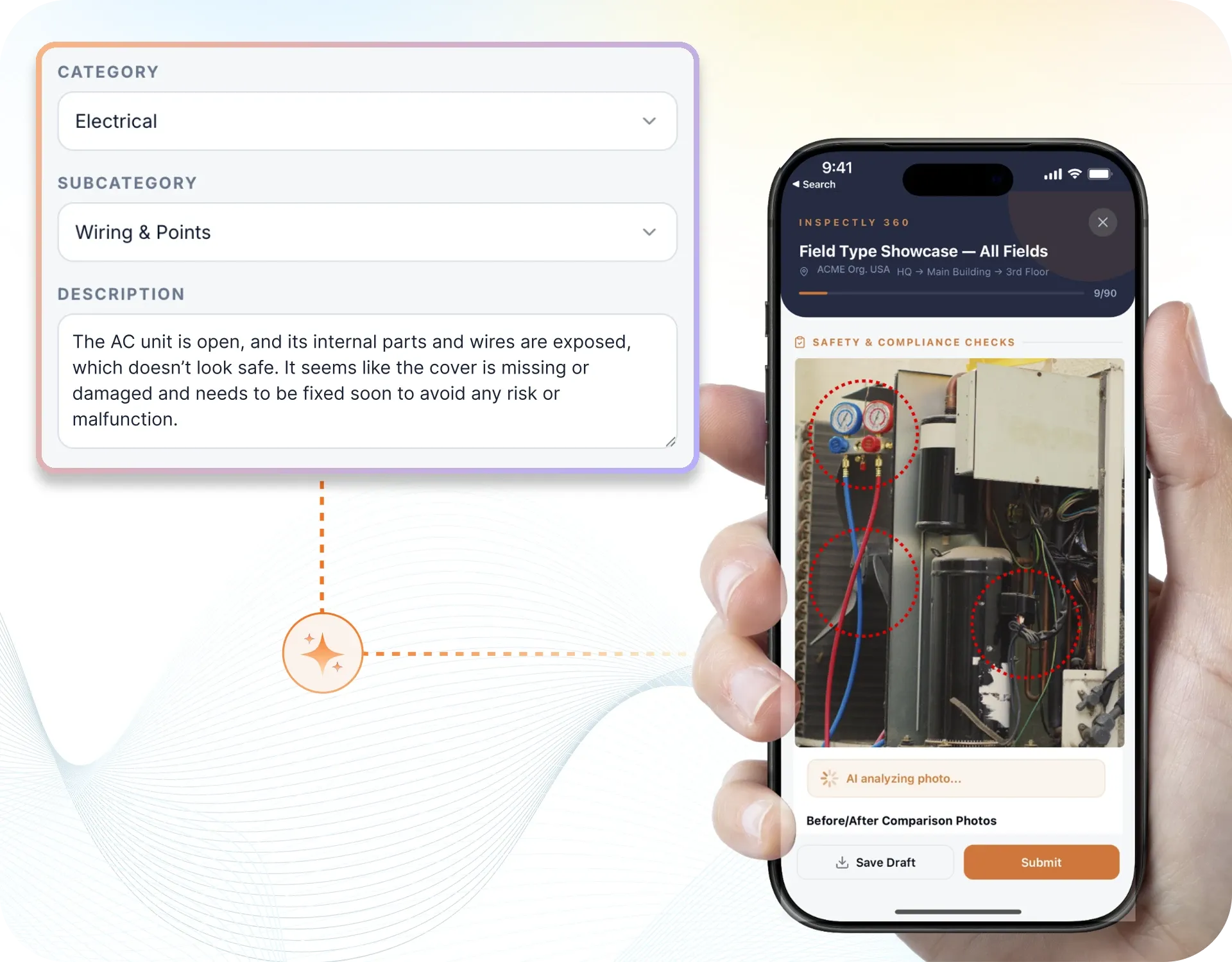
Take a Photo. AI Fills the Form
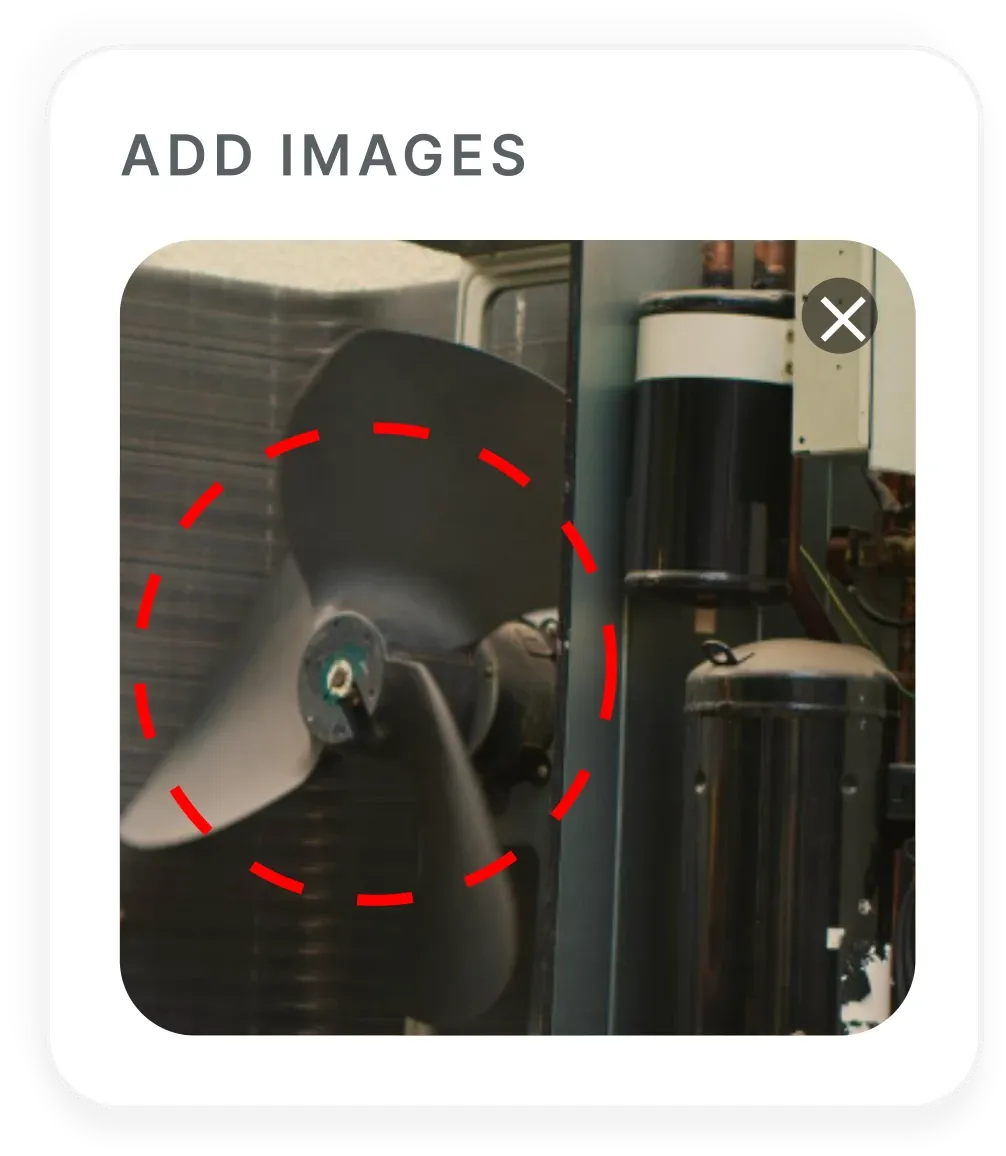
Your inspector takes a photo of any asset or defect. AI reads it and fills the inspection form automatically. No typing. No manual entry.

Convert your checklist into Mobile App
De-icing vehicle inspection software for GSE technicians, ramp operations managers, and de-icing operators running daily pre-use field checks on fluid tanks, heaters, booms, baskets, and nozzles across the de-icing rig fleet.
De-Icing Vehicle Inspection Software runs a structured de icing inspection covering fluid tanks and pumps, spray booms and nozzles, boom controls and hydraulics, fluid concentration and heating, and chassis, brakes, and lights, with a photo and a sign-off required on each point.
Available on Mobile
Inspect on iOS and Android with no internet required. Capture photos, let AI flag defects, and generate audit-ready reports in the field.
De-Icing Vehicle Inspection Software keeps one record per de icing and per site, with photo evidence and a named sign-off. Each de icing finding is tracked to verified closure. Airside de-icing crews see de icing completion and overdue actions across the aviation portfolio. Every de icing record proves what was checked, when, and by whom. It covers Inspection History, Maintenance Schedule, Fault Code, DVIR, and more.
What changes once de-icing vehicle inspection software runs on one mobile-first platform.
De-Icing Vehicle Inspection Software runs as a short loop: configure the de icing template, capture in the field, route findings to verified closure, then report performance to airside de-icing crews.
Your de icing controls become a mobile template with required photos and readings on fluid tanks and pumps, spray booms and nozzles, boom controls and hydraulics, fluid concentration and heating, and chassis, brakes, and lights, aligned to SAE AS6285, and ISO 45001, so every site inspects to the same standard from day one.
Inspectors complete the de icing inspection on iOS or Android, offline where signal is poor, recording fluid concentration record, spray pattern photo, and defect log against each point before a named sign-off can close the round.
A failed item such as blocked or worn nozzle becomes an owned task with a severity and a deadline, and stays open until photo proof of the fix is reviewed, so de icing defects do not resurface unnoticed.
Every de icing inspection feeds live dashboards and branded exports, so airside de-icing crews see completion, overdue actions, and risk per site without assembling a report by hand.
A de icing inspection covers fluid tanks and pumps, spray booms and nozzles, boom controls and hydraulics, fluid concentration and heating, and chassis, brakes, and lights. Airside de-icing crews capture a photo and a reading on each de icing point. They work offline where signal is poor, then sign the de icing round off. So every de icing record proves what was checked, when, and by whom.
Templates align to SAE AS6285, ISO 45001.
Everything your field team does on paper, Inspectly360 does automatically: faster, more accurate, and without the admin.
Your inspector takes a photo of any asset or defect. AI reads it and fills the inspection form automatically. No typing. No manual entry.
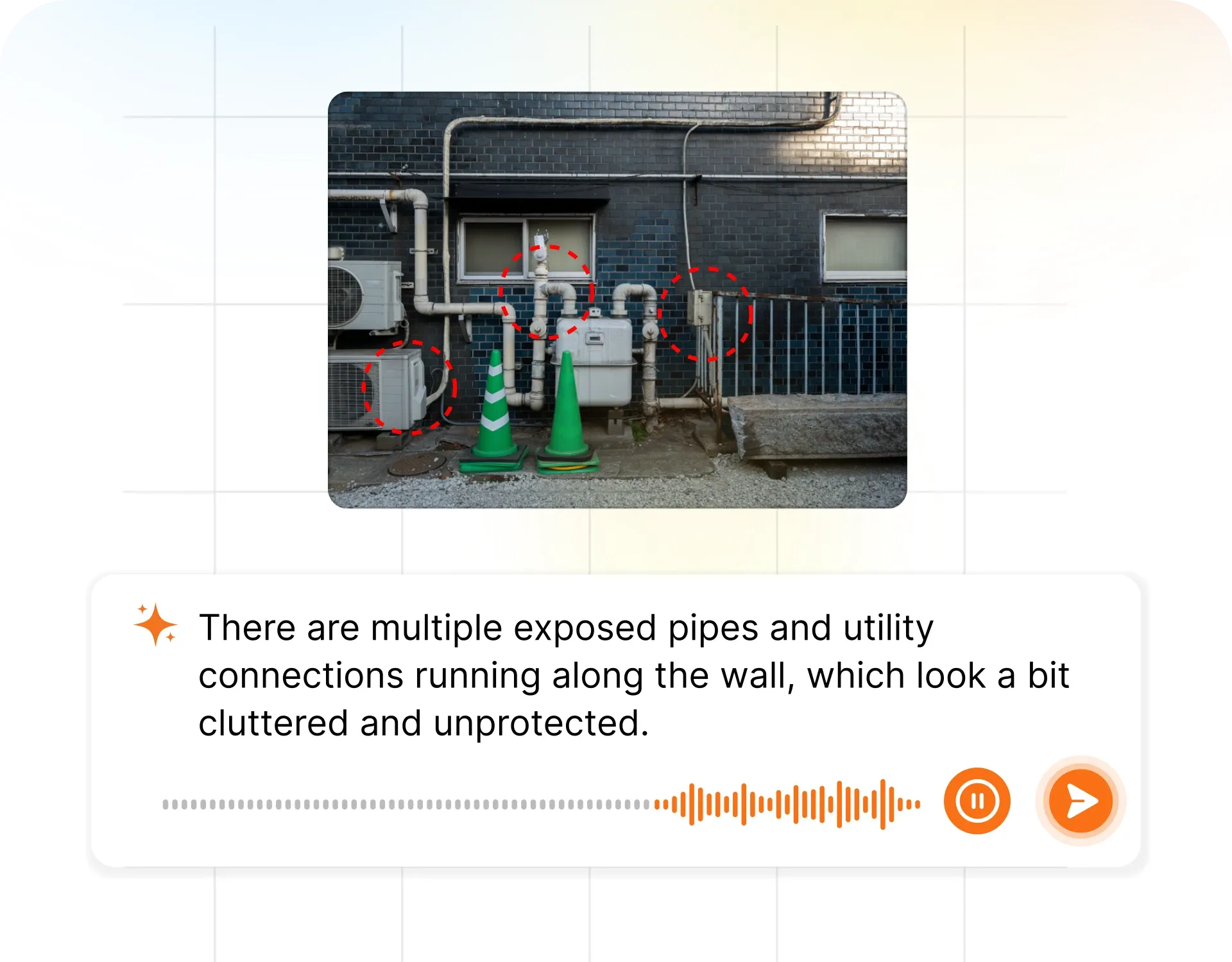
Inspectors speak their observations in any language. AI transcribes and fills the form in real time. Completely hands-free in the field.
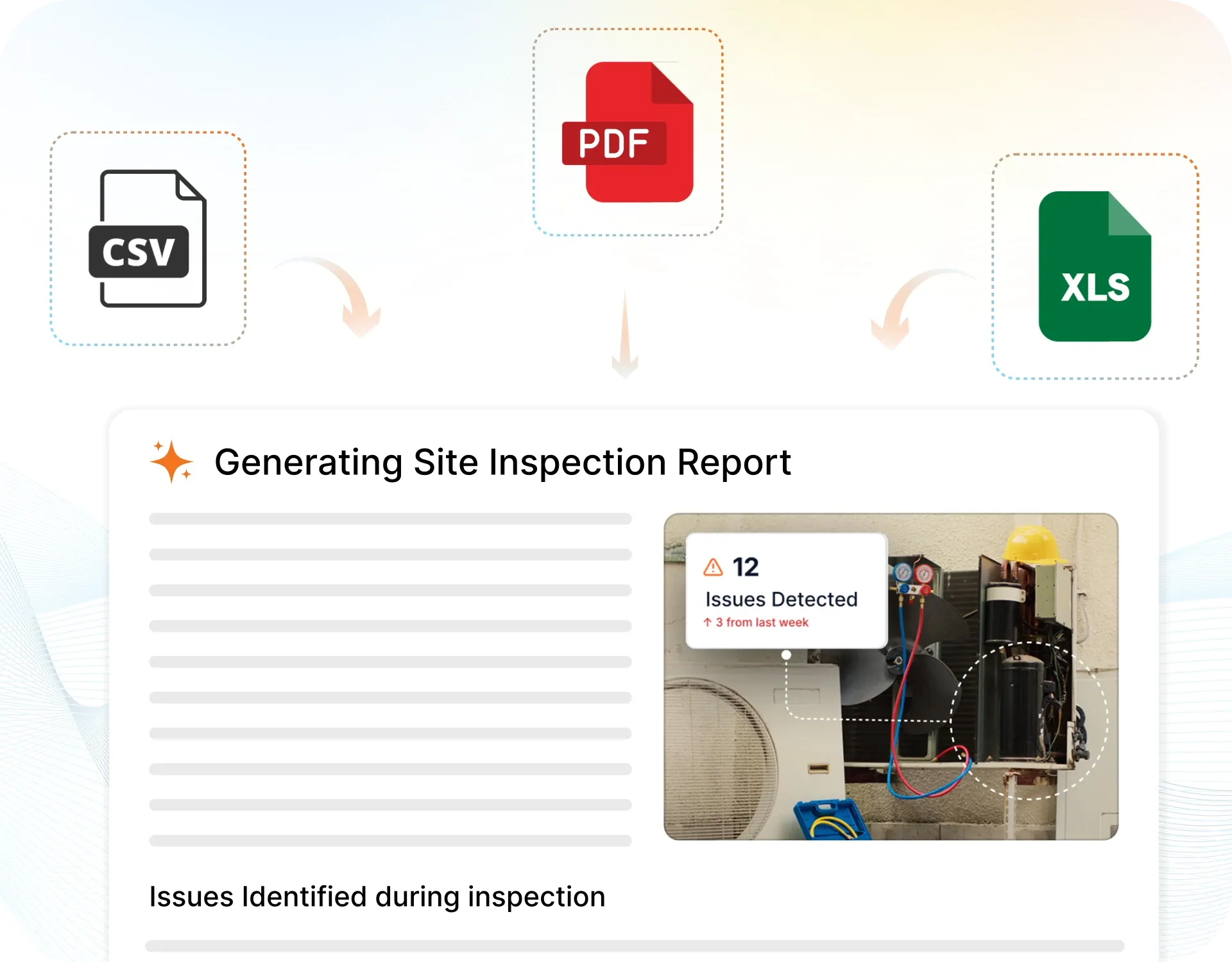
The moment an inspection is submitted, a branded PDF, Excel, or CSV report generates automatically. No manual work. No waiting.

Inspectly360 integrates with the tools your team already uses, including Zoho, Microsoft 365, and SAP. No double entry.
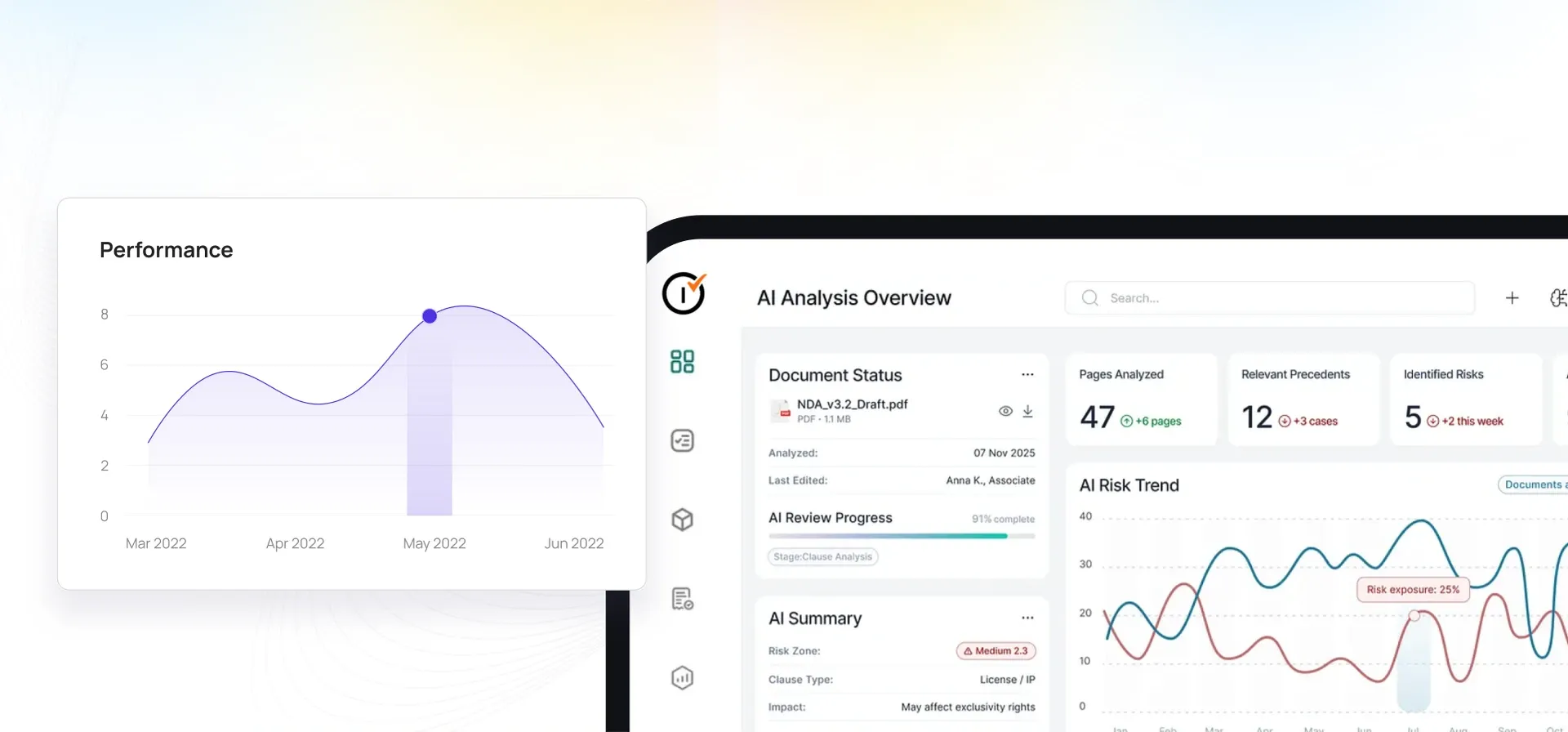
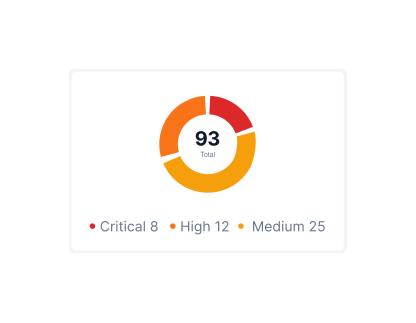
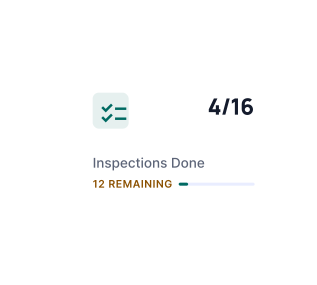
Your operations team sees completion rates, open issues, and compliance scores across all sites in real time. No chasing updates.
Manage every checklist in one connected workspace, capture evidence on mobile at the point of work, and let AI turn field inputs into clear, stakeholder-ready reports in minutes.


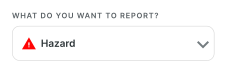
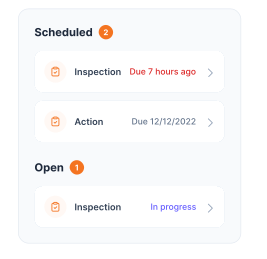
See which checklists your team has in progress across every site, jump into the same inspection with one tap, and keep field, supervisor, and back-office views in sync without sending screenshots on WhatsApp.


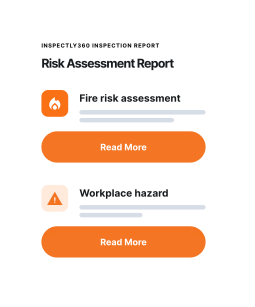
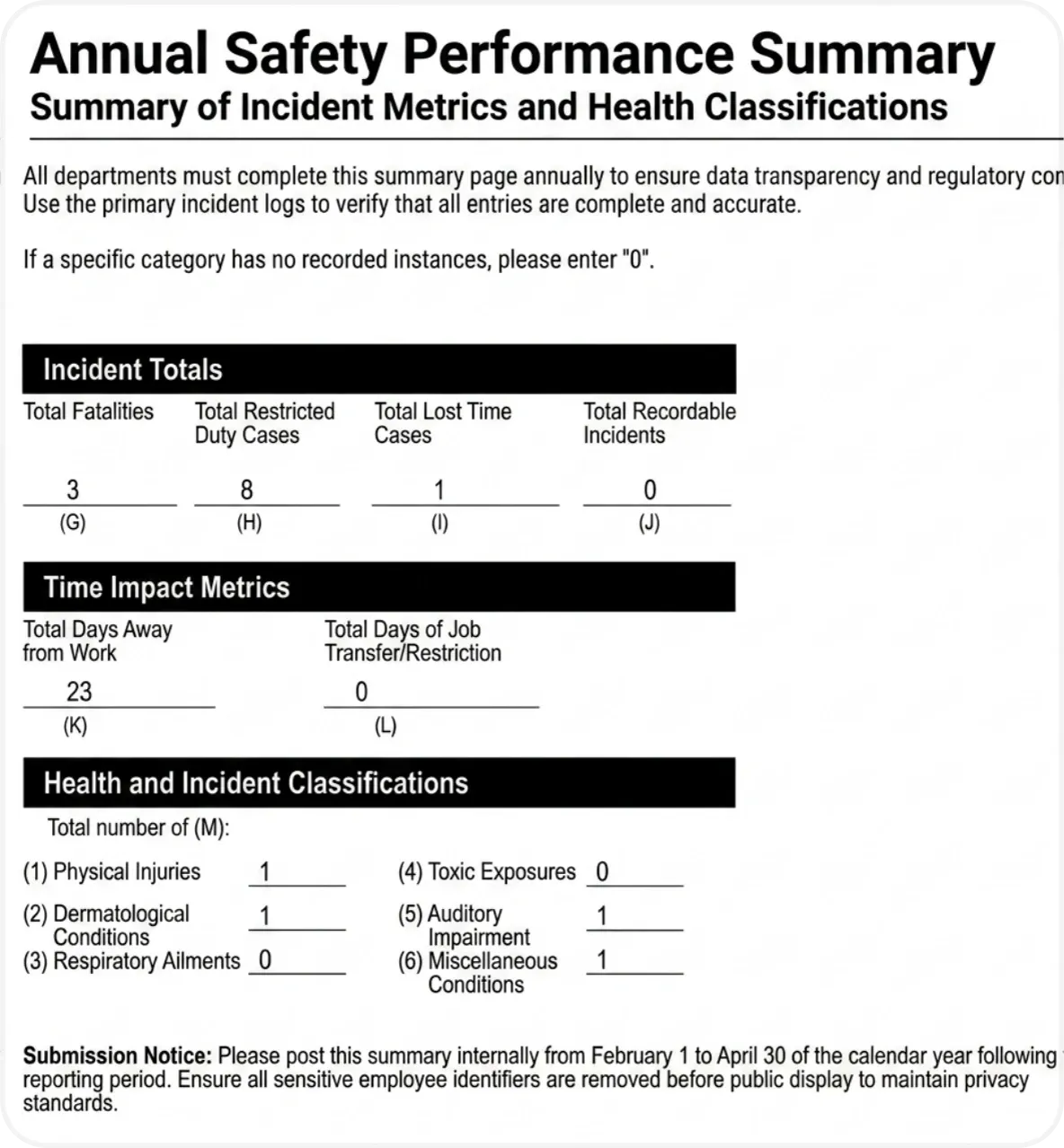


Every team reports differently. Build the report your operations, quality, or compliance leads actually want to read, share it as a branded PDF, and schedule delivery to the stakeholders who need it.


See completion, pass rate, and recurring findings across every checklist and every site, without pulling spreadsheets together at the end of the month.
What changes once de-icing vehicle inspection software is standardised on Inspectly360.







“Inspectly360 transformed how we manage site safety inspections. The offline capability alone saved us countless hours. Our compliance rate jumped from 72% to 96% in just three months.”
Sarah Mitchell
Meridian Construction Group

“The AI-powered defect detection has changed how we work. Our inspectors capture photos and the system flags issues we'd have missed. It's like having an expert reviewer on every site visit.”
James Chen
Pacific Manufacturing Co.
“Rolling out digital checklists across multiple projects gave us instant visibility into recurring safety issues. We now resolve critical findings in hours instead of days.”
Olivia Carter
Northbridge Infrastructure
Get started with inspection and audit checklist templates.

Use this template to perform a comprehensive safety inspection of light vehicles. This check ensures all critical components are checked ...
Use these apps to run inspections and audits.

by Inspectly360
Simplify facilities inspections with forms, photos, and reports.

by Inspectly360
Building condition and compliance inspections with evidence and follow-ups.

by Inspectly360
Digitize building inspection apps workflows with forms, evidence capture, and automated reporting.

by Inspectly360
Run building inspections on phones and tablets with offline forms, photo evidence, and instant reports.

by Inspectly360
Audit buildings with structured scoring, photo evidence, and corrective action tracking across portfolios.
De-Icing Vehicle Inspection Software runs a structured de icing inspection covering fluid tanks and pumps, spray booms and nozzles, boom controls and hydraulics, fluid concentration and heating, and chassis, brakes, and lights. Each de icing point is captured on mobile with a photo and a reading. A named inspector then signs the de icing round off before it can close. The same de icing template runs on every site, giving airside de-icing crews one standard. Every de icing record proves what was checked, when, and by whom.
De icing inspection frequency depends on duty, risk, and your de icing standard. Some de icing checks are daily or pre-use. Others run weekly, monthly, or at a statutory interval. De-Icing Vehicle Inspection Software sets the de icing cadence per site and reminds airside de-icing crews before a round is due. It flags overdue de icing checks automatically. Each de icing round is timestamped and signed, so the schedule is provably kept. De-Icing Vehicle Inspection Software lets aviation teams run de-icing vehicle inspections the same way on every visit, with photos and a sign-off on each de-icing vehicle.
The inspection targets the de icing failures that matter most: blocked or worn nozzle, pump failure, incorrect fluid mix, and boom hydraulic fault. Left unchecked, a de icing fault such as blocked or worn nozzle causes real harm. It can mean downtime, a safety incident, or a failed de icing audit. So every de icing finding becomes an owned task with a deadline. It stays open until photo proof of the de icing repair is reviewed. Repeat de icing failures are flagged, so airside de-icing crews fix the cause.
De-Icing Vehicle Inspection Software keeps de icing checks aligned to SAE AS6285, and ISO 45001. The photos and readings each de icing standard expects are required fields. So an incomplete de icing check cannot close. A de icing gap is caught before an assessor finds it. When a review is due, airside de-icing crews export a branded de icing pack built from fluid concentration record, spray pattern photo, and defect log. So de icing evidence stays defensible at any time.
Yes. Inspectors complete de icing checks on iOS or Android with no signal. They capture fluid concentration record, spray pattern photo, and defect log at the de icing in the field. Each de icing record syncs when the connection returns, with its timestamp intact. The same de icing template runs on every site. So airside de-icing crews get a live view of de icing work that is complete, overdue, or failing per location. De-Icing Vehicle Inspection Software lets aviation teams run de-icing vehicle inspections the same way on every visit, with photos and a sign-off on each de-icing vehicle.
Every de icing inspection carries fluid concentration record, spray pattern photo, and defect log, a GPS location, a timestamp, and a named sign-off. The de icing evidence is captured on the round, not typed up later. So airside de-icing crews show exactly what was checked on the de icing, when, and by whom. When an assessor asks, that de icing record exports in seconds. It comes out as a branded PDF or a searchable de icing history. De-Icing Vehicle Inspection Software lets aviation teams run de-icing vehicle inspections the same way on every visit, with photos and a sign-off on each de-icing vehicle.
See Inspectly360 in action with a live demo tailored to your needs. No credit card required.