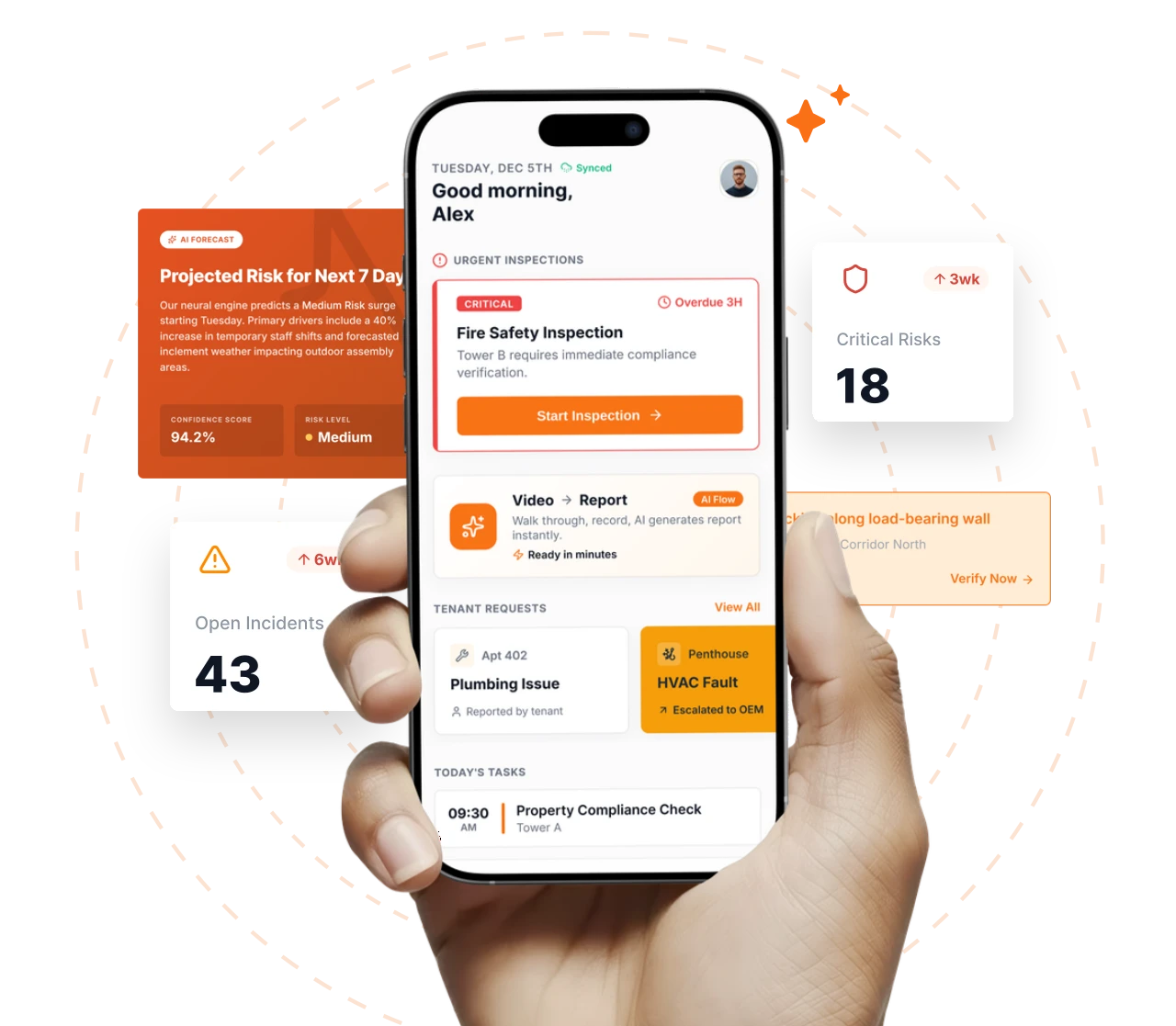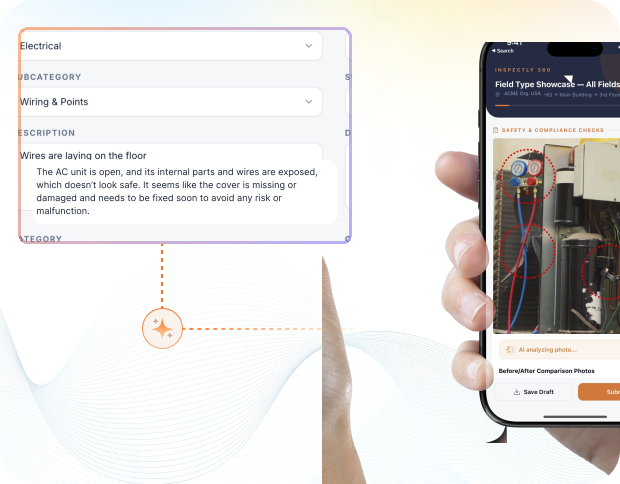
Take a Photo. AI Fills the Form
Your inspector takes a photo of any asset or defect. AI reads it and fills the inspection form automatically. No typing. No manual entry.

Convert your checklist into Mobile App
Fuel truck audit software is the platform quality leads, station auditors, and fuelling supervisors use to build evidence packs and keep traceable findings across the refueller fleet. Inspectly360 digitises audit checklists, finding-to-action traceability, corrective action tracking, and the auditor sign-off records that ATA 103, JIG, and ISAGO programmes require for aviation fuelling.
Everything your field team does on paper, Inspectly360 does automatically: faster, more accurate, and without the admin.
Your inspector takes a photo of any asset or defect. AI reads it and fills the inspection form automatically. No typing. No manual entry.
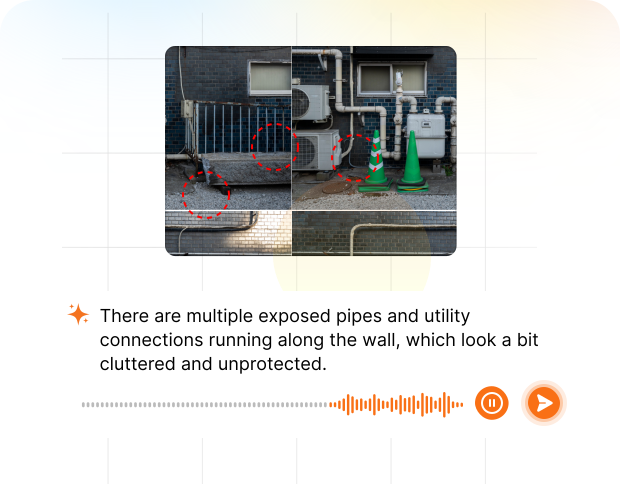
Inspectors speak their observations in any language. AI transcribes and fills the form in real time. Completely hands-free in the field.
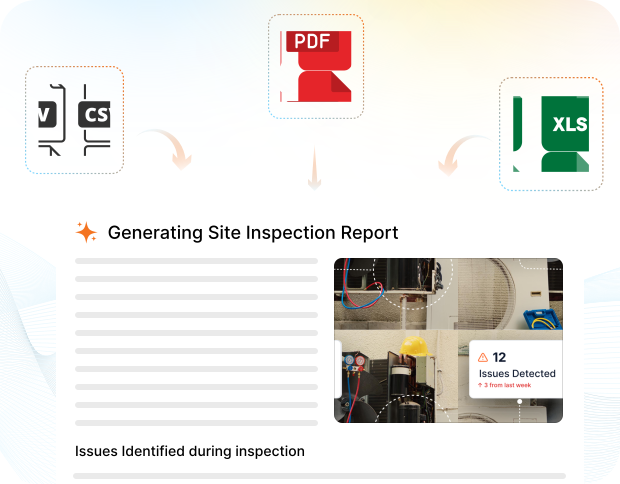
The moment an inspection is submitted, a branded PDF, Excel, or CSV report generates automatically. No manual work. No waiting.

Inspectly360 integrates with the tools your team already uses, including Zoho, Microsoft 365, and SAP. No double entry.
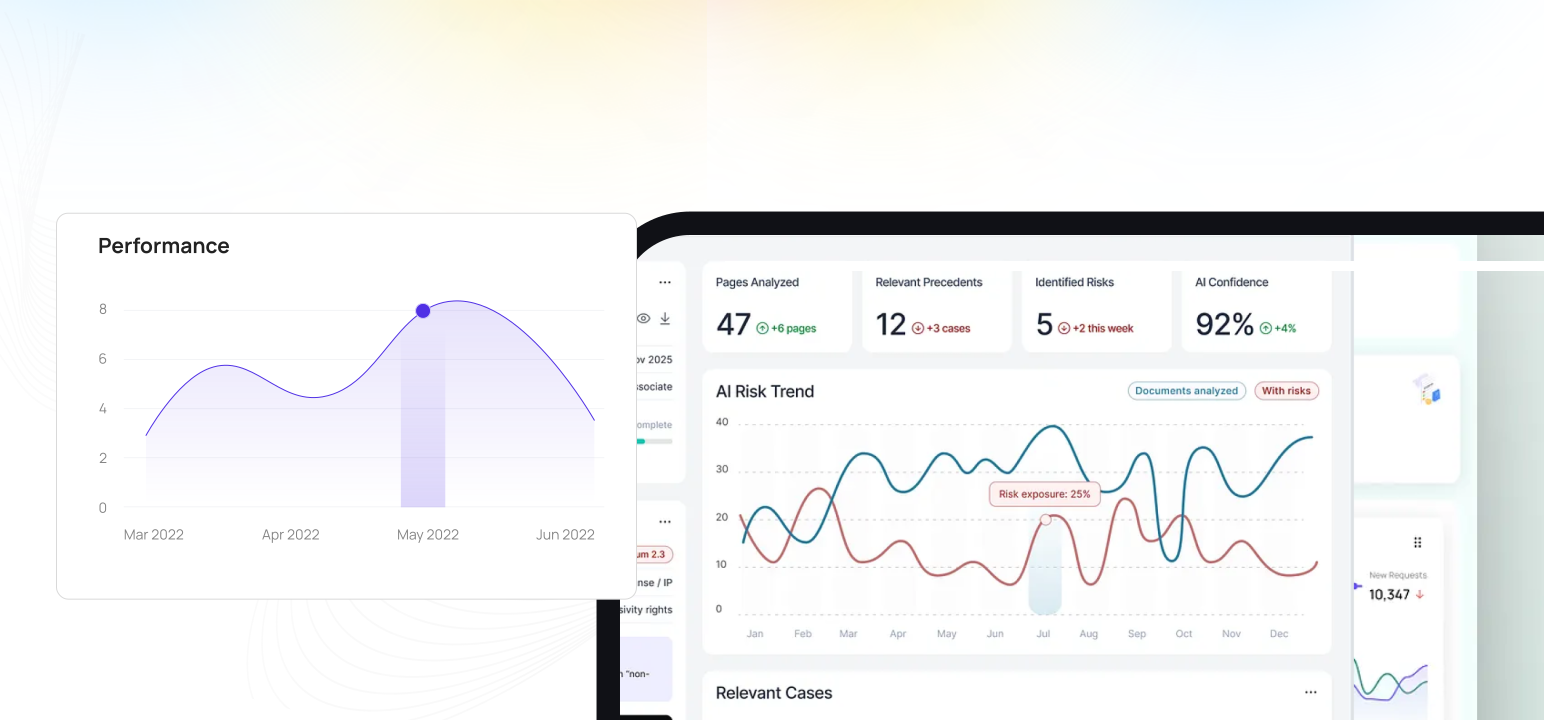
Your operations team sees completion rates, open issues, and compliance scores across all sites in real time. No chasing updates.
What changes once fuel truck audit software runs on one mobile-first platform with photo proof and live dashboards.
Fuel truck audit software is the platform quality leads, station auditors, and fuelling supervisors use to build evidence packs and keep traceable findings across the refueller fleet. Inspectly360 digitises audit checklists, finding-to-action traceability, corrective action tracking, and the auditor sign-off records that ATA 103, JIG, and ISAGO programmes require for aviation fuelling. Fuel truck audit software for quality leads and station auditors building evidence packs and traceable findings for ATA 103, JIG, and ISAGO audits across the refueller fleet.
Today an audit finding is written on a checklist, the fuel quality evidence is gathered from cards and email the week before the auditor arrives, and the proof a corrective action was completed is a claim with no fix attached. When a finding loses its link to the refueller, an action has no owner, or a closure is claimed without evidence, the next audit reopens the same gap. Across several stations every auditor records findings a little differently, so the quality lead cannot say whether the fuelling operation is audit-ready.
Inspectly360 replaces that with mobile capture on iOS and Android: each finding links to the unit, the standard clause, and photo evidence, corrective actions carry owners and deadlines, and a scoped evidence pack assembles itself from timestamped records as the audit is conducted. Closures carry verified sign-off and the named auditor, and a branded audit pack exports per unit or station when an ATA 103, JIG, or ISAGO auditor or the operator asks for the trail.
Quality and audit teams follow this loop for conducting audits, raising findings, and closing corrective actions.
Auditors work the ATA 103, JIG, and ISAGO checklist on mobile against each refueller, capturing results and photo evidence as they go.
Across the fuel truck audit portfolio, each finding links to the unit, the standard clause, the evidence, and a severity so nothing loses its context.
On fuel truck audit programmes, each corrective action carries an owner and a deadline so a finding drives a tracked fix, not a note.
For fuel truck audit field teams, the owner completes the action and a named auditor verifies the fix and signs off with evidence attached.
A scoped, branded audit pack exports per unit or station for the JIG, ATA 103, or ISAGO auditor in minutes.
Answers to common long-tail questions, kept on one canonical page to avoid thin duplicate URLs.
Start with a single station so the audit checklists, finding traceability, and corrective action workflow are validated against a real ATA 103 or JIG cycle before rollout to other stations and contracted fuelling companies.
Auditors get audit capture and finding sign-off, action owners get their assigned corrective actions, and the quality lead gets read access to the full audit trail through role-based access.
The platform capabilities that power fuel truck audit software across every site.
Auditors work ATA 103, JIG, and ISAGO checklists on mobile with each item linked to its standard clause. Why it matters: a fuel quality finding tied to the clause it failed is far easier to defend and close than a free-text note.
Each finding links to the refueller, the standard, the evidence, and the corrective action. Why it matters: a finding that loses its context is the one that reopens at the next fuel quality audit.
Each action carries an owner, a deadline, and verified closure with evidence. Why it matters: a closure claimed without proof of the fix is the gap a follow-up JIG or ATA 103 audit exposes.
Across the fuel truck audit portfolio, timestamped records assemble into a scoped pack as the audit is conducted. Why it matters: the auditor receives the evidence in minutes rather than the team scrambling the week before.
Open findings, overdue actions, and readiness roll up across units and stations. Why it matters: the quality lead states fuelling audit readiness without a manual record review.
Every finding and closure carries the named auditor, timestamp, and full history. Why it matters: traceability of who signed what and when is exactly what an ISAGO or JIG auditor checks.
Quality leads and station auditors comparing Inspectly360 to paper audit checklists, spreadsheet findings, and email evidence trails see the difference fastest on traceable findings, evidence pack assembly, corrective action tracking, auditor sign-off records, and fleet-wide audit readiness aligned to IATA ISAGO, JIG, and ATA 103 fuel quality control.
| Topic | Typical Gaps | With Inspectly360 |
|---|---|---|
| Traceable audit findings | A finding is written on a checklist and loses the link to the refueller, the evidence, and the action. | Each finding links to the unit, the standard, the photo evidence, and the corrective action on one record. |
| Evidence pack assembly | Evidence for a JIG or ATA 103 audit is gathered from cards, drives, and email the week before the auditor arrives. | A scoped evidence pack assembles itself from timestamped records as the audit is conducted. |
| Corrective action tracking | A corrective action is noted but not owned, so closure is claimed without proof of the fix. | Each corrective action carries an owner, a deadline, and verified closure with evidence. |
| Fleet audit readiness | The quality lead cannot say whether the refueller fleet is audit-ready without a manual record review. | A live dashboard shows open findings, overdue actions, and readiness across the fleet. |
| Auditor sign-off and history | Who signed off a finding and when is lost in a paper trail that is hard to reconstruct later. | Every finding and closure carries the named auditor, the timestamp, and the full history. |
What changes once fuel truck audit software is standardised on Inspectly360.
Get started with inspection and audit checklist templates.

Use this template to perform a comprehensive safety inspection of light vehicles. This check ensures all critical components are checked ...
Use these apps to run inspections and audits.

by Inspectly360
Streamline facilities inspections with forms, photos, and reports.

by Inspectly360
Building condition and compliance inspections with evidence and follow-ups.

by Inspectly360
Digitize building inspection apps workflows with forms, evidence capture, and automated reporting.

by Inspectly360
Run building inspections on phones and tablets with offline forms, photo evidence, and instant reports.

by Inspectly360
Audit buildings with structured scoring, photo evidence, and corrective action tracking across portfolios.
Each audit finding links to the refueller it was raised against, the ATA 103, JIG, or ISAGO standard clause it failed, the photo evidence, and the corrective action that addresses it. Because all of that sits on one record, a finding never loses its context the way a free-text note on a paper checklist does. When the auditor or the operator reviews the trail, they see the clause, the evidence, and the fix together. This traceability is what makes a fuel quality finding straightforward to close and to defend, and it prevents the common failure where the same gap reopens at the next audit because nobody could reconstruct what the original finding actually was.
As auditors work the checklist on mobile, every result, photo, finding, and closure is captured with a timestamp against the refueller. Those records assemble into a scoped evidence pack automatically, so the pack reflects the real state of the fleet at any point rather than being built by hand the week before the auditor arrives. When JIG or ATA 103 requests evidence, you export a branded pack per unit or station covering the audit window in minutes. This replaces the gather-from-cards-and-email scramble that paper audits force, and it means the evidence the auditor sees is the same evidence the team has been working from all along.
Yes. Capture works fully offline on iOS and Android, which matters during a station audit where the auditor moves across the fuel farm, the apron, and outstations with weak signal. Auditors complete checklists, raise findings, and attach photos while offline, and records sync automatically once the device reconnects. Nothing is lost if part of the audit is done in a dead spot, and the timestamp reflects when the finding was raised, not when it synced. This keeps the audit trail accurate for the quality lead and for the JIG or ISAGO auditor reviewing the evidence across the fleet and the stations.
Each corrective action raised from a finding carries an owner and a deadline. The action stays open and visible until the owner completes it and a named auditor verifies the fix and signs it off with evidence attached. Because the action is tied to its finding, the trail shows the gap, the action that addressed it, and the proof of the fix together. This closes the common audit failure where a corrective action is claimed as complete without any evidence of the actual fix, which is exactly what a follow-up JIG or ATA 103 audit checks and reopens when the proof is missing, particularly on fuel quality control findings.
Yes. The audit checklists are configurable, so the same platform runs internal quality audits, station self-audits, and the formal ATA 103, JIG, or ISAGO cycle from one record. Internal audits surface and close gaps before the formal audit arrives, and because findings and actions are traceable, the quality lead can show a continuous improvement trail rather than a once-a-year scramble. Running both on the same system means the evidence is consistent, the corrective action history carries across, and the fleet readiness dashboard reflects every audit. This is how a fuelling operation moves from reactive audit preparation to a state of continuous audit readiness.
Every checklist result, finding, corrective action, and closure is stored with a timestamp, the named auditor, the standard clause, and photo evidence against the specific refueller. When the JIG or ISAGO auditor asks for the audit trail, you export a scoped, branded audit pack per unit or station covering the window in minutes. The pack shows findings linked to clauses, corrective actions tracked to verified closure, and the named sign-off and history for each. This replaces the reconstruct-from-paper routine that checklist audits force, and the evidence is consistent across every auditor and station, which is exactly the traceability ATA 103 and JIG assessments are built to test.
Fuel Truck Audit Software on Inspectly360 connects directly to the inspection apps, checklist templates, forms, industries, and adjacent solutions linked below.
See Inspectly360 in action with a live demo tailored to your needs. No credit card required.