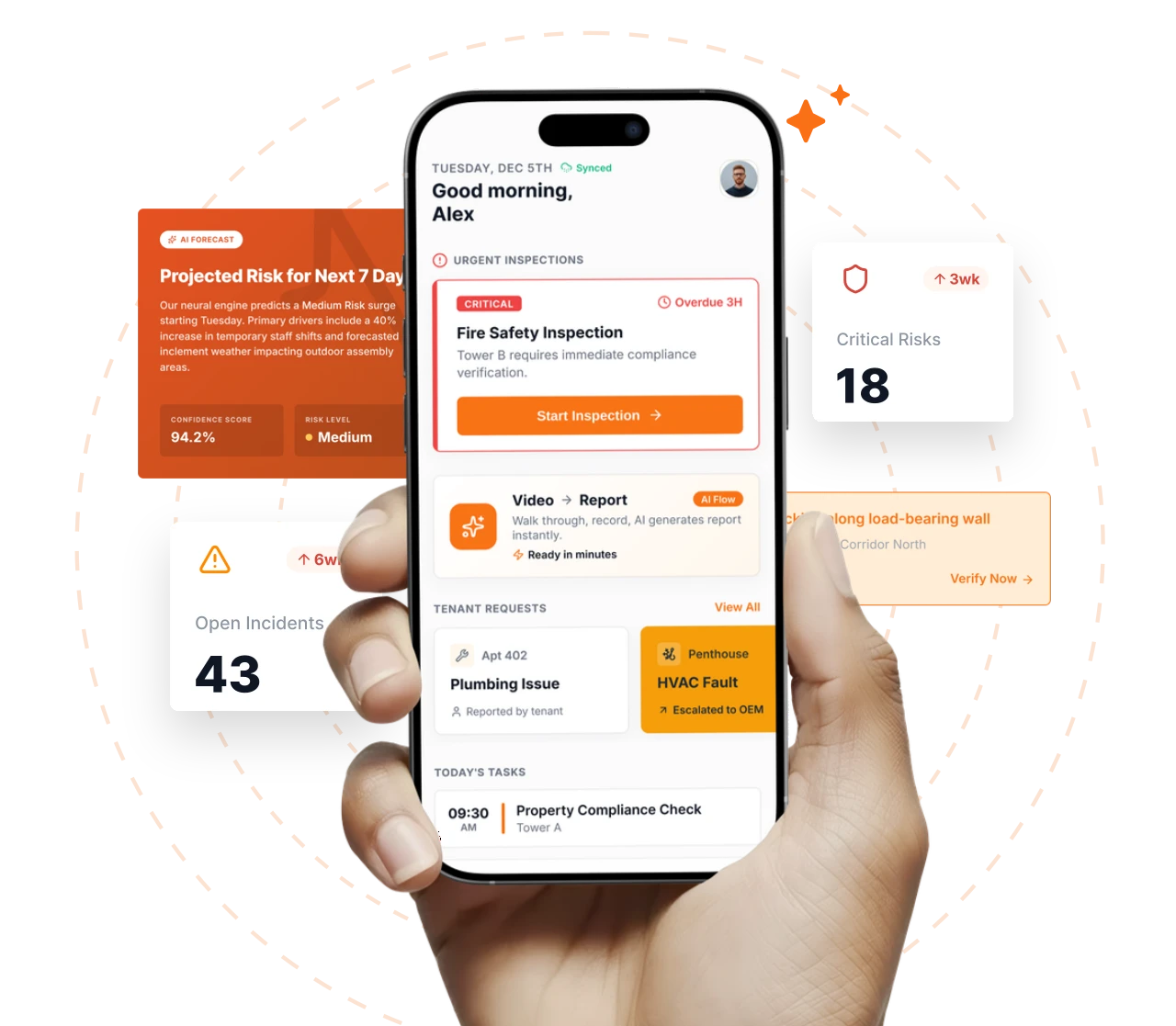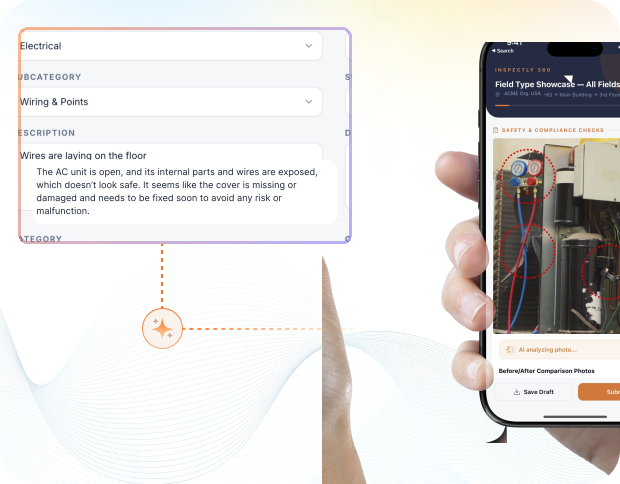
Take a Photo. AI Fills the Form
Your inspector takes a photo of any asset or defect. AI reads it and fills the inspection form automatically. No typing. No manual entry.

Convert your checklist into Mobile App
Gate checklist software is the platform terminal operations managers, ramp teams, and facilities staff use to turn paper stand checklists into controlled mobile templates with photo evidence across a terminal. Inspectly360 digitises checklist templates for FOD walks, 400 Hz ground power, pre-conditioned air (PCA) units, visual docking guidance systems (VDGS), stand markings, and lighting in one platform aligned to EN 12312-4 and airport stand procedures.
Everything your field team does on paper, Inspectly360 does automatically: faster, more accurate, and without the admin.
Your inspector takes a photo of any asset or defect. AI reads it and fills the inspection form automatically. No typing. No manual entry.
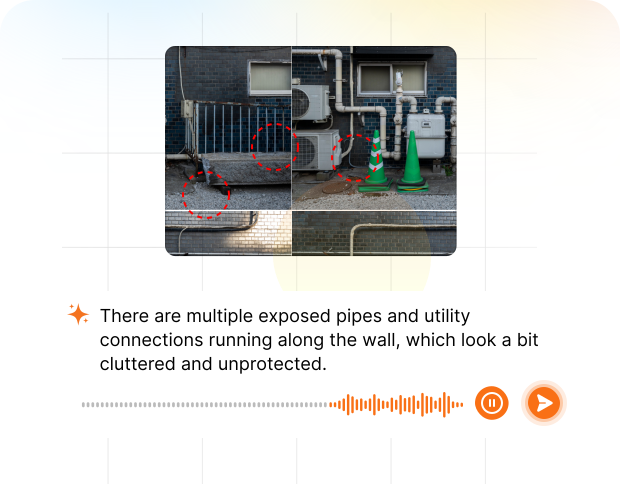
Inspectors speak their observations in any language. AI transcribes and fills the form in real time. Completely hands-free in the field.
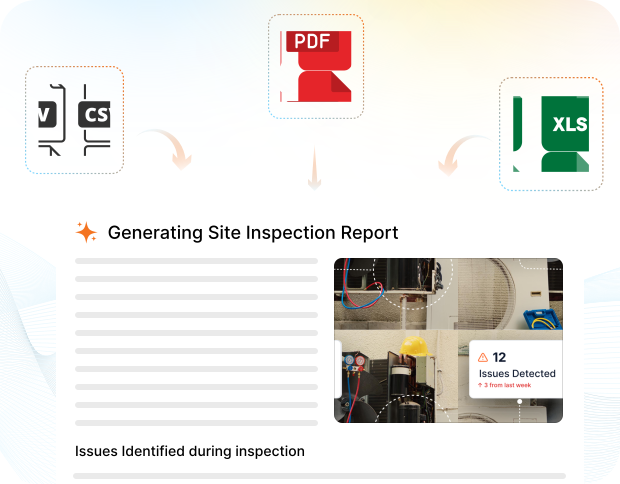
The moment an inspection is submitted, a branded PDF, Excel, or CSV report generates automatically. No manual work. No waiting.

Inspectly360 integrates with the tools your team already uses, including Zoho, Microsoft 365, and SAP. No double entry.
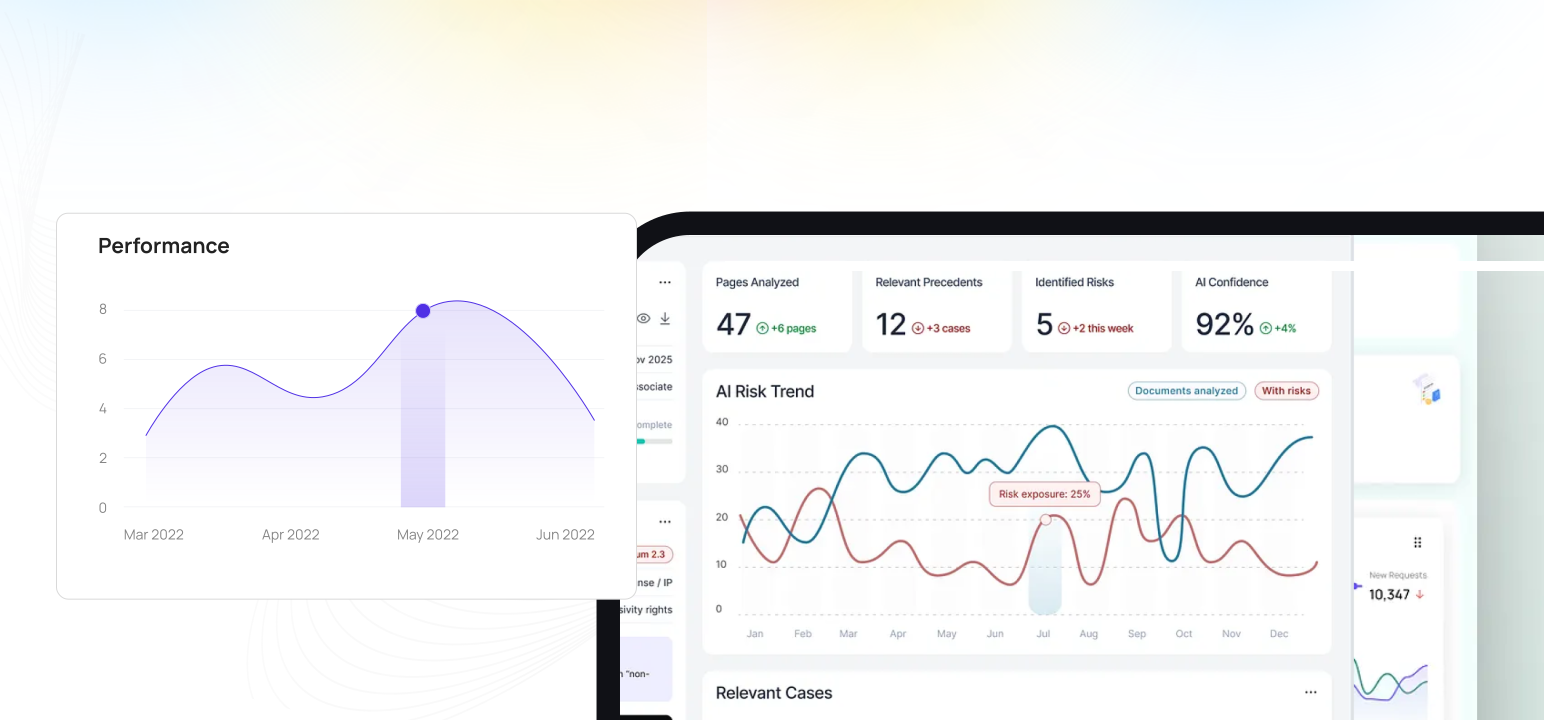
Your operations team sees completion rates, open issues, and compliance scores across all sites in real time. No chasing updates.
What changes once gate checklist software runs on one mobile-first platform with photo proof and live dashboards.
Gate checklist software is the platform terminal operations managers, ramp teams, and facilities staff use to turn paper stand checklists into controlled mobile templates with photo evidence across a terminal. Inspectly360 digitises checklist templates for FOD walks, 400 Hz ground power, pre-conditioned air (PCA) units, visual docking guidance systems (VDGS), stand markings, and lighting in one platform aligned to EN 12312-4 and airport stand procedures.
Today each shift uses a slightly different paper checklist, a tick proves nothing about what the team actually saw, and a failed item has no automatic follow-up. When a stand check is skipped or a defect is ticked and forgotten, nobody knows until a problem appears during a turnaround. Across many stands and shifts, the checklists are not comparable, so the operations manager cannot see which stands were checked or what was found without collecting the sheets and typing them up.
Inspectly360 replaces that with mobile capture on iOS and Android: one controlled template per check type runs the same way on every stand, required photos attach to each item, and a failed item opens a follow-up step and raises a tracked defect with an owner and deadline. Completion is visible live across every stand and shift, and results report automatically per stand and pier with photos and timestamps, so the paper-to-spreadsheet step disappears.
Operations and ramp teams follow this loop for running digital stand checklists, evidencing items, and reporting results.
Convert paper stand checklists for FOD, 400 Hz power, PCA, VDGS, and lighting into controlled mobile templates.
Ramp staff complete the checklist on mobile, attaching the required photo to each item as evidence of condition.
A failed item opens a conditional follow-up step and raises a tracked defect with an owner and deadline.
A live view shows which checklists are done, due, or missed across every stand and shift in the terminal.
Results report per stand and pier with photos and timestamps, removing the paper-to-spreadsheet step.
Answers to common long-tail questions, kept on one canonical page to avoid thin duplicate URLs.
Start with a single pier so the checklist templates and follow-up steps are validated against real stand checks before rollout to other piers and remote stands.
Ramp staff get checklist capture, supervisors get completion visibility, and the operations manager gets read access to results across every stand through role-based access.
The platform capabilities that power gate checklist software across every site.
One controlled template per check type runs the same way on every stand and shift. Why it matters: inconsistent paper checklists make stand checks impossible to compare or trust.
Required photos attach to each checklist item so condition is evidenced, not just ticked. Why it matters: a tick on paper proves nothing about what the FOD or power cable actually looked like.
A failed item opens a follow-up step and raises a tracked defect with an owner. Why it matters: a failed item with no follow-up is the defect that gets ticked and forgotten.
A live view shows which checklists are done, due, or missed across every stand and shift. Why it matters: collecting paper sheets to see completion is too slow to catch a missed check in time.
Results report per stand and pier with photos and timestamps attached. Why it matters: typing paper results into a spreadsheet after the shift wastes time and loses detail.
Checklists run fully offline and sync when the device reconnects. Why it matters: stands and equipment bays often have weak signal, and a checklist must still complete.
Terminal operations and ramp teams comparing Inspectly360 to paper checklists, spreadsheet forms, and photo messages see the difference fastest on checklist consistency, photo evidence, conditional steps, completion visibility, and stand-wide reporting aligned to EN 12312-4 and airport stand procedures.
| Topic | Typical Gaps | With Inspectly360 |
|---|---|---|
| Checklist consistency | Each shift uses a slightly different paper checklist, so stand checks are not comparable. | One controlled digital template per check type runs the same way on every stand and shift. |
| Photo evidence on each item | A tick on paper proves nothing about what the FOD or power cable actually looked like. | Required photos attach to each checklist item so the condition is evidenced, not just ticked. |
| Conditional follow-up steps | A failed item on paper has no automatic follow-up, so the defect is easy to forget. | A failed item opens a follow-up step and raises a tracked defect with an owner and deadline. |
| Completion visibility | Nobody knows which stand checklists were completed this shift without collecting the sheets. | A live view shows which checklists are done, due, or missed across every stand and shift. |
| Stand reporting | Reporting means typing paper results into a spreadsheet after the shift, if at all. | Results report automatically per stand and pier with photos and timestamps attached. |
What changes once gate checklist software is standardised on Inspectly360.
Get started with inspection and audit checklist templates.

Use this template to perform a comprehensive safety inspection of light vehicles. This check ensures all critical components are checked ...
Use these apps to run inspections and audits.

by Inspectly360
Streamline facilities inspections with forms, photos, and reports.

by Inspectly360
Building condition and compliance inspections with evidence and follow-ups.

by Inspectly360
Digitize building inspection apps workflows with forms, evidence capture, and automated reporting.

by Inspectly360
Run building inspections on phones and tablets with offline forms, photo evidence, and instant reports.

by Inspectly360
Audit buildings with structured scoring, photo evidence, and corrective action tracking across portfolios.
Each stand check type becomes a single controlled digital template that runs the same way on every stand and every shift. Instead of slightly different paper checklists circulating, every team works from the same items, in the same order, with the same required photos and follow-up steps. This makes results comparable across stands and shifts, so the operations manager can see genuine patterns rather than noise from inconsistent forms. A controlled template also makes it simple to update a check across the whole terminal at once: change the template, and every stand uses the new version on the next shift, with no risk of an old paper version still being used somewhere.
Yes. Any checklist item can require a photo, so a tick is backed by visual evidence of what the team actually saw. For a FOD walk, a power cable check, or a VDGS inspection, the photo captures the real condition at the stand, attached to the item with a timestamp. This turns a checklist from a set of ticks into an evidenced record. It also protects the team: if a question is raised later about whether a stand was clear or an item was serviceable, the photo answers it. Required photos on key items are the difference between a checklist that proves work happened and one that only claims it did.
A failed item opens a conditional follow-up step that captures the detail of the problem, then raises a tracked defect with an owner and a deadline. So a faded lead-in line, a damaged 400 Hz cable, or FOD on the stand does not just get a cross on a sheet and risk being forgotten. The defect routes to the responsible team and is tracked to verified closure, and it appears on the stand's record alongside the checklist that found it. This closes the common gap in paper checklists, where a failed item is ticked, the sheet is filed, and nobody acts on the defect until it causes a problem during a turnaround.
Yes. Checklists run fully offline on iOS and Android, which matters at the stand, in equipment bays, and at remote stands where signal is weak. Ramp staff complete the checklist and attach photos while offline, and the results sync automatically once the device reconnects. Nothing is lost if a checklist is run in a dead zone, and the timestamp reflects when the check was actually done, not when it synced. This means a stand checklist always completes regardless of connectivity, and the operations team gets an accurate record of when each check happened, even for the most remote stands far from the terminal building.
A live completion view shows which checklists are done, due, or missed across every stand and shift, updating as teams submit. A shift supervisor can see at a glance whether the required stand checks have been completed, and act on a missed one during the shift rather than discovering it afterwards. This replaces the slow routine of collecting paper sheets at the end of a shift to work out what was and was not done. Because completion is visible in real time, a skipped stand checklist becomes a prompt to follow up immediately, which is when it can still prevent a problem, not a finding the operations manager makes days later.
Results report automatically per stand and per pier, with the photos, timestamps, and any raised defects attached. There is no step where someone types paper results into a spreadsheet after the shift. The operations team can see completion and findings across the terminal, and export a record for a specific stand or period when needed. Because the reporting is generated from the live checklist data, it is consistent and complete rather than reassembled by hand. This removes the administrative work that paper checklists create at the end of every shift and gives the operations manager a current picture of stand checks without anyone compiling it manually.
Gate Checklist Software on Inspectly360 connects directly to the inspection apps, checklist templates, forms, industries, and adjacent solutions linked below.
See Inspectly360 in action with a live demo tailored to your needs. No credit card required.