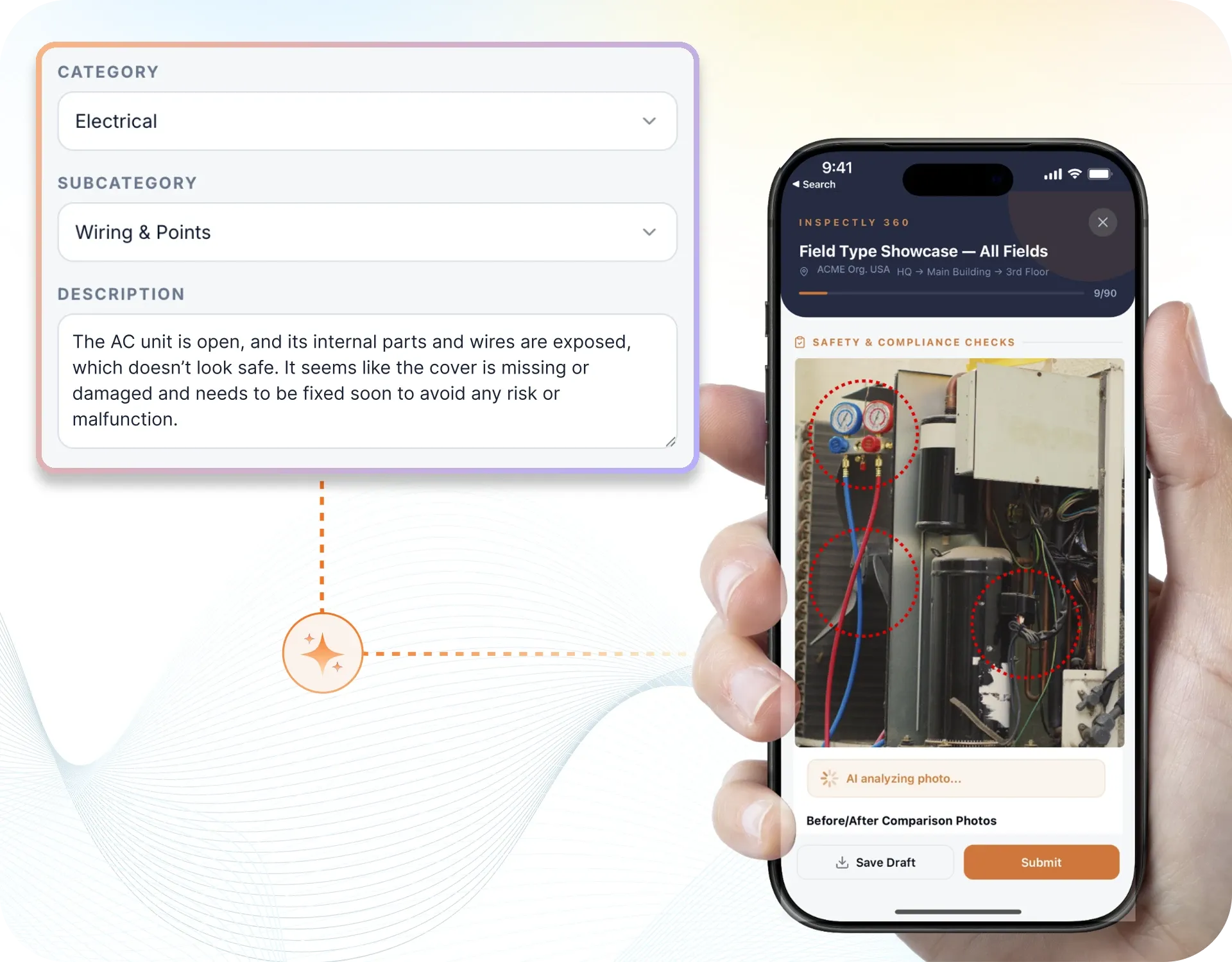
Take a Photo. AI Fills the Form
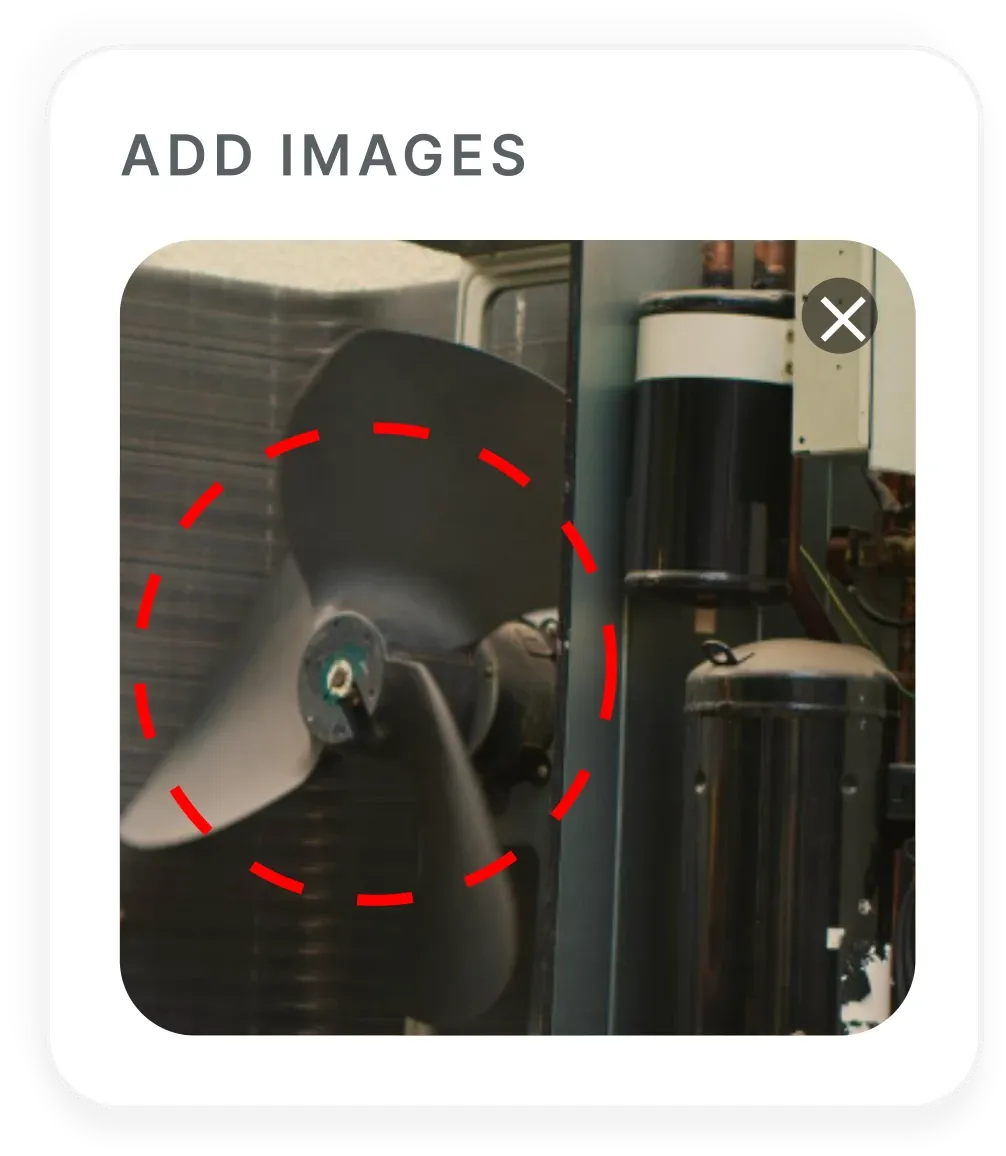
Your inspector takes a photo of any asset or defect. AI reads it and fills the inspection form automatically. No typing. No manual entry.

Convert your checklist into Mobile App
Run weighted 5S audits across office, lean cells, and shopfloor zones, with photo evidence per S, scoring against the company standard, and a trend per zone.

Customize with your logo and company details.
Available on App
Run inspections on iOS and Android - no internet required. Capture photos, annotate defects, and generate reports in the field.
Run the 5S Audit Checklist for Office on the Inspectly360 app instead of paper. Inspectors capture photo evidence, work offline, and assign corrective actions on the spot, and the report generates itself the moment the inspection is signed off.
5S Audit Checklist for Office
5S Audit Checklist for Office Dashboard
Prioritized actions to keep operations running smoothly today.
Total Revenue
$42,680
+12% compared to last month
Active Projects
128
+8 new this week
Open Requests
56
-15 resolved this week
Operational Target
You're on track to meet this month's operational goal.
Target Task
200 ↑
Complete Task
136 ↑
Pending Task
10 ↓
Monthly Performance
Recent Client Activity
Everything your field team does on paper, Inspectly360 does automatically: faster, more accurate, and without the admin.
Your inspector takes a photo of any asset or defect. AI reads it and fills the inspection form automatically. No typing. No manual entry.
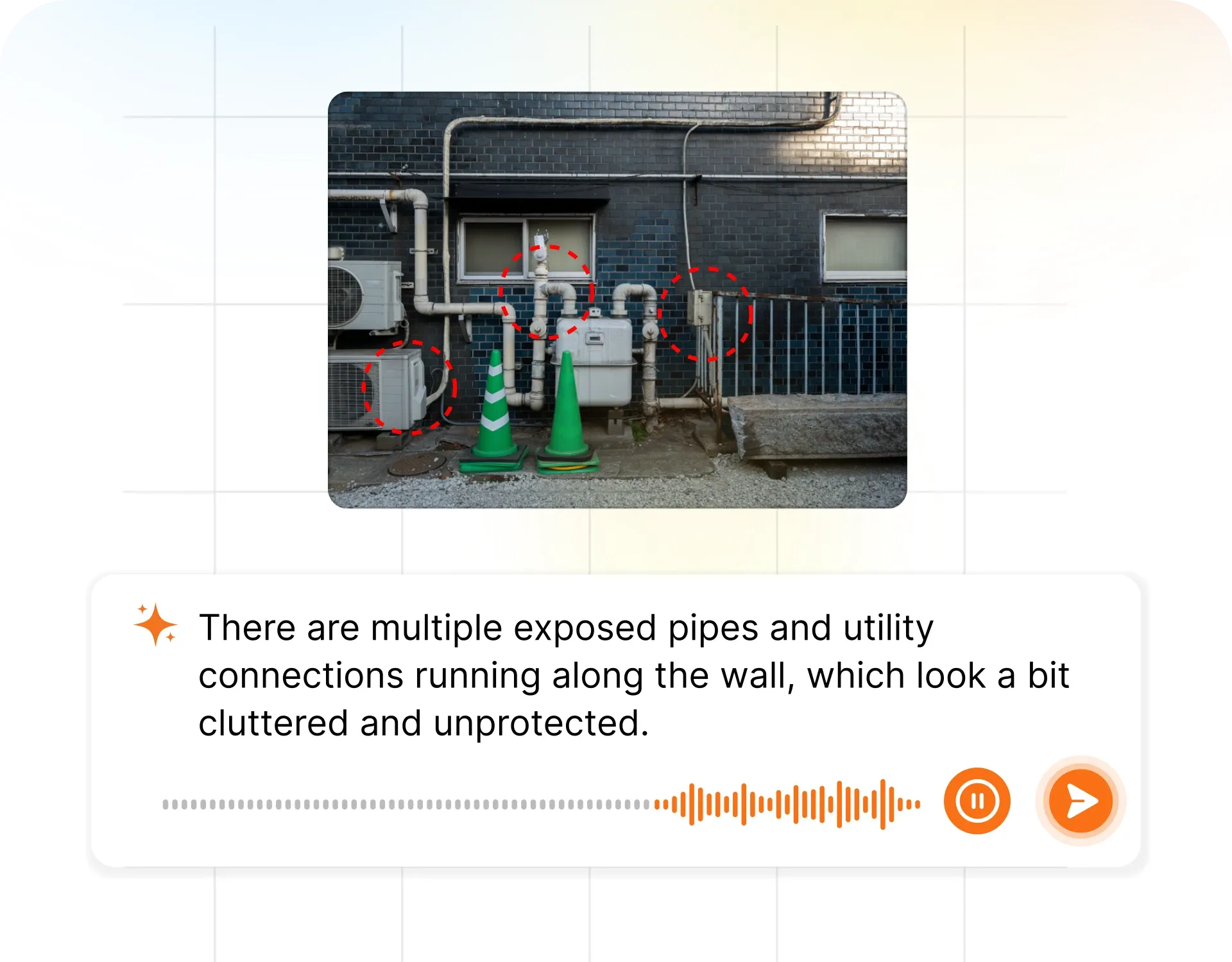
Inspectors speak their observations in any language. AI transcribes and fills the form in real time. Completely hands-free in the field.
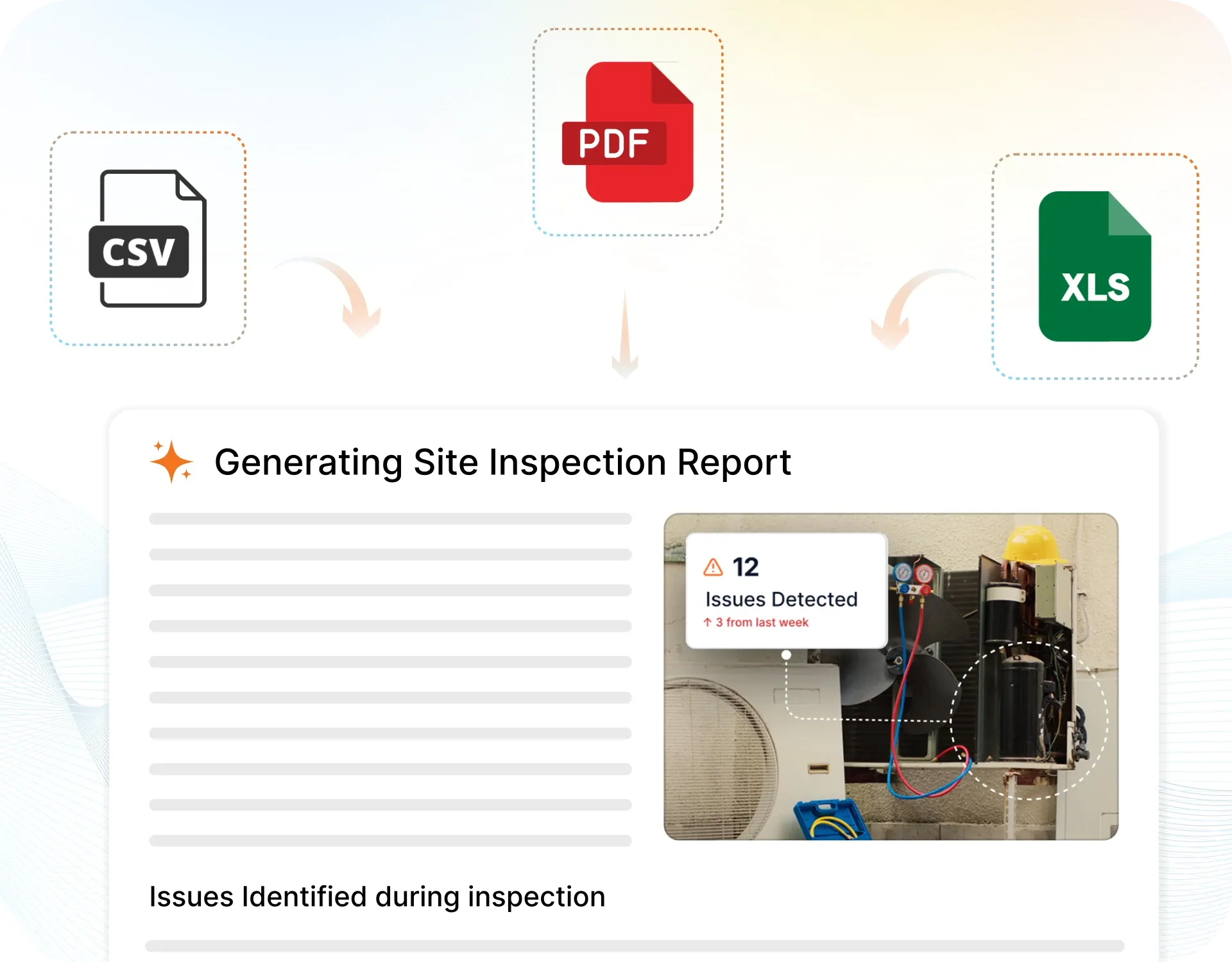
The moment an inspection is submitted, a branded PDF, Excel, or CSV report generates automatically. No manual work. No waiting.
Inspectly360 integrates with the tools your team already uses, including Zoho, Microsoft 365, and SAP. No double entry.
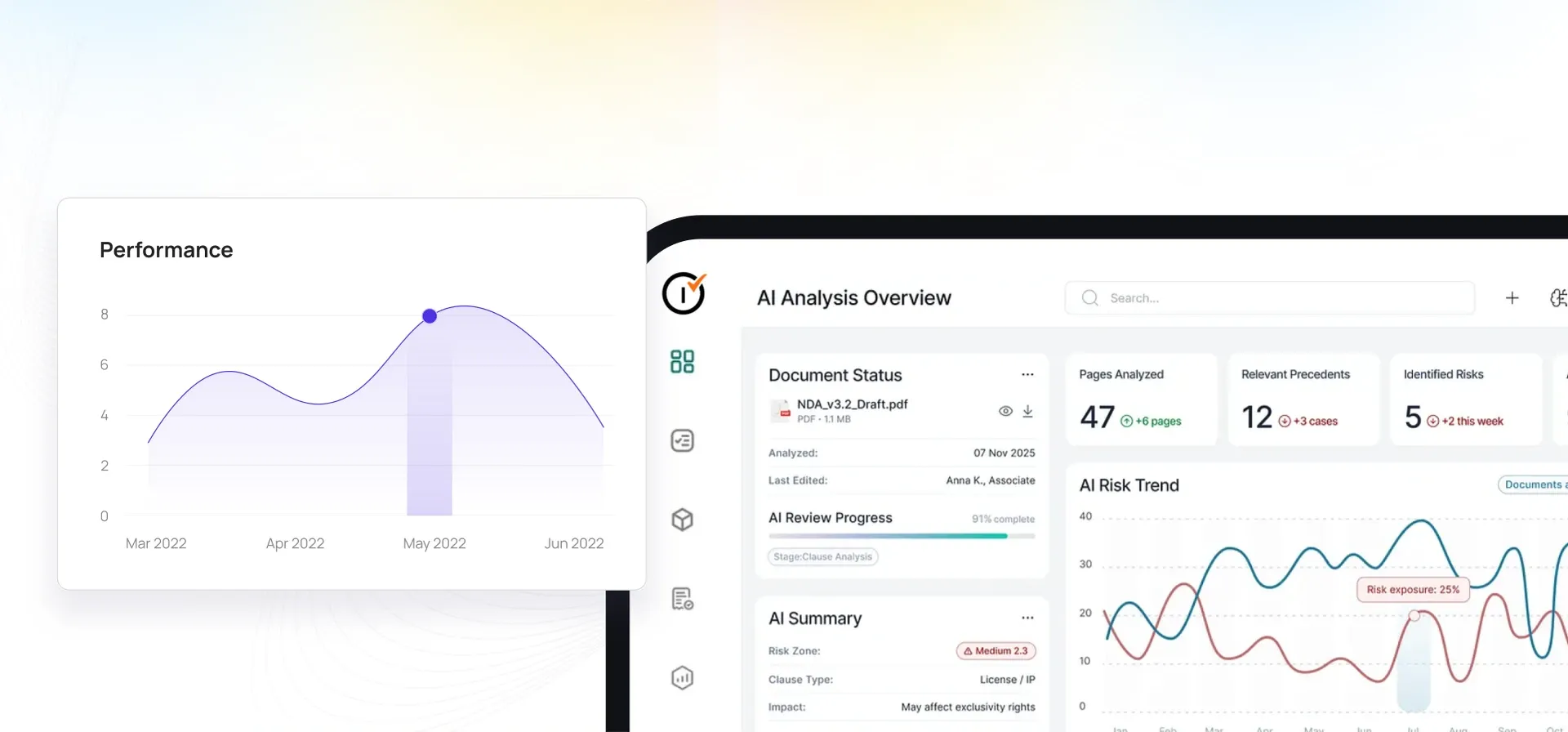
Your operations team sees completion rates, open issues, and compliance scores across all sites in real time. No chasing updates.
Manage every checklist in one connected workspace, capture evidence on mobile at the point of work, and let AI turn field inputs into clear, stakeholder-ready reports in minutes.


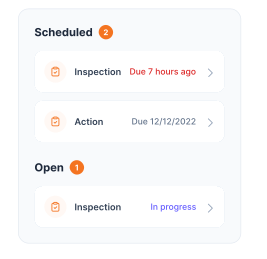
See which checklists your team has in progress across every site, jump into the same inspection with one tap, and keep field, supervisor, and back-office views in sync without sending screenshots on WhatsApp.


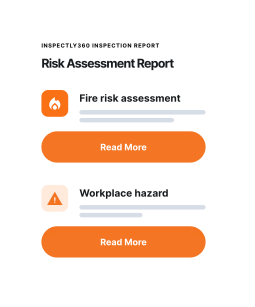


Every team reports differently. Build the report your operations, quality, or compliance leads actually want to read, share it as a branded PDF, and schedule delivery to the stakeholders who need it.


See completion, pass rate, and recurring findings across every checklist and every site, without pulling spreadsheets together at the end of the month.
Hand-picked templates for your specific industry needs.

Industrial and warehouse punch list closeout.

Loading dock snagging: levelers, doors, lighting, and safety.

Racking installation snagging: alignment, bracing, and signage.
A housekeeping check verifies cleanliness against a general standard. A 5S audit scores each zone against five specific principles - Sort (only what is needed), Set in Order (a place for everything), Shine (kept clean at a cycle), Standardise (visual standards posted), and Sustain (the audit cadence and training discipline). The 5S audit produces a weighted numerical score per S and a trend per zone, which is the operational signal lean and quality teams need to defend an ISO 9001, IATF 16949, AS9100, or customer audit. Housekeeping is a subset of Shine; the 5S audit captures all five dimensions in one structured record.
Lean shopfloor cells: weekly, ideally same day same time, with the zone owner walking it with the auditor. Office and shared zones: monthly. Customer-facing or critical zones (cleanrooms, aerospace work cells, IATF 16949 product audit zones): twice weekly or daily layered audits depending on the customer's standard. The Inspectly360 5S checklist surfaces the next-due audit on the auditor's dashboard at sign-on, with overdue zones flagged red. The auditor never has to remember which zone is on which cadence; the dashboard does that work.
The recurring-issue detection in Inspectly360 watches the audit stream across zones and time. A Sort finding that repeats three times in six weeks on the same workstation becomes a kaizen item with the workstation, the finding, and the trend attached. A Shine finding involving oil leak or machine cleanliness on a CNC cell is routed to the autonomous-maintenance team as a TPM task. The lean coordinator stops treating individual audit findings as one-off corrections and starts treating the underlying causes. This is the operational mechanism that prevents 5S from being a periodic event and turns it into a continuous improvement loop.
Yes. The checklist adapts the weighting and the evidence points to the zone type, so an office workstation audit does not get the same checks as a CNC lean cell. Office zones focus on document control, cable management, shared-printer area, and meeting-room standard. Lean cells focus on shadow boards, point-of-use storage, andon visibility, and machine cleanliness. The same checklist with the right configuration drives both. The lean coordinator gets one consolidated view across the plant, and the office and operations teams use the same evidence and scoring language.
AS9100 clause 8.5.4 and IATF 16949 clause 7.1.4 require evidence that the work environment is maintained to support product quality. The 5S audit record carries the structured score per zone, the photo evidence per S, the corrective-action history, and the named auditor and zone owner for every audit. The auditor can export the zone-by-zone 5S history per quarter as a PDF with the photo evidence inline, which is the same record the AS9100 or IATF 16949 surveillance auditor will ask for. There is no overnight rebuild and no PowerPoint slide assembly.
Yes. The lean coordinator can grant a customer auditor or third-party auditor read-only access to specific zones, or invite them to run an audit in the same checklist as the in-house team. The audit record carries the auditor's identity (in-house, customer, third-party), so the trend separates them automatically. The same evidence and scoring language is used by everyone, which removes the disputes that arise when customer audits and in-house audits run on different sheets and arrive at different numbers for the same zone in the same week.

A 5S audit checklist for office is the structured weighted audit lean and quality teams use to score Sort, Set in Order, Shine, Standardise, and Sustain across office zones, lean cells, and shopfloor areas. It captures photo evidence per S, a numerical score against the company 5S standard, and the named auditor for the round, so the lean coordinator can track the trend per zone and surface drift before the next gemba walk.
A 5S audit checklist for office is the structured weighted audit the lean coordinator, plant manager, or quality team uses to score Sort, Set in Order, Shine, Standardise, and Sustain across office workstations, meeting rooms, kaizen corners, lean cells, and shopfloor zones. Each S carries a defined set of evidence points (visual standard, labelled storage, kept-to-cycle cleanliness, posted standard work, training and audit cadence), with photo evidence captured against the company 5S manual.
It replaces the paper audit sheet on the clipboard, the Excel scorecard on the lean coordinator's laptop, and the 5S board in the corner that nobody updates. It produces one auditable record per zone per round, traceable to the named auditor and the zone owner.
The lean coordinator runs a 5S audit on Friday afternoon with a paper sheet on a clipboard. The zone scores get keyed into Excel on Monday. The 5S board in the corner gets updated the following week. By the time anyone sees the dip in Sort score, the auditor has moved on to the next zone.
A customer audit asks for the 5S trend on the lean cell that handles their parts. The coordinator pulls four months of separate Excel sheets and assembles a PowerPoint slide overnight. Two zones contradict each other on what the standard is.
5S is the foundation of every lean and quality system, and an unmaintained 5S program is the leading indicator of a struggling kaizen and TPM program. A consistent 5S audit cadence supports ISO 9001 clause 7.1.4 (work environment), ISO 45001 (workplace safety), and any IATF 16949 or AS9100 surveillance by helping the lean coordinator:
A working 5S audit covers each of the five S's with weighted, photo-backed evidence. Common sections include:
Verify that only items required for current work are in the zone:
Confirm the place-for-everything standard is visible and respected:
Capture the cycle-cadence and the discipline that holds the gains:
Tie the score into the kaizen, CAPA, and TPM streams:
Run the audit at the company's defined cadence - typically weekly for shopfloor lean cells and monthly for office and shared zones. Use the same checklist for in-house auditors and customer-mandated audits:
See how this checklist fits into Manufacturing inspection software.
This checklist runs as a mobile inspection app that works fully offline on site, with AI-powered defect detection on every photo. To see it on your own workflows, talk to our team.
See Inspectly360 in action with a live demo tailored to your needs. No credit card required.