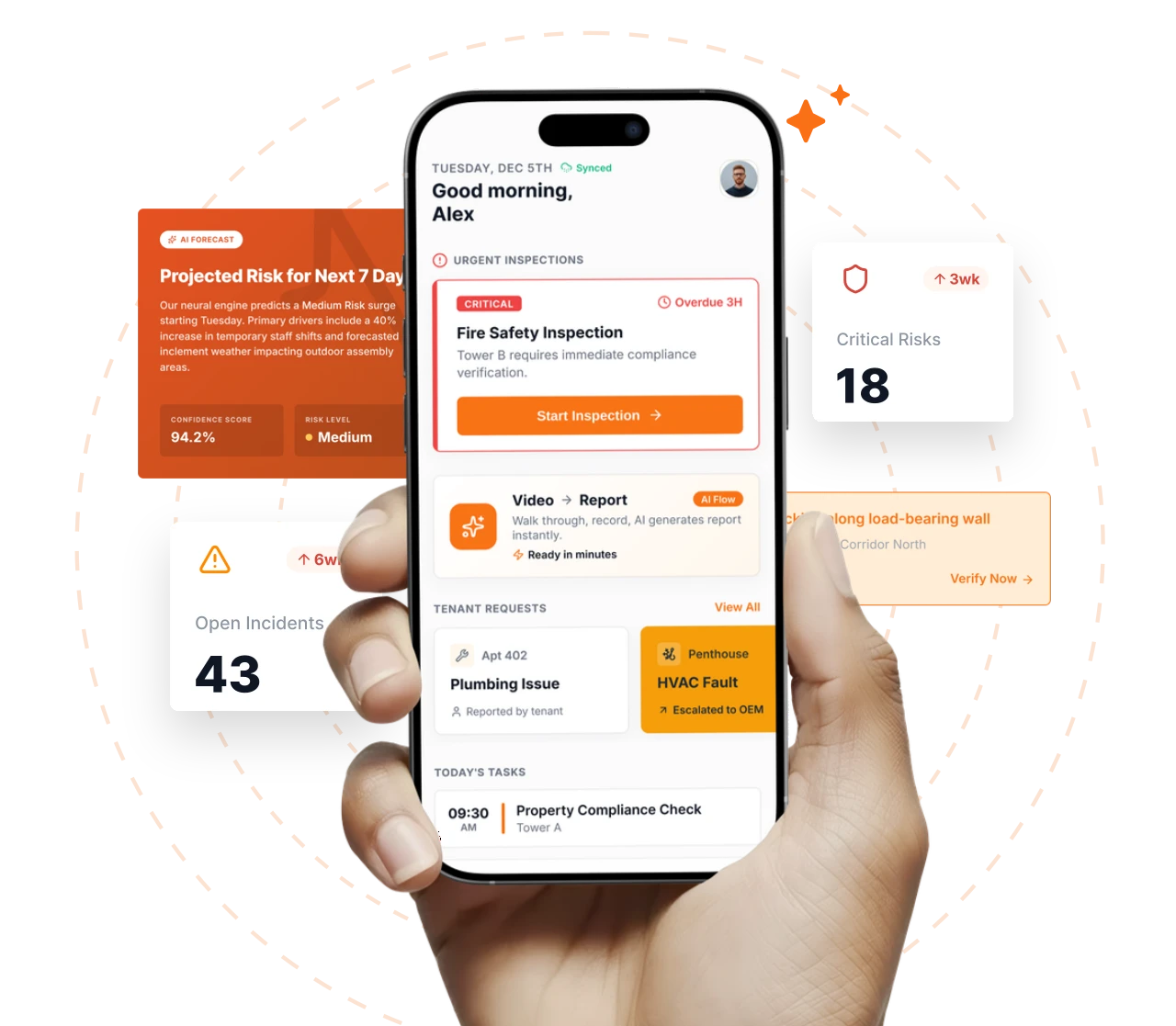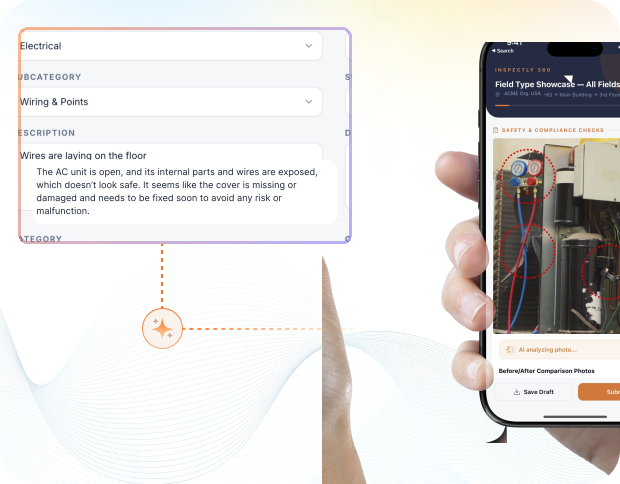
Take a Photo. AI Fills the Form
Your inspector takes a photo of any asset or defect. AI reads it and fills the inspection form automatically. No typing. No manual entry.

Convert your checklist into Mobile App
Construction site inspection tracking software is the closure-discipline layer above the construction site inspection app: it carries NCR ageing, hold-point compliance, subcontractor closure rates, repeat-NCR detection, escalation routing, and HSE walk closure tracking across active construction projects. Inspectly360 is built for PMs, quality directors, and construction directors who need closure to be a measured workflow rather than a daily chase.
Everything your field team does on paper, Inspectly360 does automatically: faster, more accurate, and without the admin.
Your inspector takes a photo of any asset or defect. AI reads it and fills the inspection form automatically. No typing. No manual entry.
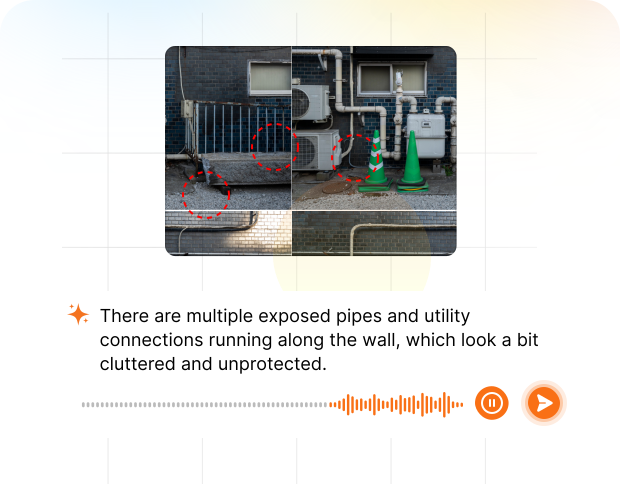
Inspectors speak their observations in any language. AI transcribes and fills the form in real time. Completely hands-free in the field.
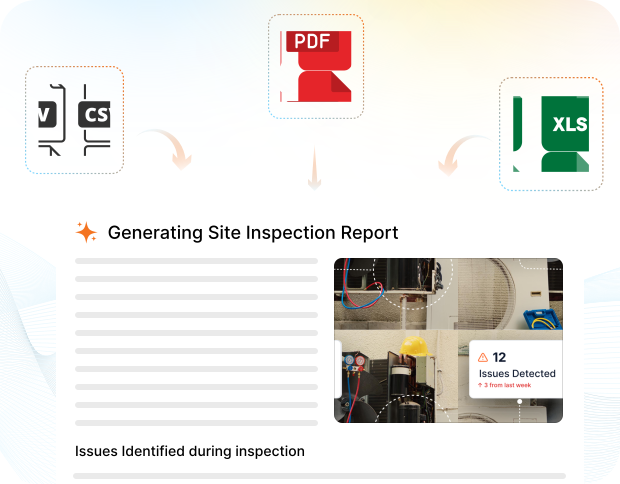
The moment an inspection is submitted, a branded PDF, Excel, or CSV report generates automatically. No manual work. No waiting.

Inspectly360 integrates with the tools your team already uses, including Zoho, Microsoft 365, and SAP. No double entry.
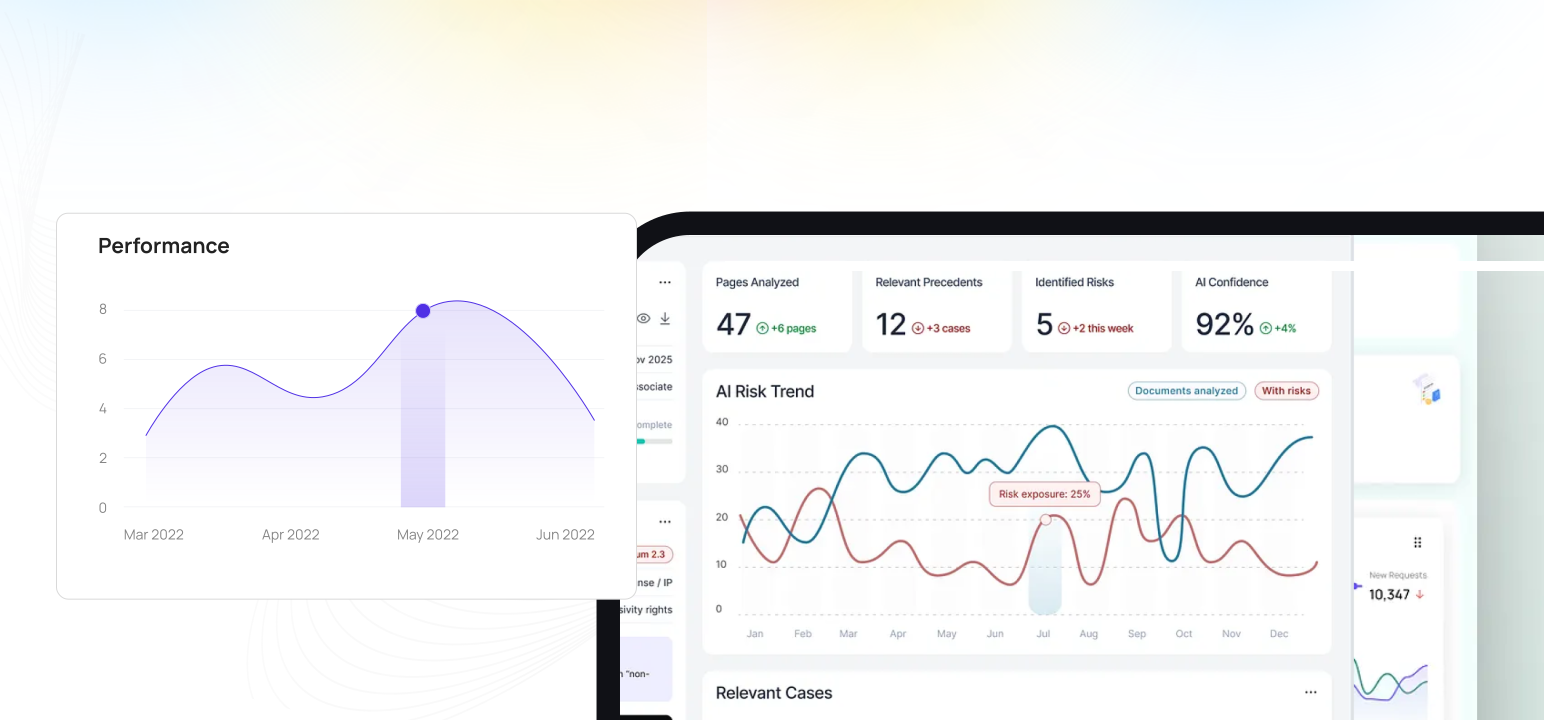
Your operations team sees completion rates, open issues, and compliance scores across all sites in real time. No chasing updates.
What changes once construction site inspection tracking software runs on one mobile-first platform with photo proof and live dashboards.
Construction site inspection tracking software is the closure-discipline layer above the construction site inspection app: it carries NCR ageing, hold-point compliance, subcontractor closure rates, repeat-NCR detection, escalation routing, and HSE walk closure tracking across active construction projects. Inspectly360 is built for PMs, quality directors, and construction directors who need closure to be a measured workflow rather than a daily chase.
For PMs, the platform replaces WhatsApp chase threads, Excel NCR ageing sheets, and Outlook reminder rules with live ageing dashboards, automatic escalation routing, and photo-verified closure that does not depend on memory. The PM stops being the chase function; the system chases. Time-based escalation rules route overdue NCRs from subcontractor reminder through package PM, project manager, and construction director on a structured cadence.
For construction directors and quality directors, NCR ageing, hold-point compliance, subcontractor closure rates, and repeat-NCR patterns aggregate across projects. The next tender qualification round opens with scored data per subcontractor. Repeat NCRs against a specific component (one reinforcement detail, one concrete mix, one MEP component) trigger alerts before the trade leaves site, which is what changes recall economics. HSE walk closure tracks alongside quality NCR closure so safety findings do not slip behind quality work.
Construction site tracking runs continuously rather than on a walk cadence; the five-step loop below is what PMs standardise to keep closure on track from raise through verified closure.
Define NCR ageing bands (0-7 days, 8-14, 15-30, 30+) and escalation rules per severity (critical structural: 24-hour reminder, 48-hour escalation; major MEP: 7-day reminder, 14-day escalation; minor finish: 14-day reminder, 30-day escalation).
Define scorecard models per trade: NCR rate, average closure time, on-time rate, re-open rate, repeat-NCR rate, hold-point compliance rate, photo-evidence compliance rate. Scorecards update from real closure data.
AI continuously analyses NCR history for repeat patterns by trade, by component, by supplier, and by project type. Alerts trigger when an NCR type appears across multiple work packages or projects.
PMs see live ageing dashboards every morning before standup: NCRs by age band, hold points by status, HSE walk findings by closure state. Overdue items surface automatically.
HSE walk findings and quality NCRs surface in the same dashboard. Safety findings cannot slip behind quality work because the unified view shows both in one place.
Answers to common long-tail questions, kept on one canonical page to avoid thin duplicate URLs.
Construction site tracking in Inspectly360 sits as the field-closure layer beside the systems of record. Procore, Asana, Smartsheet, and Microsoft Project continue to hold project tasks, milestones, and resource planning. Inspectly360 owns the NCR ageing engine, the hold-point compliance tracking, the subcontractor scorecard, the repeat-NCR detection, the escalation routing, and the unified HSE/quality closure view.
PMs should validate seven tracking requirements: live ageing dashboards that load fast on mobile during site walks; automatic escalation routing with configurable severity-based timing; subcontractor scorecards that surface in real time; AI repeat-NCR detection that catches patterns before the trade leaves site; hold-point compliance tracking that aggregates witness-point and inspection-point data; unified HSE walk and quality NCR view in one dashboard; and mobile push notifications for overdue critical items.
Subcontractor scorecards carry performance data that may be used in procurement decisions and may be challenged commercially. Inspectly360 supports audit-grade event logs (who raised the NCR, who closed it, who verified closure, who approved the score), encrypted at-rest evidence, and tamper-proof scorecard history.
Existing WhatsApp chase threads and Excel NCR sheets batch-import as searchable evidence against the same project and work package. Historical closure timelines carry forward so subcontractor scorecards reflect real history rather than starting from zero.
The platform capabilities that power construction site inspection tracking software across every site.
PMs comparing Inspectly360 to WhatsApp chase threads, Excel NCR ageing sheets, and Outlook reminder rules care about five things specific to construction site tracking: whether NCR ageing surfaces before the contract administrator raises it, whether hold-point compliance becomes a measured number, whether subcontractor closure rate becomes evidence-led rather than narrative, whether escalation routes automatically rather than depending on the PM to chase, and whether HSE walk closure tracks alongside quality NCR closure in one dashboard.
| Topic | Typical Gaps | With Inspectly360 |
|---|---|---|
| NCR ageing visibility before contract administrator notices | NCR age tracking lives in Excel. The PM sees ageing only when they compile the weekly report on Friday afternoon. By then a 4-week-old structural NCR has become a contract administrator escalation, and the project meeting opens defensively. | Live ageing dashboards show NCRs by age band (0-7 days, 8-14, 15-30, 30+) per work package, per trade, and per subcontractor. The PM sees ageing risk every morning before standup. |
| Hold-point compliance as a measured number | Hold-point compliance is described in narrative: 'We've been good at hold points lately.' Contract administrator reviews open with hope rather than evidence. Compliance rate is never a number because the data is never structured. | Hold-point compliance rate aggregates from real data: percentage of hold points cleared before activity progression, average time from witness-point notice to inspection, witness-point waiver rate. Contract administrator reviews open with scored data. |
| Subcontractor closure rate as evidence-led data | Subcontractor performance is described in narrative. Procurement on the next tender opens with relationship and ends with hope. Closure rate is never a number because the data is never structured. | Closure rate per subcontractor and per trade aggregates from real closure data: average closure time, on-time rate, re-open rate, repeat-NCR rate, hold-point compliance rate. Procurement on the next tender opens with scored data. |
| Automatic escalation routing | Escalation depends on the PM to chase. WhatsApp messages, follow-up emails, and verbal reminders consume the PM's day. Critical NCRs overdue 30+ days surface only when the construction director happens to ask. | Time-based escalation rules route overdue NCRs automatically. The PM stops being the chase function, and overdue items surface to the right level on the right cadence. |
| HSE walk closure alongside quality NCR closure | HSE walk findings and quality NCRs live in different systems. The PM running an active project has no unified view of safety and quality closure; HSE findings slip behind quality NCRs because they live in a different Excel. | HSE walk findings and quality NCRs track in the same dashboard. The PM sees the full coverage map: open safety findings, open quality NCRs, and open hold points in one view, which is what stops safety findings from slipping behind quality. |
What changes once construction site inspection tracking software is standardised on Inspectly360.
Get started with inspection and audit checklist templates.

Catch defects before handover and generate punch list reports in minutes. Room-by-room finish checks, evidence, and corrective actions.

Pre-handover snagging for new build apartments. Room-by-room finish checks, MEP, and defect tracking before keys.
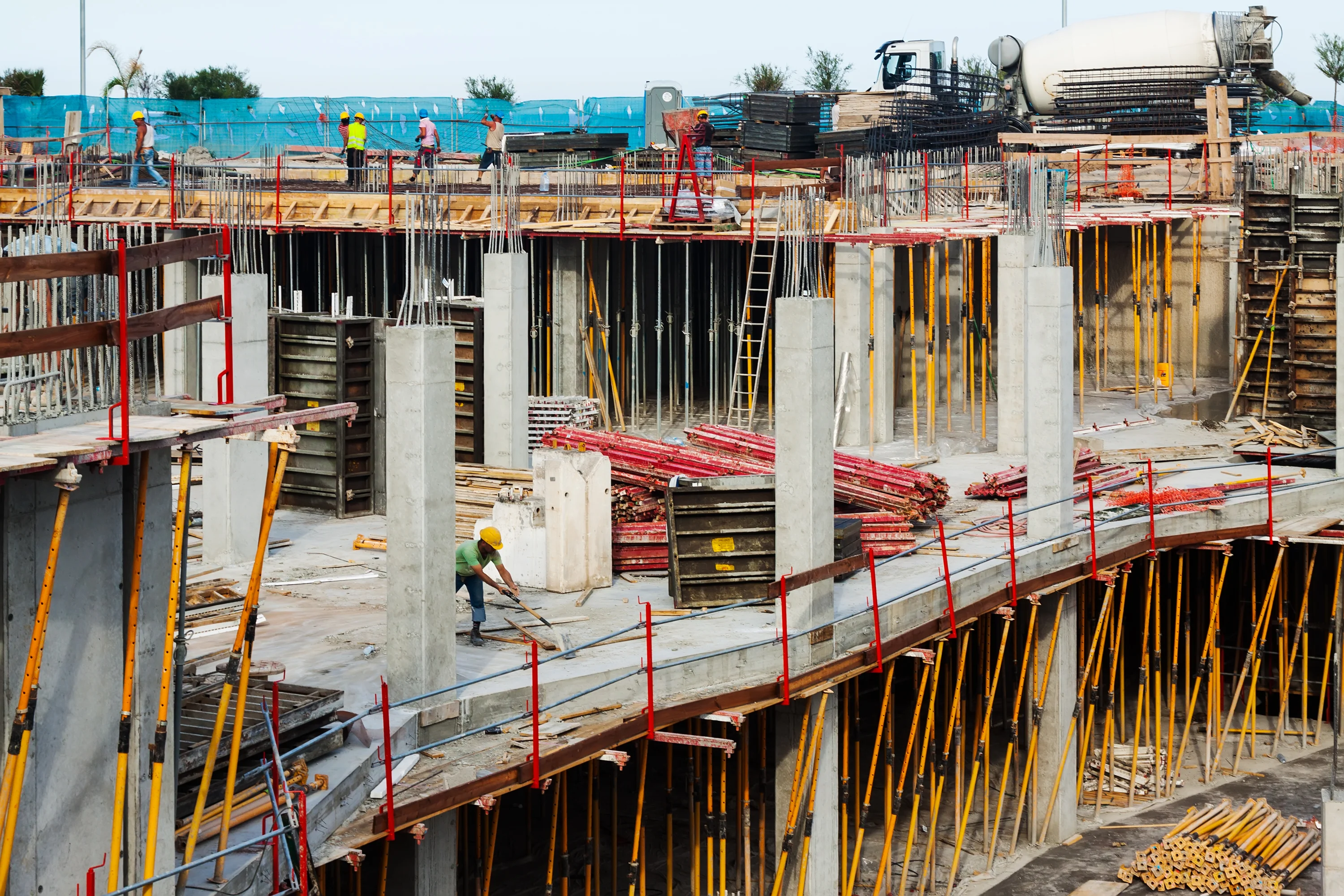
Utilize this Scaffolding Safety Inspection Checklist to spot hazards, verify stability, and ensure compliance with safety standards before work begins.
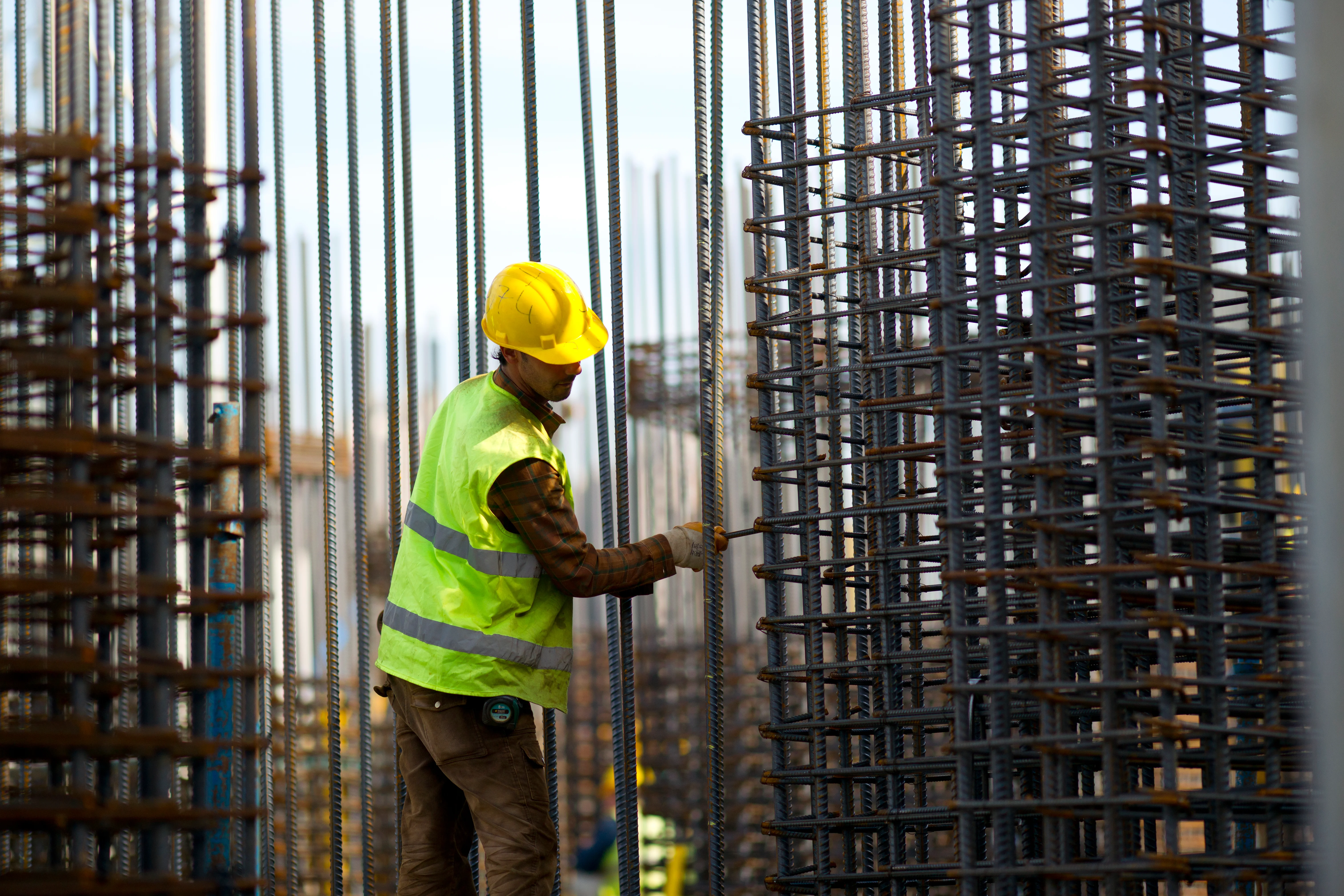
Capture job details, measurements, work performed, photos, and sign-offs in one structured field service report form.
Use these apps to run inspections and audits.

by Inspectly360
Track construction inspections, findings, and closure timelines across projects and teams.
by Inspectly360
Track construction defects from detection to assigned correction and verified closure proof.

by Inspectly360
Track construction work orders by assignee, due date, and verified closure evidence.
by Inspectly360
Report construction incidents with evidence capture, escalation workflows, and resolution tracking.

by Inspectly360
Manage construction risks with structured assessments, mitigation ownership, and control monitoring.
NCR ageing tracks the number of days from raise to closure for each NCR, aggregated by work package, trade, and subcontractor, with configurable age bands (0-7 days, 8-14, 15-30, and 30+). Live ageing dashboards refresh as NCRs close, so a PM always sees what is overdue right now rather than at the next progress meeting. Ageing matters because the longer an NCR stays open, the more likely the trades that follow it will build over an unresolved defect, turning a quick fix into rework and a contract administrator escalation. Surfacing the oldest open NCRs first is what lets the team close the highest-consequence items before the next work package covers them up, and the same view shows which trades and subcontractors let NCRs age the most.
Hold-point compliance tracking measures several things together: the percentage of hold points cleared before the activity progressed, the average time from a witness-point notice to the inspection arriving, the witness-point waiver rate, and the hold-point re-open rate. That data feeds the contract administrator reviews and the project quality-plan compliance dashboard, so compliance is a live number rather than a question answered after the fact. The measures matter because a hold point bypassed under schedule pressure is exactly how a slab gets poured or steel erected before the witness sign-off, which is the kind of gap a contract administrator and an insurer both probe. By tracking waivers and re-opens explicitly, the platform shows not just whether hold points were cleared but whether the discipline is holding up as the programme tightens.
Scorecards aggregate from real closure data for each subcontractor and trade: average NCR closure time, on-time rate, re-open rate, repeat-NCR rate, hold-point compliance rate, and photo-evidence compliance rate. Each subcontractor sees their own scorecard with peer-anonymised benchmarks, so they know where they stand without seeing a rival's numbers. Because every figure traces back to an audit-grade event, a strong or weak score is defensible at the next tender. That means a subcontractor whose re-open rate is climbing, or whose NCR rate on critical items is rising, is visible at the qualification gate before the next contract is signed, rather than after the defects show up on a live project. It turns subcontractor selection from relationship and impression into evidence.
AI continuously analyses the NCR history for patterns a single work package would never reveal. It raises an alert when the same NCR type appears across multiple work packages on the same floor, which suggests a localised method or supervision issue; when the same NCR type keeps appearing against the same subcontractor across multiple projects, which suggests a workmanship pattern; or when the same NCR type appears against a specific component or supplier, which suggests a supply problem. Each alert surfaces with its frequency, the affected work packages, and the trend direction, so the PM can tell whether a pattern is growing. That turns repeated single fixes into one systemic correction, whether that means retraining a trade, changing a method statement, or challenging a supplier.
HSE walk findings, such as open hazards, near-miss reports, and safety-walk failures, and quality NCRs all surface in the same PM dashboard with state filters, so a PM sees safety and quality in one place rather than in two disconnected systems. Both follow the same closure workflow, with severity-matched verification and photo-verified closure, so a safety finding is held to the same discipline as a quality defect. The unified view stops safety findings from slipping behind quality work, which is a real risk when the two live in separate tools and the loudest list gets the attention. Because everything closes through one workflow, the PM can see at a glance whether the project is keeping up on safety and quality together, and a serious hazard cannot quietly age while quality snags are worked.
Subcontractor scorecards export to corporate procurement systems through the REST API, a scheduled CSV, or a direct integration with SAP Ariba, Oracle Procurement, or a custom procurement database. The export carries closure metrics broken down per trade, per project type, per geography, and per contract size band, so procurement can compare like with like rather than judging a small fit-out subcontractor against a major structural one. That feeds the next qualification round with objective quality data sitting alongside the commercial scoring, so a subcontractor's record is part of the award decision rather than a reference check made after the price is agreed. Procurement, quality, and operations all work from the same scorecard, which removes the usual argument about whose numbers are right.
Construction Site Inspection Tracking Software on Inspectly360 connects directly to the inspection apps, checklist templates, forms, industries, and adjacent solutions linked below.
See Inspectly360 in action with a live demo tailored to your needs. No credit card required.