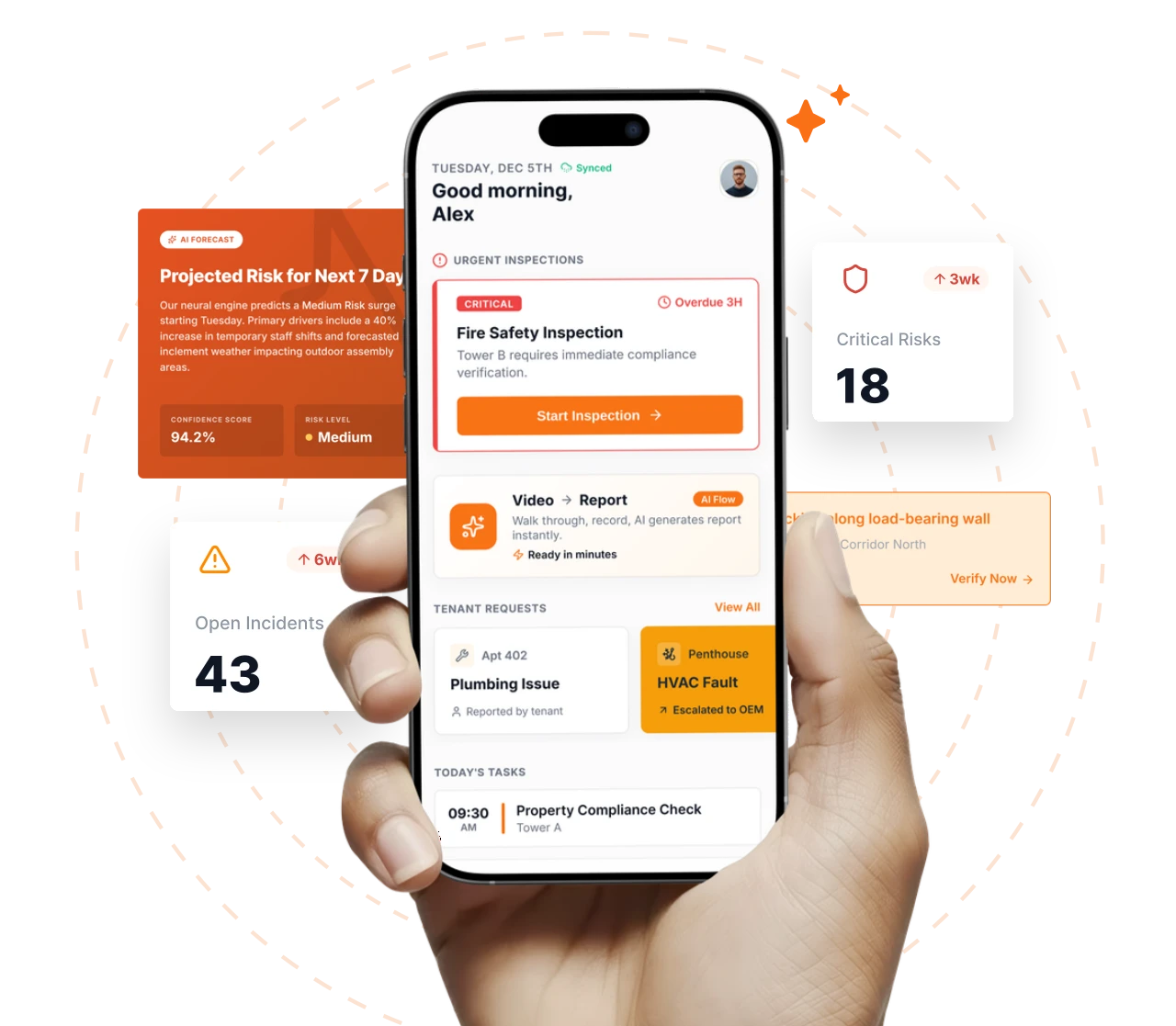
Take a Photo. AI Fills the Form
Your inspector takes a photo of any asset or defect. AI reads it and fills the inspection form automatically. No typing. No manual entry.

Convert your checklist into Mobile App
Life vests safety software is the platform cabin safety managers and safety management system teams use to capture hazards, assess risk, and close corrective action on aircraft life vests across a fleet. Inspectly360 turns a missing under-seat vest, a broken tamper seal, or a failed CO2 inflation cylinder into a risk-scored hazard report with an owner and a deadline, feeding the cabin SMS rather than a paper form that may sit for days.
Everything your field team does on paper, Inspectly360 does automatically: faster, more accurate, and without the admin.
Your inspector takes a photo of any asset or defect. AI reads it and fills the inspection form automatically. No typing. No manual entry.
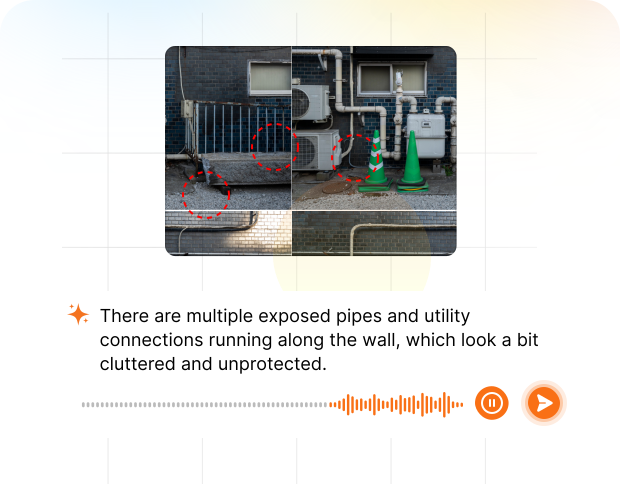
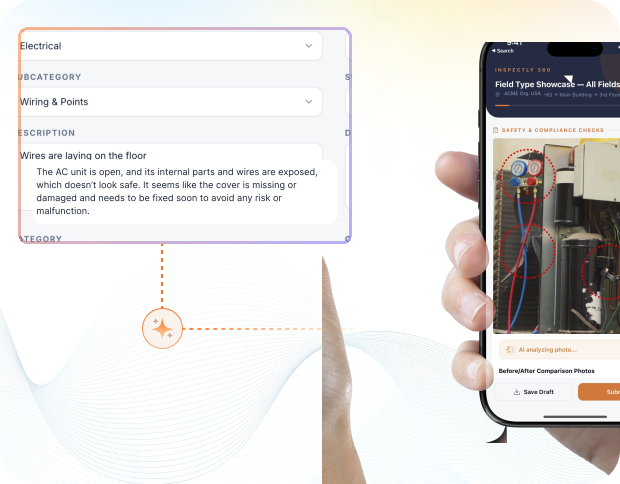
Inspectors speak their observations in any language. AI transcribes and fills the form in real time. Completely hands-free in the field.
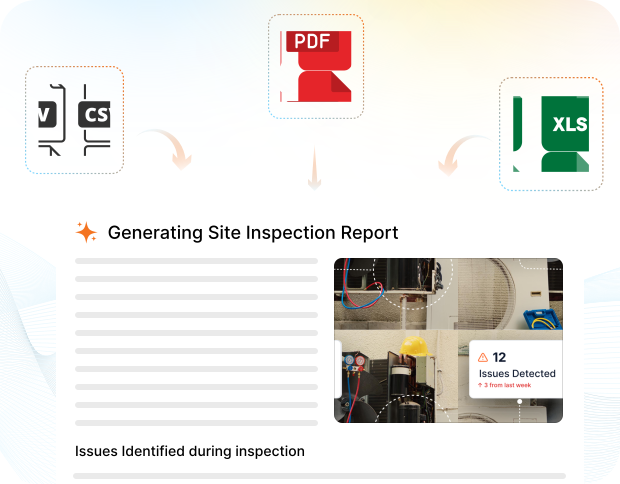
The moment an inspection is submitted, a branded PDF, Excel, or CSV report generates automatically. No manual work. No waiting.

Inspectly360 integrates with the tools your team already uses, including Zoho, Microsoft 365, and SAP. No double entry.
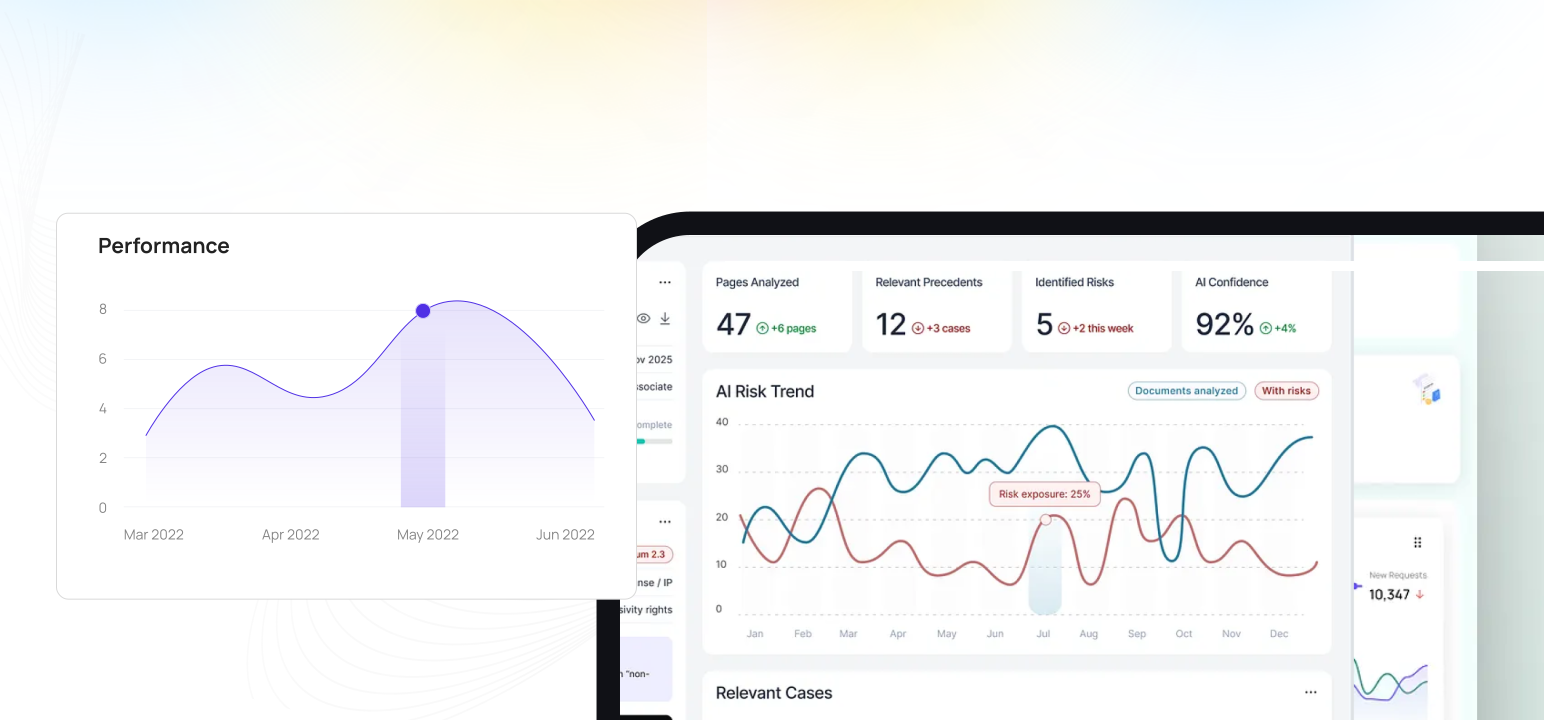
Your operations team sees completion rates, open issues, and compliance scores across all sites in real time. No chasing updates.
What changes once life vests safety software runs on one mobile-first platform with photo proof and live dashboards.
Life vests safety software is the platform cabin safety managers and safety management system teams use to capture hazards, assess risk, and close corrective action on aircraft life vests across a fleet. Inspectly360 turns a missing under-seat vest, a broken tamper seal, or a failed CO2 inflation cylinder into a risk-scored hazard report with an owner and a deadline, feeding the cabin SMS rather than a paper form that may sit for days.
Today a cabin crew hazard goes on a paper form, the risk is judged informally, and corrective action is agreed verbally and rarely tracked. When a vest defect is reported but not scored, when a failed cylinder is treated the same as a cosmetic issue, or when the same fault recurs on one vest type without anyone seeing the trend, the safety risk on an overwater sector grows quietly. Across a fleet, reports never aggregate, so the safety manager cannot tell a one-off from a systemic problem.
Inspectly360 replaces that with structured hazard capture on iOS and Android: cabin crew raise a report from the cabin with seat location and photo, each hazard is risk-scored so a failed inflation outranks a stowage scuff, corrective actions carry owners and deadlines, and trends surface repeat defects by vest type. The record feeds the SMS and exports as scoped safety evidence when an audit asks, aligned to the overwater requirements of 14 CFR 121.339 and CAT.IDE.A.285.
Cabin safety and SMS teams follow this loop to capture life vest hazards, assess risk, and close corrective action.
Cabin crew report a missing, unsealed, or failed vest from the cabin with seat location and a photo so it reaches the safety team at once.
Each life vest hazard is scored for severity and likelihood so a failed CO2 inflation outranks a cosmetic stowage issue.
A corrective action is assigned with an owner and deadline, linked to the hazard and the affected vest serial.
Repeat defects aggregate by vest type and tail so the root cause is addressed, not just the individual symptom.
Verified closure feeds the safety management system, and scoped safety evidence exports for an SMS audit on request.
Answers to common long-tail questions, kept on one canonical page to avoid thin duplicate URLs.
Start with one cabin crew base so the hazard categories, risk scoring, and corrective action workflow are validated against real life vest reports before rollout to other bases and the wider SMS.
Cabin crew get hazard capture, the safety team gets risk scoring and corrective action ownership, and SMS leads get read access to trends and evidence through role-based access.
The platform capabilities that power life vests safety software across every site.
Crew raise a life vest hazard from the cabin with seat location and a photo. Why it matters: a hazard that reaches the safety team in minutes can stop a non-compliant overwater dispatch.
Each vest hazard is scored for severity and likelihood so the response matches the risk. Why it matters: a failed CO2 inflation is a life-safety risk that must outrank a cosmetic stowage scuff.
Each action carries an owner, deadline, and verified closure linked to the hazard. Why it matters: a corrective action agreed verbally is the one that never gets closed.
Repeat defects aggregate by vest type and tail across the fleet. Why it matters: a recurring cylinder failure is a systemic root cause, not a series of one-offs.
Closed hazards and actions feed the safety management system record. Why it matters: a hazard outside the SMS is a safety event the audit will say you failed to manage.
Scoped hazard and corrective action records export for an SMS audit. Why it matters: an audit request becomes a minutes-long export, not a hazard-form search.
Cabin safety and SMS teams comparing Inspectly360 to paper hazard forms, spreadsheet risk logs, and email trails see the difference fastest on hazard capture, risk scoring, corrective action closure, trend visibility, and fleet-wide safety reporting for overwater life vest defects under FAA 14 CFR 121.339 and EASA CAT.IDE.A.285.
| Topic | Typical Gaps | With Inspectly360 |
|---|---|---|
| Hazard report from the cabin | Crew note a failed or missing vest on a paper form that may not reach the safety team for days. | Crew raise a hazard report from the cabin with seat location and photo that reaches the safety team at once. |
| Risk scoring of a vest defect | A missing vest and a failed CO2 cylinder are treated the same because nothing scores severity. | Each life vest hazard is risk-scored so a failed inflation outranks a cosmetic stowage issue. |
| Corrective action closure | Corrective action is agreed verbally and rarely tracked to a verified close-out. | Each corrective action carries an owner, deadline, and verified closure linked to the hazard. |
| Trend across the fleet | Repeated CO2 cylinder failures on one vest type go unseen because reports never aggregate. | Trends surface repeat vest defects by type so the root cause is addressed, not just the symptom. |
| Safety evidence for the SMS audit | Hazard forms photocopied and searched by hand when the SMS audit asks for the record. | Scoped, timestamped hazard and corrective action records export for the auditor in minutes. |
What changes once life vests safety software is standardised on Inspectly360.
Get started with inspection and audit checklist templates.

Use this template to perform a comprehensive safety inspection of light vehicles. This check ensures all critical components are checked ...
Use these apps to run inspections and audits.

by Inspectly360
Streamline facilities inspections with forms, photos, and reports.

by Inspectly360
Building condition and compliance inspections with evidence and follow-ups.

by Inspectly360
Digitize building inspection apps workflows with forms, evidence capture, and automated reporting.

by Inspectly360
Run building inspections on phones and tablets with offline forms, photo evidence, and instant reports.

by Inspectly360
Audit buildings with structured scoring, photo evidence, and corrective action tracking across portfolios.
Cabin crew raise a life vest hazard directly from the cabin on iOS or Android, recording the seat location, a photo, and a short description of the defect, such as a missing vest, a broken tamper seal, or a failed CO2 cylinder. The report reaches the safety team at once rather than sitting on a paper form for days. Because the hazard is tied to the specific seat and tail number, the safety manager can see exactly where the issue is and decide whether it affects an overwater dispatch. This replaces the slow paper route that lets a real safety hazard wait until someone happens to read the form.
Each life vest hazard is scored for severity and likelihood so the response matches the real risk. A failed CO2 inflation cylinder, which means the vest will not inflate for a passenger, is scored higher than a cosmetic scuff on a stowage pouch. The score drives priority, so the safety team and line maintenance act on the dangerous defect first. Without scoring, every report looks the same and a serious fault can wait behind a trivial one. Risk scoring also feeds the trend view, so the fleet can see whether high-severity vest hazards are concentrated on a particular type, base, or vest part number that needs a deeper fix.
When a life vest hazard needs action, a corrective action is created with an owner, a deadline, and the specific step required, linked to the hazard and the affected vest serial. The platform alerts before the deadline and holds the action open until a verified closure is recorded with evidence. This prevents the common failure where corrective action is agreed verbally and never confirmed, which is exactly what an SMS audit probes. The closed action becomes part of the safety record, so the safety manager can show not only that a hazard was reported but that it was assessed, owned, and resolved within the agreed time.
Yes. Life vest hazards aggregate by vest type, part number, base, and tail number, so the safety team can see whether a defect is a one-off or a recurring pattern. If the same CO2 cylinder failure or the same locator light fault keeps appearing on one vest type, the trend view surfaces it as a systemic issue that needs a root-cause action rather than repeated individual fixes. This turns scattered reports into safety intelligence the SMS can act on. Spotting the pattern early can prevent a fleet-wide problem and supports a stronger case when raising the issue with the vest manufacturer or MRO.
Closed life vest hazards and their corrective actions feed the safety management system record, so each event is captured, assessed, owned, and resolved inside the SMS rather than outside it. A hazard managed on a paper form that never reaches the SMS is a gap an audit treats as a failure to manage safety. The platform keeps the full loop, from cabin report through risk score and corrective action to verified closure, in one timestamped record per vest serial and tail. This gives the SMS lead a defensible account of how each life vest safety issue was handled and a clear trail when the regulator reviews the system.
Yes. Hazard capture works fully offline on iOS and Android, which matters in the cabin, in flight, and at remote stands where signal is weak. Cabin crew raise a life vest hazard with seat location and photo while offline, and the report syncs automatically once the device reconnects, with the timestamp reflecting when the hazard was actually observed. Nothing is lost if a crew member spots a missing or failed vest in an area with no coverage. This keeps the safety record accurate and timely, so a hazard raised on a long overwater sector still reaches the safety team and feeds the SMS as soon as connection returns.
Life Vests Safety Software on Inspectly360 connects directly to the inspection apps, checklist templates, forms, industries, and adjacent solutions linked below.
See Inspectly360 in action with a live demo tailored to your needs. No credit card required.