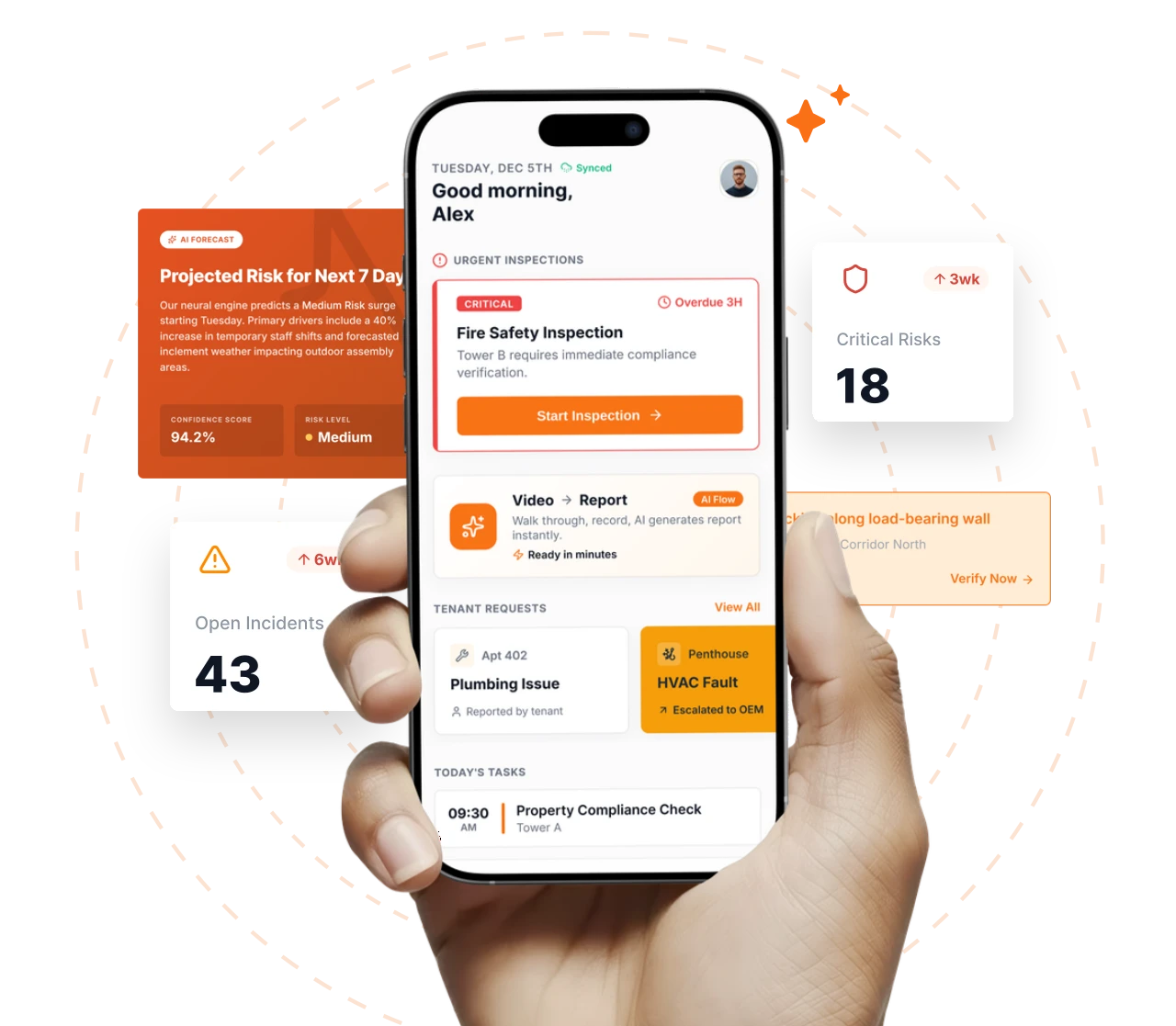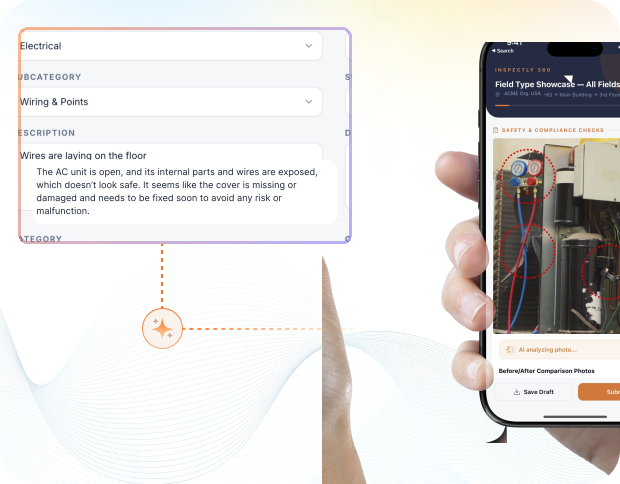
Take a Photo. AI Fills the Form
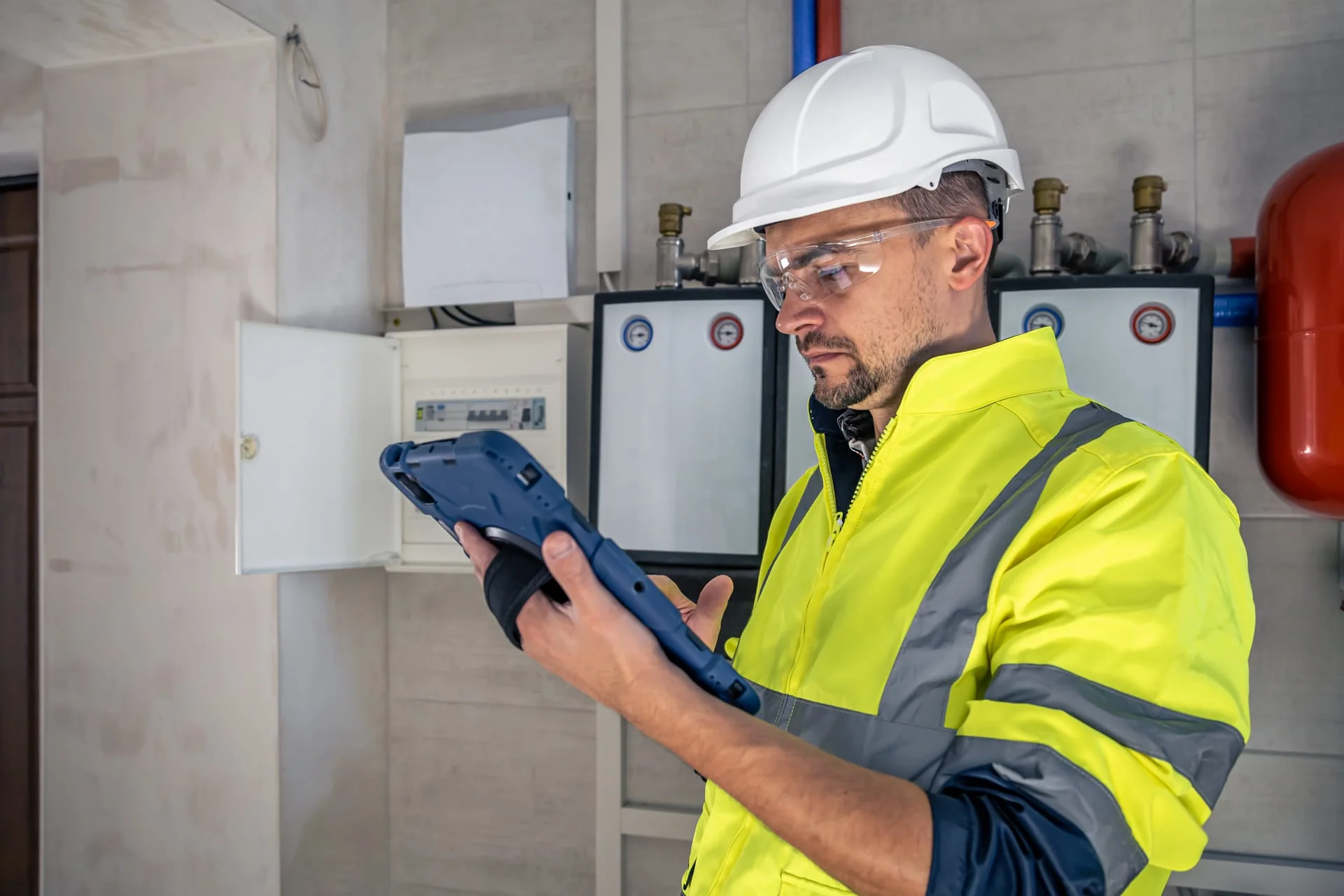
Your inspector takes a photo of any asset or defect. AI reads it and fills the inspection form automatically. No typing. No manual entry.

Convert your checklist into Mobile App
Oxygen masks safety software is the platform Cabin Safety Managers, cabin crew, and Safety Management System teams use to identify, rate, and control hazards in aircraft oxygen systems across a fleet. Inspectly360 captures oxygen hazards such as a portable bottle below minimum pressure, a failed mask drop test, or a regulator fault, rates the risk, and tracks the control action to closure within the cabin SMS, aligned to FAA 14 CFR 121.
Everything your field team does on paper, Inspectly360 does automatically: faster, more accurate, and without the admin.
Your inspector takes a photo of any asset or defect. AI reads it and fills the inspection form automatically. No typing. No manual entry.
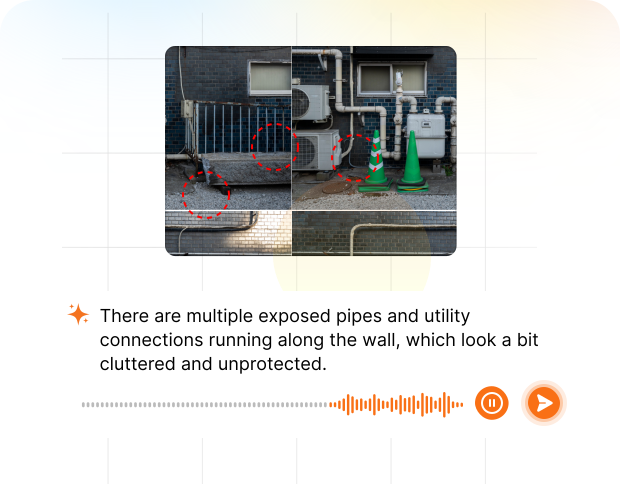
Inspectors speak their observations in any language. AI transcribes and fills the form in real time. Completely hands-free in the field.
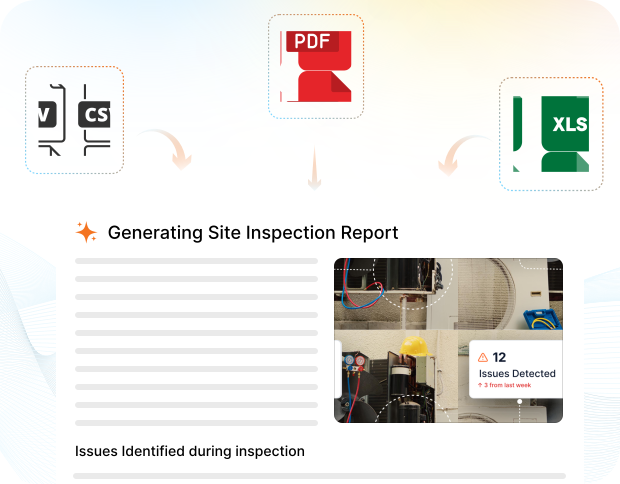
The moment an inspection is submitted, a branded PDF, Excel, or CSV report generates automatically. No manual work. No waiting.

Inspectly360 integrates with the tools your team already uses, including Zoho, Microsoft 365, and SAP. No double entry.
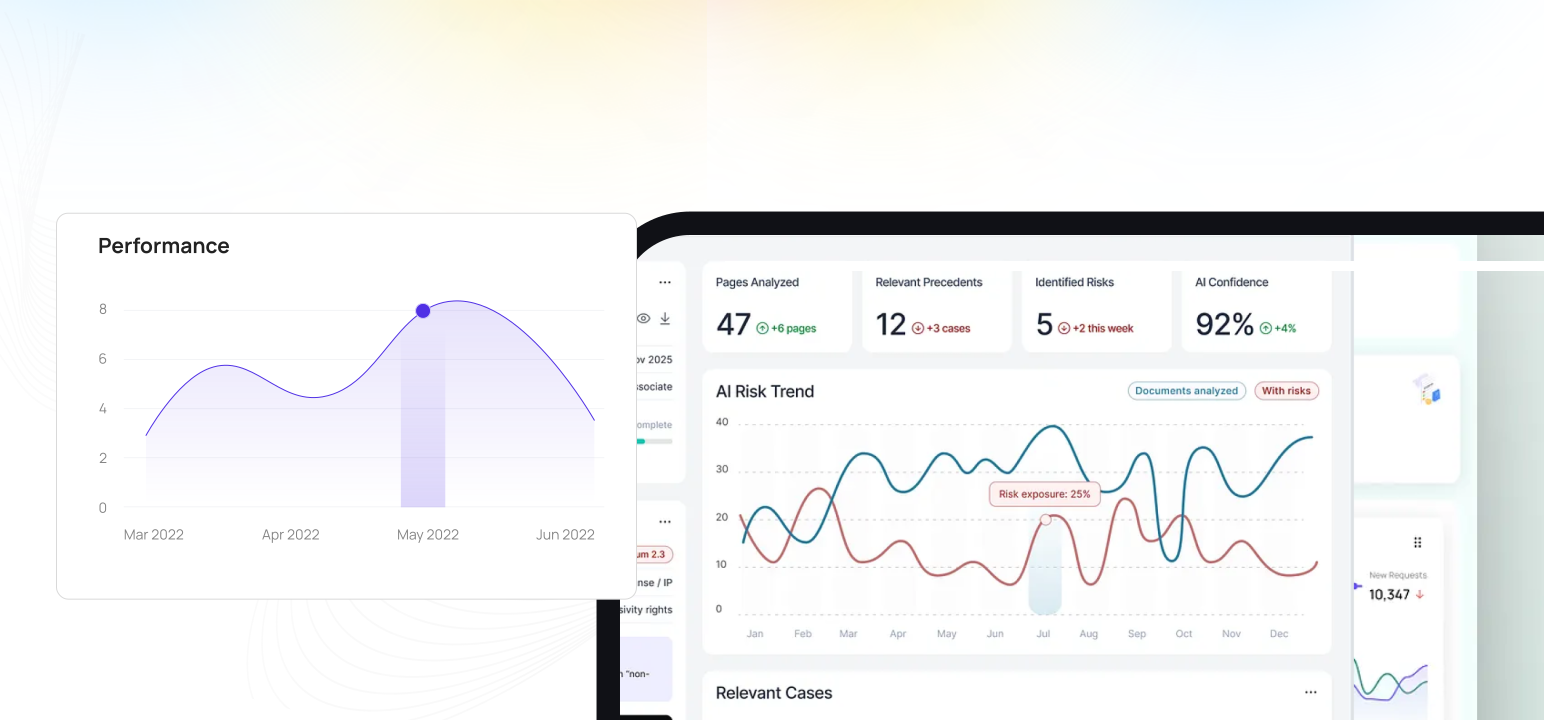
Your operations team sees completion rates, open issues, and compliance scores across all sites in real time. No chasing updates.
What changes once oxygen masks safety software runs on one mobile-first platform with photo proof and live dashboards.
Oxygen masks safety software is the platform Cabin Safety Managers, cabin crew, and Safety Management System teams use to identify, rate, and control hazards in aircraft oxygen systems across a fleet. Inspectly360 captures oxygen hazards such as a portable bottle below minimum pressure, a failed mask drop test, or a regulator fault, rates the risk, and tracks the control action to closure within the cabin SMS, aligned to FAA 14 CFR 121.333 and EASA CAT.IDE.A.235.
Today an oxygen hazard is often noted in a logbook or an email, judged informally, and rarely tracked to a written control action. A portable bottle below its minimum pressure can be flown because the risk was never escalated, and a recurring mask drop fault on one fleet type goes unseen because no one trends the events. Across several bases, the safety manager cannot tell which open oxygen hazards are still unresolved without calling around.
Inspectly360 replaces that with structured hazard management: cabin crew raise an oxygen hazard on iOS or Android in seconds with a photo, location, and severity; the safety team rates the risk and assigns a control action with an owner and deadline; and a below-minimum bottle or failed drop raises an immediate flag before dispatch. Repeat events trend by type, base, and defect so the root cause is visible, and a live SMS dashboard shows open hazards and overdue controls across the fleet.
Cabin safety and SMS teams follow this loop for oxygen hazard reporting, risk rating, and control closure.
Cabin crew report a low-pressure bottle, failed mask drop, or regulator fault on mobile with a photo, location, and severity.
Each oxygen hazard is rated on a consistent scale so a below-minimum bottle is treated the same way at every base.
The safety team assigns a control action with an owner and deadline, and the hazard stays open until the control is verified.
A below-minimum bottle or failed drop raises an immediate flag so the risk is escalated before pushback, not after.
Recurring oxygen events trend by fleet type, base, and defect so the safety team can target the underlying cause.
Answers to common long-tail questions, kept on one canonical page to avoid thin duplicate URLs.
Start with a single fleet type so the oxygen hazard categories, risk-rating scale, and control workflow are validated against real cabin events before rollout to mixed types and other bases.
Cabin crew get hazard reporting, the safety team gets risk rating and control assignment, and Quality Assurance gets read access to trends per tail number through role-based access.
The platform capabilities that power oxygen masks safety software across every site.
Cabin crew raise a low-pressure bottle, failed drop, or regulator fault on mobile in seconds. Why it matters: a hazard noted in a logbook the safety team sees days later cannot be controlled in time.
Each oxygen hazard is rated on a single scale across the fleet. Why it matters: a below-minimum bottle judged informally is treated differently at every base.
Every hazard gets a control action with an owner, deadline, and verified closure. Why it matters: a risk with no assigned control is the gap that lets the same event recur.
A below-minimum portable bottle or failed mask drop raises an instant risk flag. Why it matters: a bottle flown below its minimum is a passenger safety risk that should never reach pushback.
Recurring oxygen events trend by fleet type, base, and defect. Why it matters: a mask drop fault that keeps recurring on one type points to a root cause worth fixing once.
Open oxygen hazards, risk ratings, and overdue controls roll up across tails. Why it matters: the safety manager sees fleet risk without calling each base.
Cabin Safety Managers and SMS teams comparing Inspectly360 to paper hazard forms, email reports, and a spreadsheet risk log see the difference fastest on hazard reporting, risk rating, control actions, repeat-event trends, and fleet-wide safety visibility aligned to FAA 14 CFR 121.333 and EASA CAT.IDE.A.235.
| Topic | Typical Gaps | With Inspectly360 |
|---|---|---|
| Oxygen hazard reporting | A low-pressure bottle or failed mask drop is noted in a logbook that the safety team may see days later. | Cabin crew raise an oxygen hazard on mobile in seconds with photo, location, and severity routed to safety. |
| Risk rating and control | Risk is judged informally and the control action is rarely written down or assigned. | Each oxygen hazard is rated and assigned a control action with an owner and a deadline. |
| Repeat-event trends | Nobody can see that the same mask drop fault keeps recurring on one fleet type. | Trends surface repeat oxygen events by type, base, and defect so the root cause is visible. |
| Mask drop and bottle pressure risk | A portable bottle below minimum pressure is sometimes flown because the risk was never escalated. | A below-minimum bottle or failed drop raises an immediate risk flag before dispatch. |
| Fleet safety visibility | The safety manager calls each base to learn which open oxygen hazards are unresolved. | A live SMS dashboard shows open oxygen hazards, risk ratings, and overdue controls across tails. |
What changes once oxygen masks safety software is standardised on Inspectly360.
Get started with inspection and audit checklist templates.

Use this template to perform a comprehensive safety inspection of light vehicles. This check ensures all critical components are checked ...
Use these apps to run inspections and audits.

by Inspectly360
Streamline facilities inspections with forms, photos, and reports.

by Inspectly360
Building condition and compliance inspections with evidence and follow-ups.

by Inspectly360
Digitize building inspection apps workflows with forms, evidence capture, and automated reporting.

by Inspectly360
Run building inspections on phones and tablets with offline forms, photo evidence, and instant reports.
by Inspectly360
Audit buildings with structured scoring, photo evidence, and corrective action tracking across portfolios.
Cabin crew raise an oxygen hazard on iOS or Android in seconds, recording what they found, where, and how severe it is, with a photo as evidence. A portable bottle below its minimum pressure, a failed mask drop test, or a regulator fault routes straight to the safety team with location and severity. This replaces the logbook note that the safety team might not see for days. Because the report is structured, the safety team can rate the risk and assign a control action immediately, so a hazard that would once have been judged informally now enters the SMS with the detail needed to act on it before the next sector.
Each oxygen hazard is rated on a single consistent scale built into the report, so a below-minimum bottle or a failed mask drop is assessed the same way at every base. The rating drives the urgency of the control action and the escalation. Without this, the same hazard can be treated as minor at one station and serious at another, which undermines the SMS. With a shared scale, the safety manager can compare risk across tails and types, and the trends are meaningful because the inputs are consistent. The rating and its rationale stay on the record, so a later review can see why a hazard was treated as it was.
Yes. When a portable oxygen bottle is logged below its preflight minimum pressure, or a mask drop test fails, the platform raises an immediate risk flag rather than waiting for a periodic review. The flag escalates to the safety team and the responsible engineer so the risk is addressed before pushback, not discovered afterwards. This directly targets the dangerous case where a bottle below minimum is flown because the risk was never escalated. The flag, the reading, and the gauge photo stay on the record, so the decision and its evidence are traceable if the event is later reviewed in the SMS.
Every oxygen hazard is categorised by fleet type, base, and defect, so the platform can surface when the same event keeps recurring. A mask drop fault that appears repeatedly on one type, or a base that reports low-pressure bottles more often than others, becomes visible instead of staying hidden in scattered reports. This lets the safety team target the underlying root cause once, rather than handling each event in isolation. The trend view supports the SMS principle of learning from data, and it gives the quality team the evidence to drive a fix at the type or process level.
Yes, with different access. Cabin crew get a hazard reporting role: they raise an oxygen hazard with photo, location, and severity in seconds. The safety team gets risk rating and control assignment, and Quality Assurance gets read access to trends. A hazard reported by crew routes to the safety team immediately, who rate it and assign a control action with an owner and deadline. This keeps reporting easy for the people closest to the hazard while keeping the risk decisions with the safety team. Access changes are logged, so the trail shows who reported, rated, and closed each oxygen hazard.
Yes. Hazard reporting works fully offline on iOS and Android, which matters on the aircraft and at remote stands where signal is weak. Cabin crew raise an oxygen hazard with a photo while offline, and the report syncs automatically once the device reconnects. The timestamp reflects when the hazard was actually found, not when it synced, which keeps the SMS record accurate. Nothing is lost if the report is made in an area with no coverage, so a low-pressure bottle or failed mask drop is captured at source even when the aircraft has no connectivity at the gate.
Oxygen Masks Safety Software on Inspectly360 connects directly to the inspection apps, checklist templates, forms, industries, and adjacent solutions linked below.
See Inspectly360 in action with a live demo tailored to your needs. No credit card required.