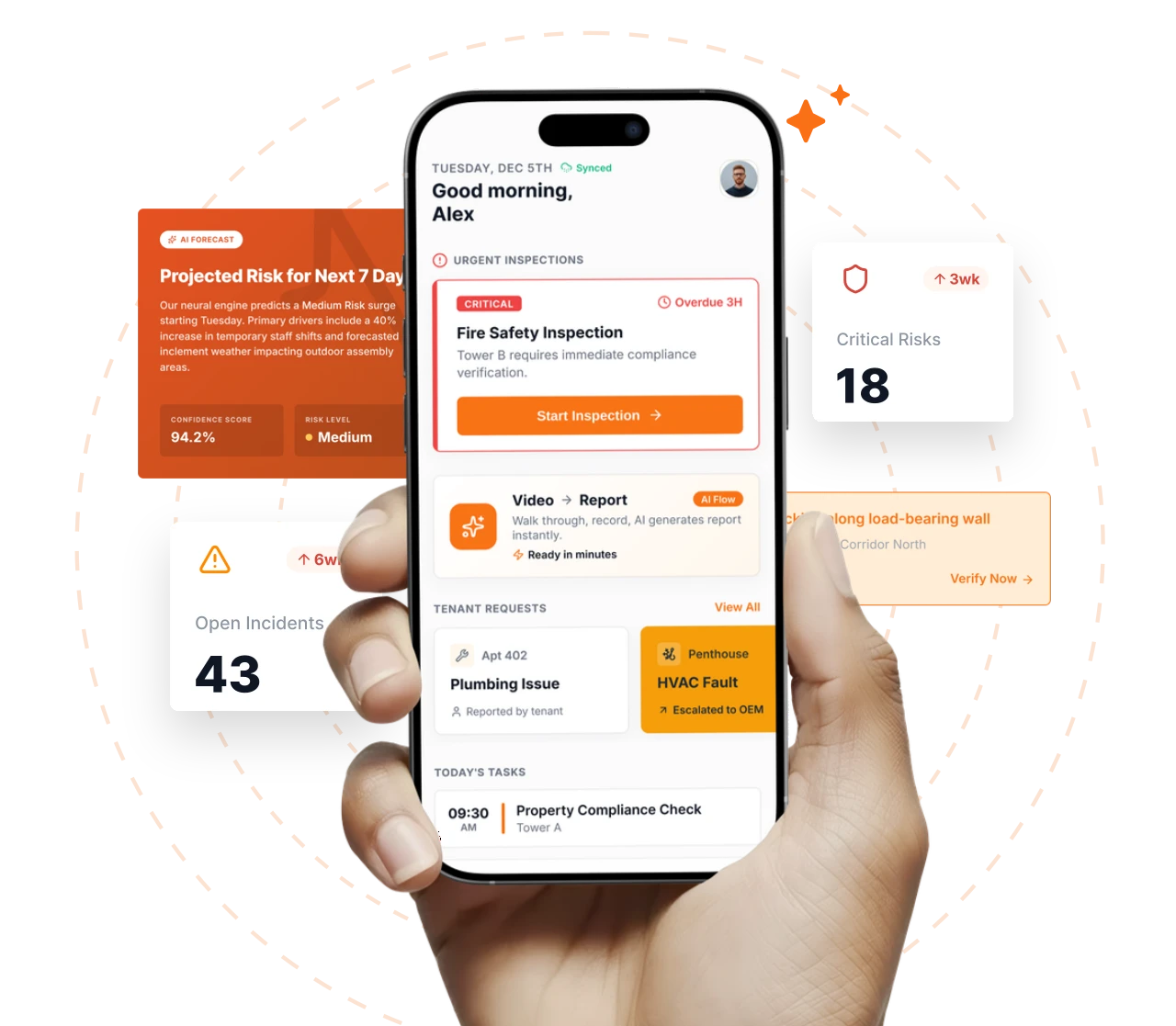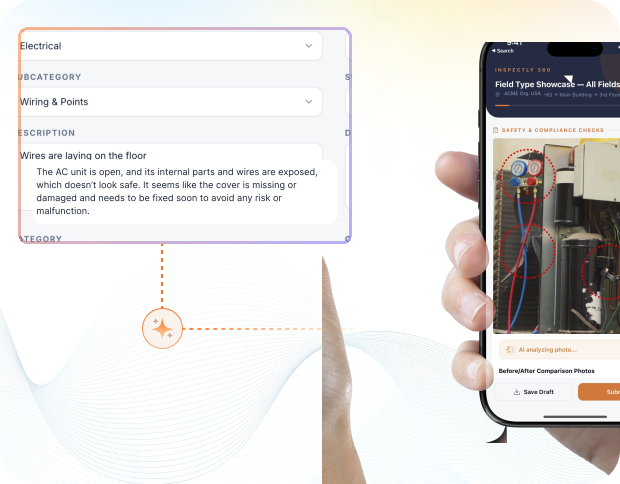
Take a Photo. AI Fills the Form
Your inspector takes a photo of any asset or defect. AI reads it and fills the inspection form automatically. No typing. No manual entry.

Convert your checklist into Mobile App
Construction site inspection compliance software is the regulatory-proof layer beside the field site inspection platform: it carries the CDM 2015 documentation, the statutory inspection evidence, the Building Safety Act 2022 Golden Thread, the warranty defect trails, and the contract administrator records that UK Building Regulations, OSHA 1926, NEC, JCT, FIDIC, and local building regulation each require, structured for retention across the full liability window.
Everything your field team does on paper, Inspectly360 does automatically: faster, more accurate, and without the admin.
Your inspector takes a photo of any asset or defect. AI reads it and fills the inspection form automatically. No typing. No manual entry.
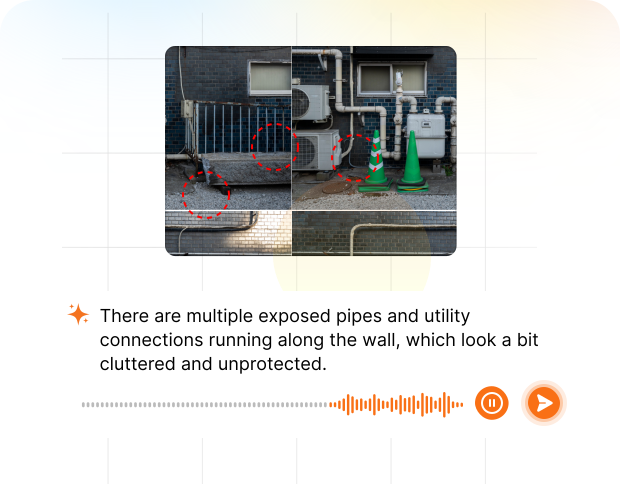
Inspectors speak their observations in any language. AI transcribes and fills the form in real time. Completely hands-free in the field.
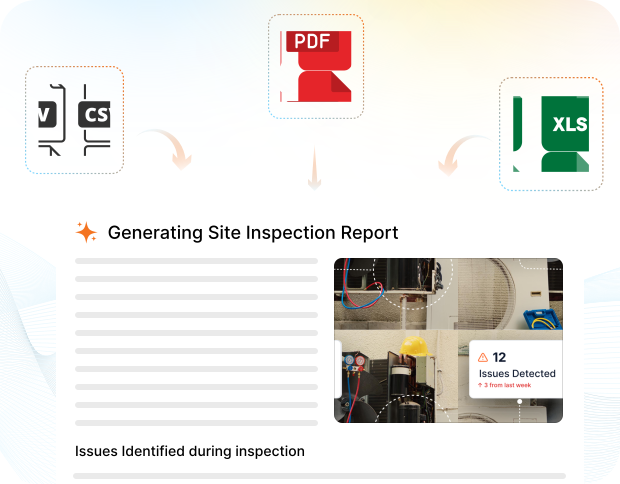
The moment an inspection is submitted, a branded PDF, Excel, or CSV report generates automatically. No manual work. No waiting.

Inspectly360 integrates with the tools your team already uses, including Zoho, Microsoft 365, and SAP. No double entry.
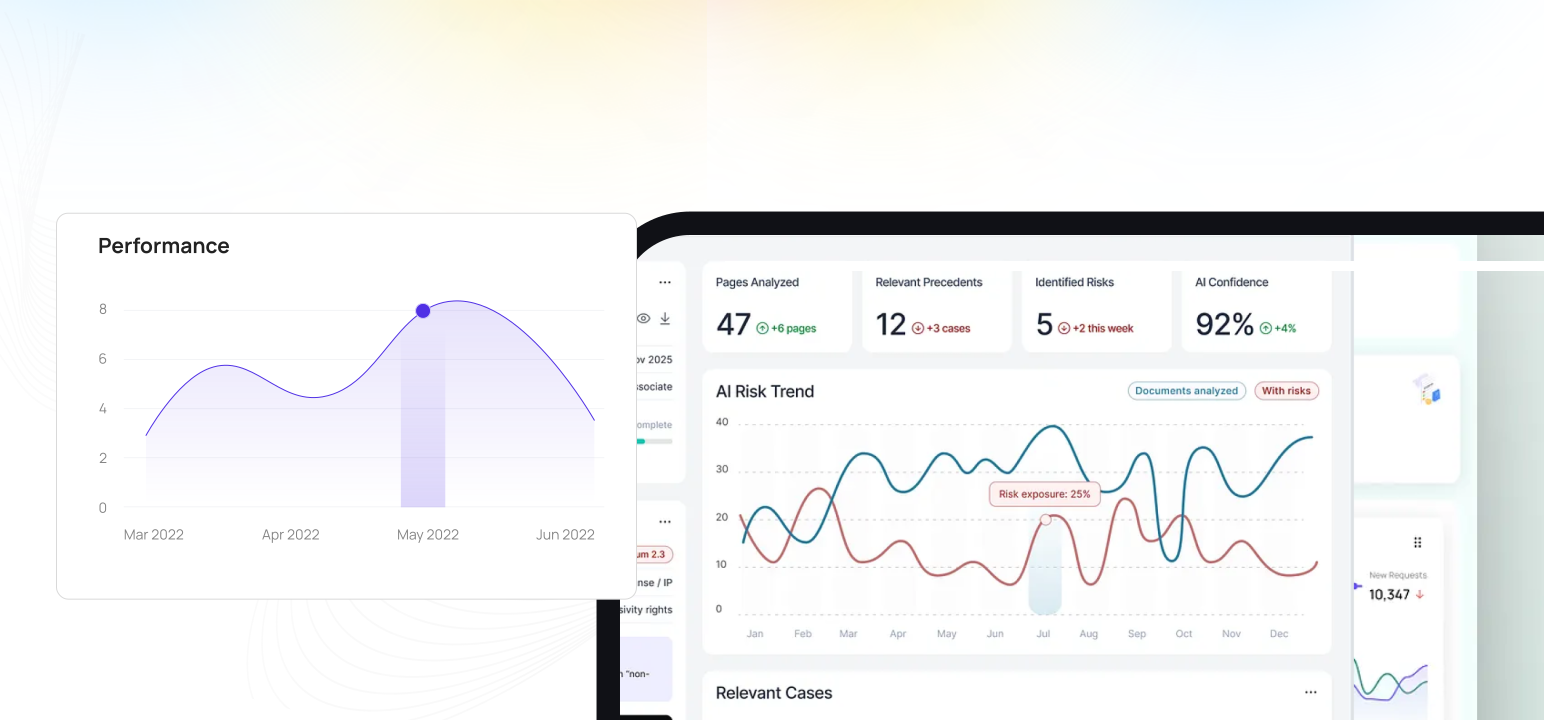
Your operations team sees completion rates, open issues, and compliance scores across all sites in real time. No chasing updates.
What changes once construction site inspection compliance software runs on one mobile-first platform with photo proof and live dashboards.
Construction site inspection compliance software is the regulatory-proof layer beside the field site inspection platform: it carries the CDM 2015 documentation, the statutory inspection evidence, the Building Safety Act 2022 Golden Thread, the warranty defect trails, and the contract administrator records that UK Building Regulations, OSHA 1926, NEC, JCT, FIDIC, and local building regulation each require, structured for retention across the full liability window. Inspectly360 is built for principal contractors, construction directors, and compliance officers who carry personal accountability for HSE inspector visits, CDM claims, Building Safety Act obligations, and warranty defences.
For compliance programmes, the platform replaces paper CDM files, PDF statutory folders, and Excel compliance trackers with one defensible record aligned to CDM 2015 principal contractor obligations, UK Building Regulations Parts A-Q, Building Safety Act 2022 Gateway processes, OSHA 1926 construction standards, NHBC Standards, NEC quality plan obligations, JCT inspection regimes, and FIDIC engineer audit requirements. Every inspection on a regulated project carries timestamped photos, geofenced location, named inspector, and the statutory template version in force.
For the principal contractor, the compliance record survives the full liability window (commonly 6 years under CDM 2015, 12 years residential JCT, 7 years NHBC, longer per regional insurance retention) with audit-grade event logs that survive litigation hold. HSE inspector visits, building control reviews, contract administrator audits, and warranty defences open with the same evidence the field captured. FFI exposure drops because evidence gaps stop being the dominant finding pattern.
Construction compliance runs a different cadence to field execution; the five-step loop below is what principal contractors standardise to keep regulatory proof intact across the full liability window.
Tag every inspection template item with the regulatory framework it satisfies (CDM 2015 principal contractor obligations, UK Building Regulations Parts A-Q, OSHA 1926 construction standards, Building Safety Act 2022 Gateway processes, NHBC Chapters, RERA Schedules, NBC Sections, IS codes). The map turns the field walk into a structured compliance record by design.
CDM 2015 inspection cycles, building control milestones, OSHA 1926 inspection windows, Higher-Risk Building Gateway One/Two/Three reviews, NHBC technical inspections, and lift licence renewals schedule against project programme dates. Retention windows configure per contract type.
Compliance inspections capture timestamped photos, geofenced location, named inspector identity, and the statutory template version in force. Mandatory evidence rules apply per regulatory item; submissions that lack required evidence are rejected.
HSE inspector packs, building control completion certificates, Higher-Risk Building Gateway submissions, NHBC technical inspection PDFs, OSHA 300 logs, and contract administrator reviews export from the same record in the format each regulator accepts.
Audit-grade event logs, statutory inspection records, building control sign-offs, and subcontractor closure trails preserve for the configured retention window. Warranty claims years after handover open with the original record intact.
Answers to common long-tail questions, kept on one canonical page to avoid thin duplicate URLs.
Inspectly360 sits as the principal contractor's compliance-evidence layer beside CDM document control systems and the Building Safety Regulator portal. CDM Compliance Manager, Procore, Aconex, and Asite continue to hold the construction phase plan, F10 notifications, and document control. The Building Safety Regulator's Gateway portal continues to run Higher-Risk Building statutory submissions. HSE's RIDDOR portal continues to run statutory incident notifications. Inspectly360 produces the principal contractor's evidence trail that each authority expects to see at inspection time.
Principal contractors should validate seven retention requirements: configurable retention per regulatory framework (6 years CDM 2015, 12 years residential JCT, 7 years NHBC, 10 years insurance product liability, 30 years for certain construction product warranties); audit-grade event logs that survive litigation hold; encrypted at-rest evidence; regional data residency; certified retention expiry with final exports; legal-hold flags that pause retention purges during active claims; and bulk export to corporate archive systems.
Production construction compliance programmes carry subcontractor PII, client representative data, and inspection evidence that HSE inspectors, building control officers, CDM auditors, and corporate insurance auditors may request years later. Inspectly360 supports configurable retention, audit-grade event logs, encrypted at-rest evidence, regional data residency, and legal-hold flags. RBAC enforcement happens server-side.
Existing paper CDM files, PDF statutory folders, and Excel compliance trackers batch-import as searchable evidence against the same project. Historical statutory inspections carry forward with the original evidence attached. Building control completion certificates, F10 notifications, NHBC technical inspection reports, and OSHA 300 logs seed from the current project record.
The platform capabilities that power construction site inspection compliance software across every site.
Principal contractors and construction directors comparing Inspectly360 to paper CDM files, PDF statutory folders, and Excel compliance trackers care about five things specific to construction site compliance: whether HSE inspector unannounced visits open with proof rather than reconstruction, whether CDM 2015 documentation survives the principal contractor's liability window, whether Building Safety Act 2022 Golden Thread obligations meet for Higher-Risk Buildings, whether regulatory updates flow into the inspection template library, and whether warranty defence years after handover opens with original evidence.
| Topic | Typical Gaps | With Inspectly360 |
|---|---|---|
| HSE inspector unannounced visit readiness | HSE inspectors arrive unannounced; the site team scrambles through paper files, photo galleries, and email threads for the last 12 weeks of inspections. Findings on documentation gaps surface repeatedly; FFI fees apply. | HSE inspector packs export in one click with the last 12 weeks of inspections, photo evidence, named inspectors, and the statutory template version in force. The inspector sees the same record the site captured rather than a reconstruction. |
| CDM 2015 documentation through the liability window | CDM documentation lives in PDF folders on local drives. When the principal contractor's CDM liability claim arrives years after handover, half the records cannot be located. | Configurable retention per contract type with audit-grade event logs that survive litigation hold. CDM 2015 documentation stays intact for the principal contractor's full liability window. |
| Building Safety Act 2022 Golden Thread obligations | Higher-Risk Building Gateway One, Two, and Three documentation lives in disconnected systems. The Golden Thread of information breaks between design, construction, and occupation phases. | Higher-Risk Building Gateway evidence trails carry across the construction phase with the Accountable Person assigned. Mandatory occurrence reporting integrates through structured incident capture; the Golden Thread maintains across phases. |
| Regulatory template updates flow into the inspection library | Building Regulation amendments, OSHA 1926 letters of interpretation, and Building Safety Act guidance reach the site team through industry press; the inspection template still inspects against the previous version. | Regulatory template marketplace surfaces updates per framework (UK Building Regulations, OSHA 1926, NBC chapters, IS codes, NHBC Standards). Updates publish to the corporate library; the audit trail records when the upgrade happened. |
| Warranty defence years after handover | A warranty claim arrives eight years after handover; the principal contractor cannot find the original inspection record, the building control file, or the subcontractor closure photos. The claim settles on cost because the evidence does not exist. | Warranty claims open with the full handover record, the inspection walk evidence, and the subcontractor closure trail intact for the configured retention window. Many claims close without payout because the defect was outside the principal contractor's scope. |
What changes once construction site inspection compliance software is standardised on Inspectly360.
Get started with inspection and audit checklist templates.

Catch defects before handover and generate punch list reports in minutes. Room-by-room finish checks, evidence, and corrective actions.

Pre-handover snagging for new build apartments. Room-by-room finish checks, MEP, and defect tracking before keys.
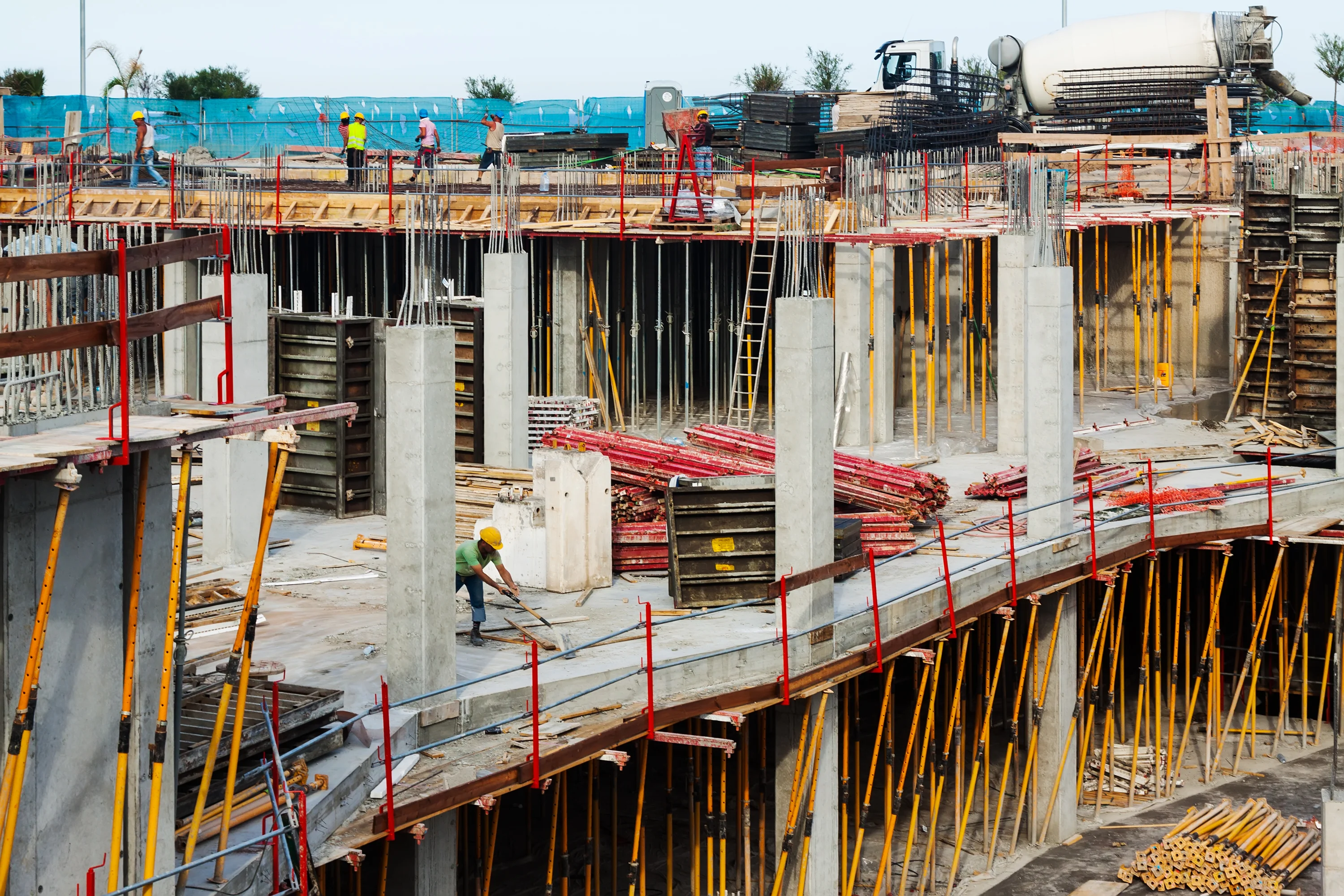
Utilize this Scaffolding Safety Inspection Checklist to spot hazards, verify stability, and ensure compliance with safety standards before work begins.

Capture job details, measurements, work performed, photos, and sign-offs in one structured field service report form.
Use these apps to run inspections and audits.
by Inspectly360
Manage construction compliance workflows with documented evidence and audit-ready records.

by Inspectly360
Track construction compliance obligations, deadlines, and evidence trails across active sites.
by Inspectly360
Execute construction apps workflows with field evidence capture and accountable follow-up actions.

by Inspectly360
Execute construction audits with structured findings, assignment tracking, and verified closure.

by Inspectly360
Run construction safety checks with hazard tracking, corrective actions, and closure verification.
Every inspection on a regulated project carries timestamped photos, a geofenced location, the named inspector, and the CDM 2015 template version that was in force. When an HSE inspector visits unannounced, the principal contractor exports the HSE inspector pack in one click rather than scrambling through paper files. The inspector then sees the same evidence the principal contractor holds, so there is no gap between what was claimed and what can be shown. Fee For Intervention exposure drops because the evidence chain was built from day one rather than reconstructed on the day of the visit. Because the record is captured as the work happens, an unannounced visit becomes a routine export rather than a crisis, and the contractor can demonstrate exactly which inspections ran, when, and by whom.
CDM 2015 principal contractor obligations cover documentation, inspection, coordination, and information sharing. Inspectly360 produces the documented inspection evidence, the coordination records between contractors, and the information-sharing trail through scoped read-only access for designers, principal designers, and clients. Audit-grade event logs survive any litigation hold for the full CDM liability window, commonly six years. Because the coordination and information-sharing duties are met through the same system that captures the inspections, the principal contractor can show not just that checks happened but that the right parties were kept informed, which is the part of CDM that paper trails usually fail to evidence. When the HSE or a client asks how the duties were discharged, the answer is an export rather than a reconstruction.
Higher-Risk Buildings, meaning those over 18 metres or 7 storeys with residential use, require structured information through the Gateway One, Two, and Three processes. Inspectly360 carries the Gateway evidence trail: design intent at Gateway One, construction completion at Gateway Two, and occupation at Gateway Three with the Accountable Person assigned. Mandatory occurrence reporting is handled through structured incident capture, so a reportable occurrence is logged, routed, and evidenced in the same system. The Golden Thread of information is maintained across the construction phase, the handover, and the in-use phase, so the building's safety record is continuous rather than reset when responsibility moves. For the principal contractor, that means the Gateway Two completion evidence is assembled as the work proceeds rather than reconstructed under deadline at handover.
Retention is configured per regulatory framework: 6 years under CDM 2015 principal contractor obligations, 12 years for residential JCT under the Defective Premises Act 1972, 7 years for NHBC Buildmark cover, 10 years for insurance product liability, and varying periods for FIDIC. Audit-grade event logs survive any litigation hold placed during the full retention window, so a record cannot be altered or purged while a dispute is live, and legal-hold flags pause retention purges during active disputes. Because each framework runs on its own clock against the record it applies to, a single project can be held to the longest applicable window without forcing every document onto one blanket period. When a window finally closes, the record is purged under the corporate policy, with a certified export available first.
Inspection template items are tagged with the relevant UK Building Regulations Approved Document Part: A (structure), B (fire safety), C (resistance to moisture), D (toxic substances), E (sound), F (ventilation), G (sanitation), H (drainage), J (combustion appliances), K (protection from falling), L (conservation of fuel and power), M (access), N (glazing), P (electrical safety), and Q (security). Building control sign-offs export in the format building control bodies accept. Because each inspection is tagged to the Part it evidences, a building control officer or approved inspector can be shown exactly the records relevant to their decision rather than the whole project file. That turns a building control sign-off from a document-gathering exercise into a filtered export of evidence that already exists.
OSHA 29 CFR 1926 construction standards are mapped to each inspection template item across the subparts: fall protection, scaffolding, electrical, demolition, excavations, concrete, and steel erection. OSHA 300, 300A, and 301 log generation aligns with the recordable-incident requirements, so the recordkeeping is a by-product of the inspection data rather than a separate compile cycle. Construction qualified-person and competent-person designations are bound to inspector identity, so a check that requires a competent person can only be signed off by one. OSHA inspection records export in OSHA-accepted documentation patterns, so when a compliance officer arrives, the principal contractor produces the evidence in the format the agency expects rather than reformatting it under pressure during the visit.
Construction Site Inspection Compliance Software on Inspectly360 connects directly to the inspection apps, checklist templates, forms, industries, and adjacent solutions linked below.
See Inspectly360 in action with a live demo tailored to your needs. No credit card required.