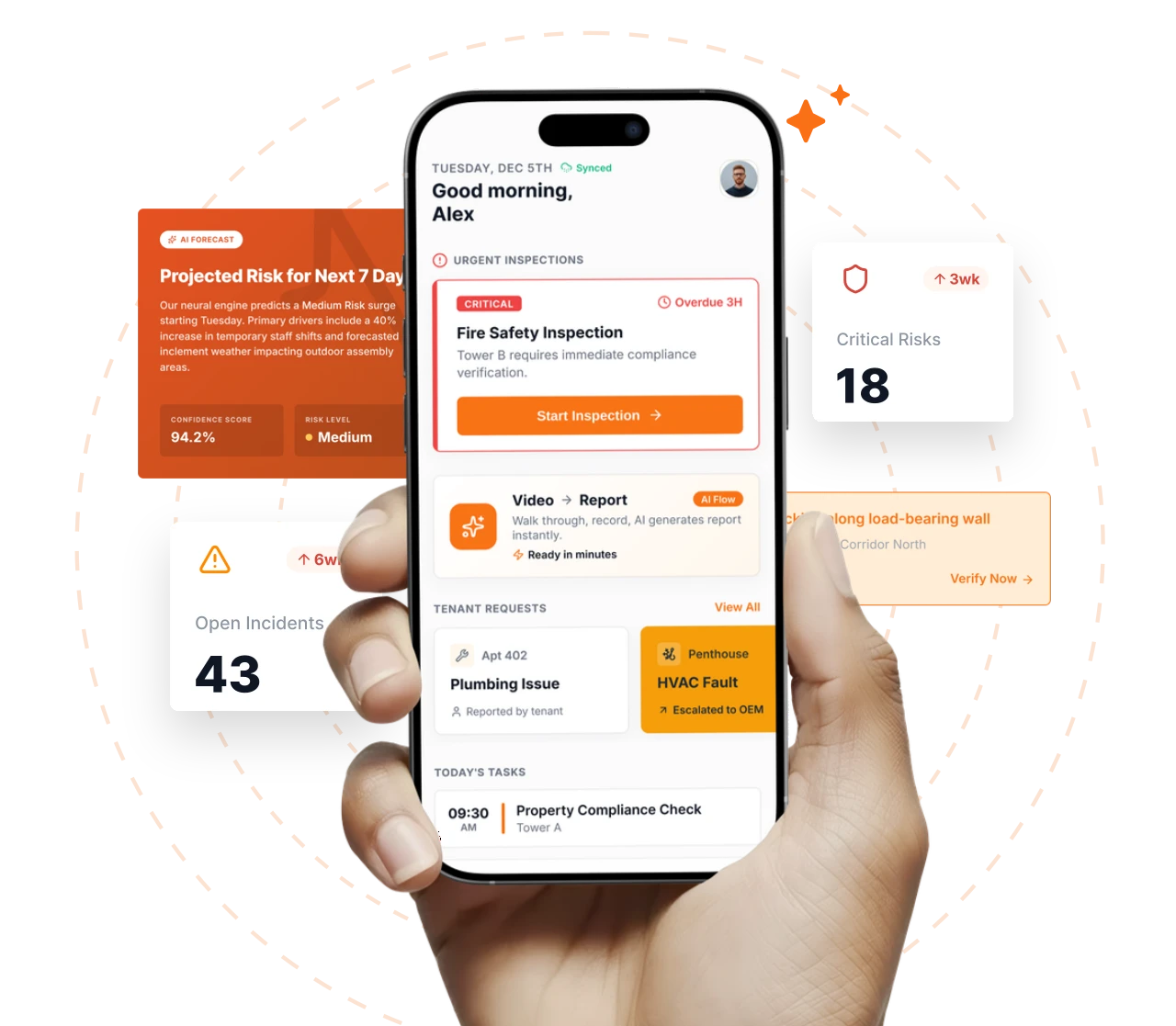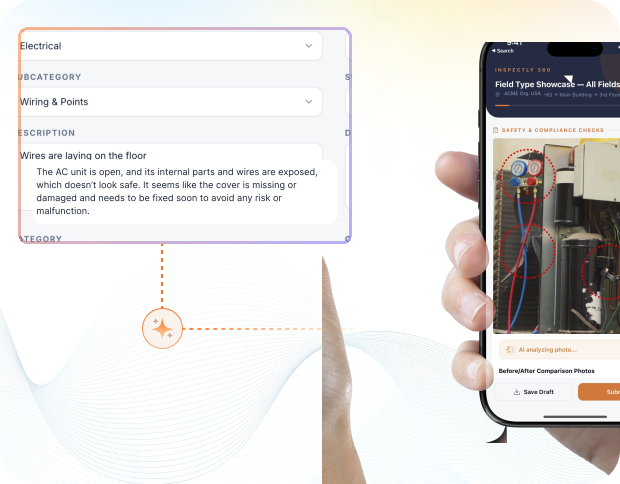
Take a Photo. AI Fills the Form
Your inspector takes a photo of any asset or defect. AI reads it and fills the inspection form automatically. No typing. No manual entry.

Convert your checklist into Mobile App
Common area inspection compliance software is a regulatory mapping and evidence system that connects ISO 41001 facility management requirements, NFPA 101 fire egress obligations, ADA and EN 301 549 accessibility standards, body corporate and strata bylaws, and RERA common-area maintenance rules to the actual lobby, corridor, stairwell, elevator, mail room, gym, and pool inspection workflows running in residential towers and mixed-use buildings.
Everything your field team does on paper, Inspectly360 does automatically: faster, more accurate, and without the admin.
Your inspector takes a photo of any asset or defect. AI reads it and fills the inspection form automatically. No typing. No manual entry.
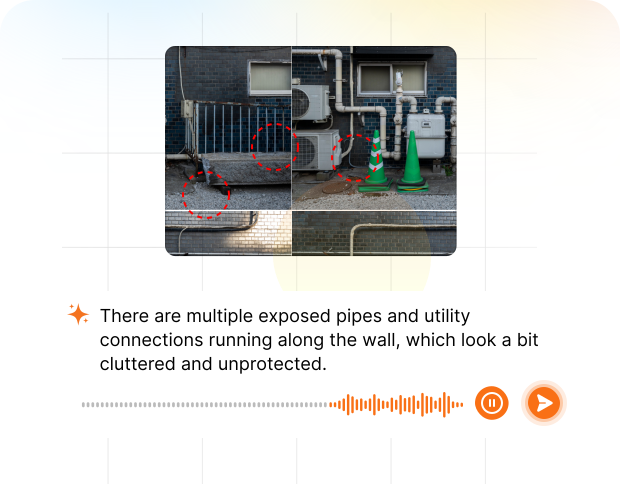
Inspectors speak their observations in any language. AI transcribes and fills the form in real time. Completely hands-free in the field.
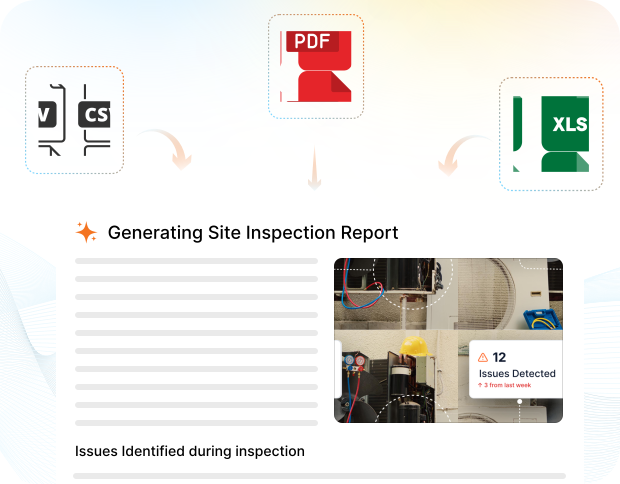
The moment an inspection is submitted, a branded PDF, Excel, or CSV report generates automatically. No manual work. No waiting.

Inspectly360 integrates with the tools your team already uses, including Zoho, Microsoft 365, and SAP. No double entry.
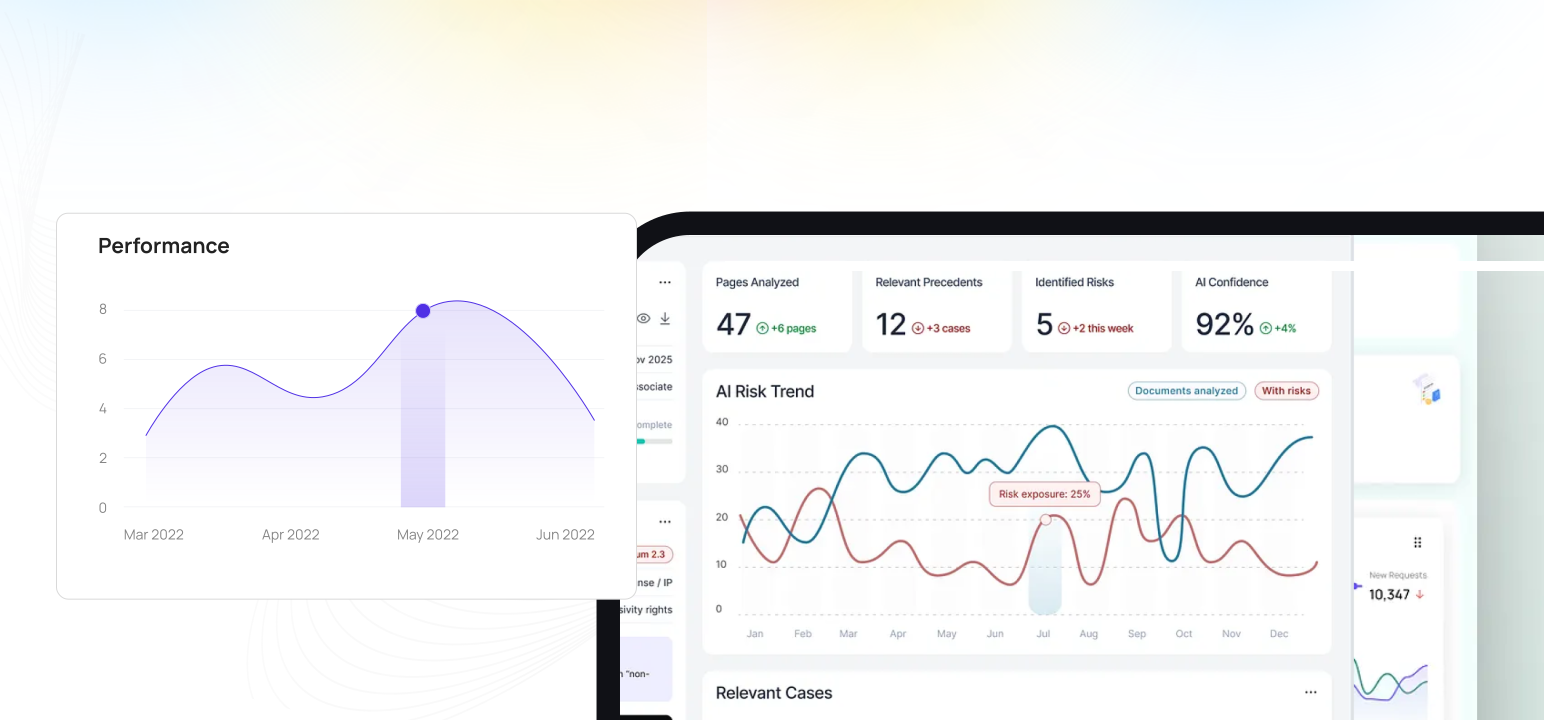
Your operations team sees completion rates, open issues, and compliance scores across all sites in real time. No chasing updates.
What changes once common area inspection compliance software runs on one mobile-first platform with photo proof and live dashboards.
Common area inspection compliance software is a regulatory mapping and evidence system that connects ISO 41001 facility management requirements, NFPA 101 fire egress obligations, ADA and EN 301 549 accessibility standards, body corporate and strata bylaws, and RERA common-area maintenance rules to the actual lobby, corridor, stairwell, elevator, mail room, gym, and pool inspection workflows running in residential towers and mixed-use buildings. Inspectly360 is built for compliance managers, property managers, body corporate officers, and FM directors who carry accountability for proving shared-space compliance to regulators, committees, and owners — not for teams that treat compliance as a filing exercise separate from field operations.
For building teams, compliance obligations translate into scheduled inspection tasks on mobile with mandatory evidence rules. The concierge or FM lead scans a stairwell QR, the NFPA egress template opens with required photo checkpoints, accessibility fields capture door clearance and ramp gradient, and AI Visual Inspection flags blocked exits or missing signage for human confirmation. Every completed walk attaches to the obligation register entry it satisfies.
For compliance managers and committees, the obligation register shows which regulatory requirements are current, overdue, or at risk across the portfolio. Branded compliance packs for ISO 41001 surveillance, fire marshal review, accessibility audit, body corporate AGM, and RERA disclosure generate from field evidence rather than reconstructed spreadsheets. CAPA items from compliance failures carry verified closure before the obligation status returns to green.
Compliance managers typically build common area compliance programmes in this sequence before scaling across the tower portfolio.
Map ISO 41001 clauses, NFPA egress requirements, ADA checkpoints, body corporate bylaws, and RERA common-area rules to inspection task types with cadence, evidence rules, and responsible roles per tower.
Publish versioned templates for fire egress walks, accessibility checks, amenity safety inspections, and bylaw compliance verifications with mandatory photos and conditional escalation on critical failures.
Cadence engine publishes compliance walks to building teams on schedule. Overdue obligations escalate to compliance managers before regulatory deadlines pass.
Building teams execute walks on mobile with offline capture. Failures promote to CAPA with regulatory severity tagging, named owners, and photo-verified closure gates.
ISO 41001 surveillance packs, fire marshal evidence, accessibility audit reports, body corporate AGM summaries, and RERA disclosure exports generate from the obligation register and field evidence.
Answers to common long-tail questions, kept on one canonical page to avoid thin duplicate URLs.
Inspectly360 sits as the field compliance evidence layer beside enterprise GRC platforms and CAFM systems. GRC continues to hold policy registers, risk assessments, and corporate compliance dashboards. Inspectly360 owns the field proof: which stairwell walk satisfied NFPA egress this month, which lobby accessibility check covered ADA door clearance, which pool inspection met RERA maintenance disclosure. Compliance status flows up to GRC via API; obligation registers flow down to field devices as scheduled tasks.
Compliance managers should validate: obligation register mapping to ISO 41001, NFPA, ADA, bylaws, and RERA requirements; template versioning with regulatory change tracking; escalation rules on critical compliance failures (blocked egress, pool safety); offline capture in stairwells and basement amenities; retention periods aligned to strata, fire marshal, and RERA record-keeping rules; and export formats matching auditor and regulator expectations.
Compliance evidence may be disclosed to fire marshals, accessibility auditors, body corporate committees, RERA authorities, and owner AGMs. Inspectly360 maintains immutable evidence trails with configurable retention per regulatory framework. RBAC ensures compliance packs export only the scope appropriate to each recipient — fire marshal packs exclude resident PII; RERA packs include maintenance records without internal CAPA commentary.
Regulatory change management links template version updates to obligation register entries. When NFPA 101 updates egress signage requirements or a body corporate amends amenity bylaws, compliance managers publish template changes that propagate to scheduled tasks with documented effective dates. Towers running prior template versions complete their current cycle before switching, with version history preserved for auditor review.
The platform capabilities that power common area inspection compliance software across every site.
Compliance managers comparing Inspectly360 to spreadsheet obligation registers, generic GRC platforms, and paper fire-egress logs care about five things specific to common-area compliance: whether ISO 41001 obligations map to actual inspection tasks, whether fire egress evidence survives NFPA scrutiny, whether accessibility checks cover ADA and EN requirements, whether body corporate bylaws translate to field workflows, and whether RERA common-area obligations in India produce export-ready evidence.
| Topic | Typical Gaps | With Inspectly360 |
|---|---|---|
| ISO 41001 obligation-to-inspection mapping | ISO 41001 certification exists on paper; common-area inspection tasks live in a separate spreadsheet. Auditors ask which lobby walk proves performance evaluation clause 9.1 and the manager searches email for last year's PDF. | ISO 41001 clauses map directly to scheduled inspection tasks with evidence rules. Performance evaluation exports show which common-area walks satisfied which clause this quarter, without reconstructing from archives. |
| NFPA fire egress and stairwell evidence | Monthly stairwell checks ticked on a register in the plant room. Fire marshal inspection asks for photos of blocked exits, damaged fire doors, or missing signage and the building manager has no timestamped record. | NFPA 101-aligned egress templates require photo evidence at every stairwell checkpoint. Fire marshal and body corporate packs export with inspector identity, timestamps, and linked photos. |
| ADA and accessibility compliance in lobbies and amenity spaces | Accessibility checks happen ad hoc when a resident complains. Door clearances, ramp gradients, elevator button heights, and pool lift availability have no scheduled verification or photo record. | Scheduled accessibility templates cover lobby entrances, corridor widths, elevator controls, amenity access, and pool lifts with measurement fields and photo evidence. Compliance gaps surface on schedule, not on complaint. |
| Body corporate bylaw enforcement in shared spaces | Bylaws governing common-area use, pet policies in lobbies, bike storage in corridors, and amenity booking rules enforced reactively when a resident breaches. No inspection cadence verifies ongoing compliance. | Bylaw-aligned inspection templates verify ongoing compliance with storage rules, signage, amenity conditions, and shared-space use policies. Evidence attaches to the zone record for committee enforcement actions. |
| RERA common-area compliance for India portfolios | RERA common-area maintenance obligations tracked in Excel with no field evidence. Regulatory inspection or owner association review scrambles to produce lobby, corridor, and amenity maintenance records. | RERA-aligned common-area inspection schedules produce export-ready evidence packs with maintenance records, photo proof, and CAPA closure trails mapped to regulatory disclosure requirements. |
What changes once common area inspection compliance software is standardised on Inspectly360.
Get started with inspection and audit checklist templates.

Standard site-level inspections for construction, safety, and compliance. Capture conditions, photos, and follow-ups in one place.

Inspect assets and equipment: condition, location, photos, and maintenance history. Track condition over time.

Complete work orders with checklist items, photos, and sign-off. Track completion and proof of work.

Preventive and corrective maintenance inspections. Log repairs, parts, and condition with photos and follow-ups.
Use these apps to run inspections and audits.

by Inspectly360
Inspect common area with structured checks, photo evidence, and corrective action tracking.

by Inspectly360
Run common area inspections on phones and tablets with offline forms, photo evidence, and instant reports.

by Inspectly360
Audit common area inspection programmes with weighted scoring, photo evidence, and corrective action tracking.
by Inspectly360
Run common area inspections on Android phones and rugged tablets with offline forms and photo capture.
The obligation register links each ISO 41001 clause (planning, support, operation, performance evaluation, improvement) to inspection task types with defined cadence and evidence rules. Clause 9.1 performance evaluation maps to scored common-area audit walks; clause 8.1 operational planning maps to scheduled lobby and corridor rounds; clause 10.2 corrective action maps to CAPA workflows. ISO 41001 surveillance audits export showing which clauses were satisfied by which field activities this period, with photo evidence linked to each entry. That mapping is what lets an FM team demonstrate ISO 41001 conformance from the work it already does, because each clause is evidenced by the routine inspections, audits, and CAPAs rather than by a separate compliance exercise assembled for the surveillance visit.
Yes. Export filters generate fire marshal packs with full egress route photos, inspector credentials, and NFPA 101 criterion references, while body corporate packs summarise egress status with critical findings only. The same field evidence serves both audiences; export scope controls what each recipient sees. Critical egress failures trigger immediate escalation to building management and optional committee notification regardless of export timing. Producing a full technical pack for the fire marshal and a summary for the committee from the same field evidence means neither audience is given the wrong level of detail, and the critical-egress escalation runs immediately on its own rather than waiting for whichever report cycle comes next.
Accessibility templates include grandfathering notes and measurement fields for door clearances, ramp gradients, elevator button heights, and corridor widths. Older towers run the same template with documented exceptions where structural modification is not feasible, satisfying auditor expectations for reasonable accommodation records. Scheduled checks verify that existing accommodations (portable ramps, visual alerts, pool lifts) remain functional rather than assuming one-time installation equals ongoing compliance. That distinction matters on legacy buildings, because an accessibility duty is met not by installing a ramp once but by keeping it, the visual alerts, and the pool lift working; scheduling the verification turns a static accommodation record into evidence that the accommodation is actually maintained.
RERA-aligned templates cover common-area maintenance obligations including lobby upkeep, corridor lighting, stairwell safety, lift maintenance evidence, amenity operation, and parking area condition. Inspection schedules produce export-ready maintenance records with photo proof and CAPA closure trails mapped to RERA disclosure requirements. Owner association reviews and authority inspections receive packs formatted for regulatory submission without manual reconstruction from building manager files. That matters because RERA common-area obligations are exactly the maintenance items owners and authorities scrutinise, so producing the records as a by-product of the routine inspections means an owner association review or an authority inspection opens with the evidence already in the required format rather than a scramble to assemble it.
Template version control links bylaw amendments to inspection template updates with effective dates. Compliance managers publish the new template version; towers complete their current scheduled cycle on the prior version unless the bylaw change is safety-critical (in which case immediate re-inspection triggers). Version history preserves evidence captured under both old and new requirements for committee and auditor review. That means a mid-cycle bylaw change is adopted on a controlled date with a clear record of which requirement applied when, so a tower is never judged against a rule that was not in force at the time, while a genuinely safety-critical change still triggers immediate re-inspection rather than waiting for the cycle to end.
Yes. Each tower carries its own obligation register forked from the corporate parent with tower-specific bylaw mappings, regional regulatory requirements (NFPA in the US, UK Building Safety Act, UAE fire code, India RERA), and amenity-specific rules. Portfolio compliance dashboards roll up status consistently while respecting tower-level differences. FM directors see aggregate posture; building managers see tower-specific obligations. That lets a single portfolio span very different regimes, a tower under US NFPA, one under the UK Building Safety Act, one under India RERA, without forcing them onto one set of rules, so each building answers to its own regulator while the FM director still gets one comparable view of compliance posture across the estate.
Common Area Inspection Compliance Software on Inspectly360 connects directly to the inspection apps, checklist templates, forms, industries, and adjacent solutions linked below.
See Inspectly360 in action with a live demo tailored to your needs. No credit card required.