
“Inspectly360 transformed how we manage site safety inspections. The offline capability alone saved us countless hours. Our compliance rate jumped from 72% to 96% in just three months.”
Sarah Mitchell
Meridian Construction Group

Convert your checklist into Mobile App
Looking for risk register software built around how your team manages risk? We provide it. Inspectly360 delivers a tailored risk register solution on our platform, configured to your risk scoring, owners, and controls. Book a demo to scope it.
Risk register software keeps a live, central record of the risks an organisation has identified, and keeps them moving: scored, owned, controlled, and reviewed. Inspectly360 provides a risk register solution tailored to your operation, built on our workflow and records platform and configured to your risk scoring, categories, and review cadence.
Most risk registers are a spreadsheet that is built for an audit and then abandoned. Risks have no owner, scores are never revisited, mitigation actions are not tracked, and residual risk is a column nobody updates. The register describes risk as it was months ago, not as it is, so it cannot guide a decision.
We deliver your risk register solution in five steps, from scoping your risk scoring to rollout and support.
We map your risk categories, scoring scale, owners, and review cadence, so the register matches how your organisation actually manages risk.
We build the risk register on the platform with likelihood and impact scoring, categories, owners, and the fields your process needs.
We configure mitigation and treatment actions, controls, residual risk, review dates, and escalation, so risks are managed rather than logged.
You run the register with one team or project, so scoring, ownership, and review are proven before it scales across the organisation.
We roll the solution across your projects and functions and support it, with risk dashboards live for your risk and leadership teams.
A risk register covers the ongoing record of identified risks and their management: identification, scoring, owners, mitigation, controls, residual risk, and review. The scope below is what the register holds and keeps current, which is distinct from the hazard identification and risk assessment that finds and assesses a risk in the first place.
Inspectly360 is the risk register and evidence layer beside your GRC or project system, not a replacement for it. A GRC platform may hold enterprise policy and audit, and a project system holds programme and cost. Inspectly360 owns the working register: identification, scoring, owners, mitigation actions, controls, residual risk, and reviews. Risk records link back to the project, site, or function, so the register and its evidence sit beside your systems of record without duplicating them.
Validate four things during the pilot rather than after. First, that risks can be captured and scored on your matrix with owners. Second, that mitigation actions and controls are tracked. Third, that residual risk is reassessed and reviews are scheduled and escalate. Fourth, that risk rolls up to a dashboard across teams. Run one team or project so the score, own, control, and review loop is proven on real risks before it scales.
Risk data informs leadership decisions, so its integrity matters. Inspectly360 enforces role-based access so teams manage their risks, risk managers review scoring and controls, and leadership sees exposure across the organisation. Risks, scores, actions, controls, and reviews are logged and retained for the period your risk and audit teams require, so any claim about how a risk was managed can be traced to its evidence with time and author preserved.
A risk-register rollout works best team by team or project by project rather than all at once. Start where risk visibility matters most or a review is due, prove the scoring, ownership, and review loop there, then extend. Existing risk spreadsheets import so teams do not start empty. Because the register is configuration rather than code, each area can carry its own categories while exposure rolls up to one organisation-wide view for risk leadership.
What Risk Register Software covers for your team.
Teams comparing Inspectly360 to a risk spreadsheet see the difference on five points: currency, ownership, mitigation, residual risk, and visibility.
| Capability | Without Inspectly360 | With Inspectly360 |
|---|---|---|
| Currency | The register is built for an audit and then abandoned, so it describes risk as it was, not as it is. | Risks are reviewed on cadence with status, so the register reflects the current risk position. |
| Ownership | Risks have no clear owner, so nobody is accountable for managing them down. | Every risk has an owner, so accountability for mitigation is clear and tracked. |
| Mitigation | Mitigation actions are listed but not tracked, so risks stay at their initial level. | Mitigation and treatment actions are tracked to completion, so risk is actively reduced. |
| Residual risk | Residual risk is a column nobody updates, so the register overstates or understates exposure. | Residual risk is reassessed after controls, so exposure reflects what has actually changed. |
| Visibility | Risk lives in separate spreadsheets, so leadership cannot see the position across the organisation. | Risk dashboards roll up across projects and functions, so exposure is visible where decisions are made. |
Manage every checklist in one connected workspace, capture evidence on mobile at the point of work, and let AI turn field inputs into clear, stakeholder-ready reports in minutes.


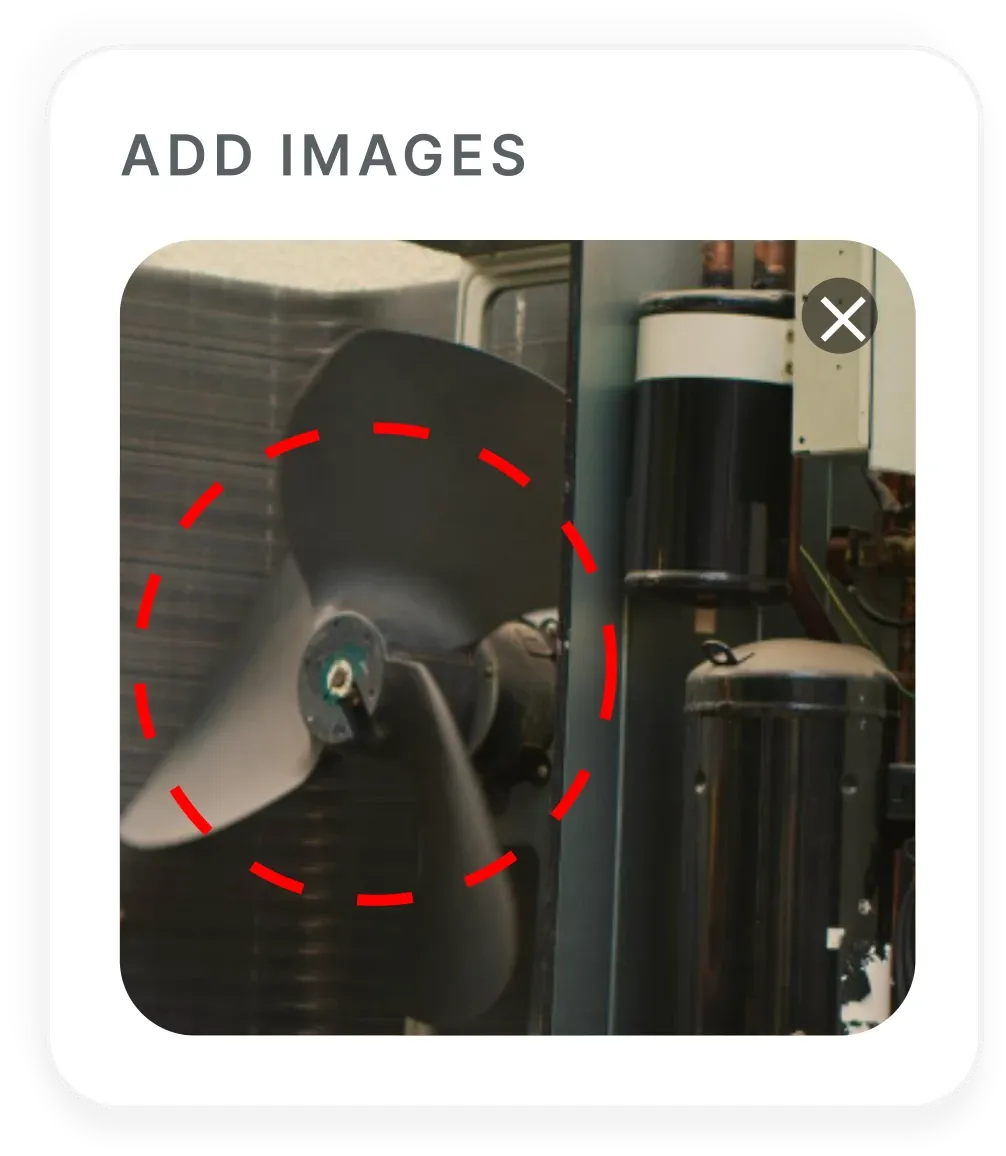

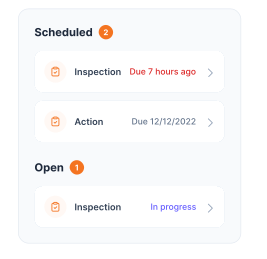
See which checklists your team has in progress across every site, jump into the same inspection with one tap, and keep field, supervisor, and back-office views in sync without sending screenshots on WhatsApp.


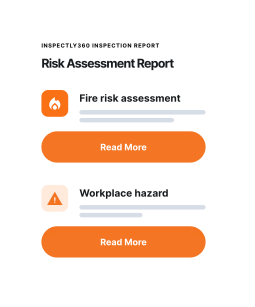
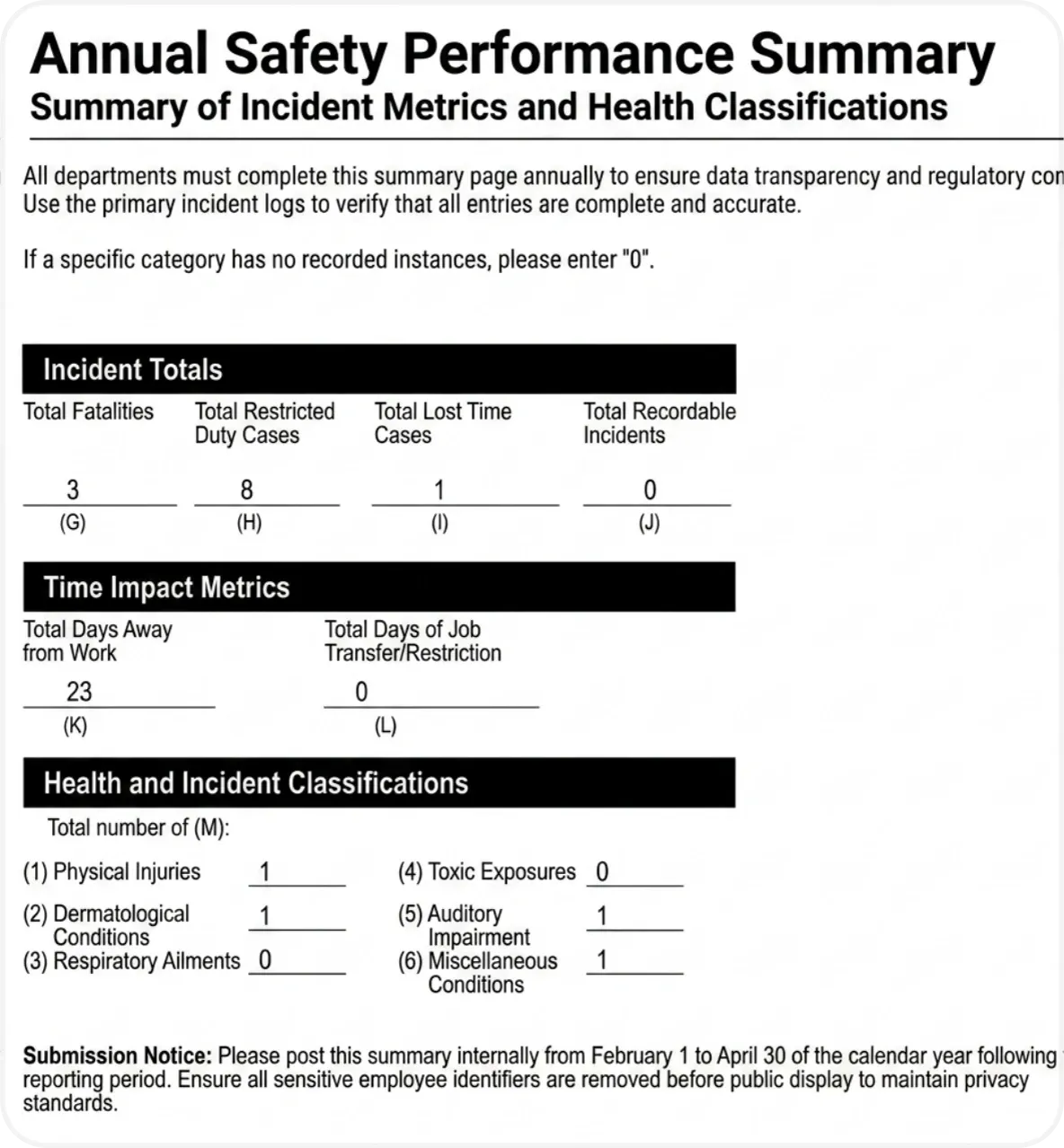


Every team reports differently. Build the report your operations, quality, or compliance leads actually want to read, share it as a branded PDF, and schedule delivery to the stakeholders who need it.


See completion, pass rate, and recurring findings across every checklist and every site, without pulling spreadsheets together at the end of the month.
What changes once risk register software is standardised on Inspectly360.





“Inspectly360 transformed how we manage site safety inspections. The offline capability alone saved us countless hours. Our compliance rate jumped from 72% to 96% in just three months.”
Sarah Mitchell
Meridian Construction Group

“The AI-powered defect detection has changed how we work. Our inspectors capture photos and the system flags issues we'd have missed. It's like having an expert reviewer on every site visit.”
James Chen
Pacific Manufacturing Co.
“Rolling out digital checklists across multiple projects gave us instant visibility into recurring safety issues. We now resolve critical findings in hours instead of days.”
Olivia Carter
Northbridge Infrastructure
Get started with inspection and audit checklist templates.

Safety inspections with hazard identification, corrective actions, and compliance reporting. Offline capture and evidence.

Report incidents and near-misses with details, photos, location, and timeline. Ready for safety or quality review.

Verify arc-flash labels on electrical equipment: presence, visibility, legibility, equipment identification, voltage and incident-energy information, PPE data, and label condition.

Inspect grounding and bonding systems: grounding conductors and electrodes, bonding connections, equipment grounding, continuity, corrosion, and panel connections.
Use these apps to run inspections and audits.

by Inspectly360
Simplify facilities inspections with forms, photos, and reports.

by Inspectly360
Building condition and compliance inspections with evidence and follow-ups.

by Inspectly360
Digitize building inspection apps workflows with forms, evidence capture, and automated reporting.

by Inspectly360
Run building inspections on phones and tablets with offline forms, photo evidence, and instant reports.
by Inspectly360
Audit buildings with structured scoring, photo evidence, and corrective action tracking across portfolios.
They work together but do different jobs. Hazard identification and risk assessment, or HIRA, is about finding hazards and assessing the risk they present, typically for safety, at a point in time. Risk register software is about maintaining and monitoring the ongoing list of risks an organisation or project has identified, across every category, not just safety, and keeping them scored, owned, controlled, and reviewed over time. A risk assessment can feed risks into the register, and the register is where they then live and get managed. Inspectly360 provides both as connected solutions, so hazard-level assessment and organisational risk tracking each have a proper home without one trying to be the other. If your need is the living register that leadership reviews, this is the right page.
We build your risk register solution on the Inspectly360 platform and configure it to your process, rather than handing you a fixed product. Our team scopes your risk categories, scoring scale, owners, and review cadence, configures the register, scoring, mitigation actions, controls, residual risk, reviews, and dashboards to match, and rolls it out with a pilot team or project first. Because the platform is built for configurable records, scoring, actions, scheduling, and reporting, a risk register solution tailored to your process is delivered without custom code. You get software shaped to how your organisation actually manages risk, supported by our team, rather than a spreadsheet that is built for an audit and then left to go out of date.
The core failure of a spreadsheet register is that it decays: risks are logged once and never revisited. This solution keeps the register live by giving every risk an owner, a review date, and a status, so risks are actively reviewed on cadence rather than forgotten, and reviews that come due are surfaced and can escalate. Mitigation and treatment actions are tracked to completion, and residual risk is reassessed once controls are in place, so the register shows exposure as it actually is after what has been done, not as it was when the risk was first raised. Because everything sits on the risk record and rolls up to a dashboard, a risk manager can see which risks are overdue for review, which are trending, and where exposure is concentrated, which is exactly what keeps a register a decision tool rather than a document.
Yes. Risk is not confined to one area, so the register is designed to hold risks across projects, facilities, operations, and business functions, each with its own category and owner, while rolling up to one organisational view. That means a project can manage its own risks day to day while leadership sees the aggregate exposure across the whole organisation, with the ability to filter by category, owner, score, or site. Scoring on a shared likelihood-and-impact matrix makes risks comparable wherever they come from, so a high risk on a project and a high risk in a function are measured the same way. This combination of local ownership and organisation-wide visibility is what lets a risk register support both the team managing a specific risk and the board reviewing the overall risk position.
Yes, and this is central to a register being useful rather than alarmist. Each risk records the controls that are in place or planned, and residual risk is reassessed after those controls, so the register distinguishes the inherent risk from the exposure that actually remains. That matters because a risk with strong controls may be well managed even if its inherent score is high, and without residual risk a register either overstates exposure and causes noise, or understates it and creates false comfort. Because controls, mitigation actions, and residual risk all sit on the risk record and update as things change, the register reflects the organisation's true position, and dashboards can show where residual risk is still high and needs attention. This is what turns a register from a static list of worries into an accurate picture of managed exposure.
See Inspectly360 in action with a live demo tailored to your needs. No credit card required.