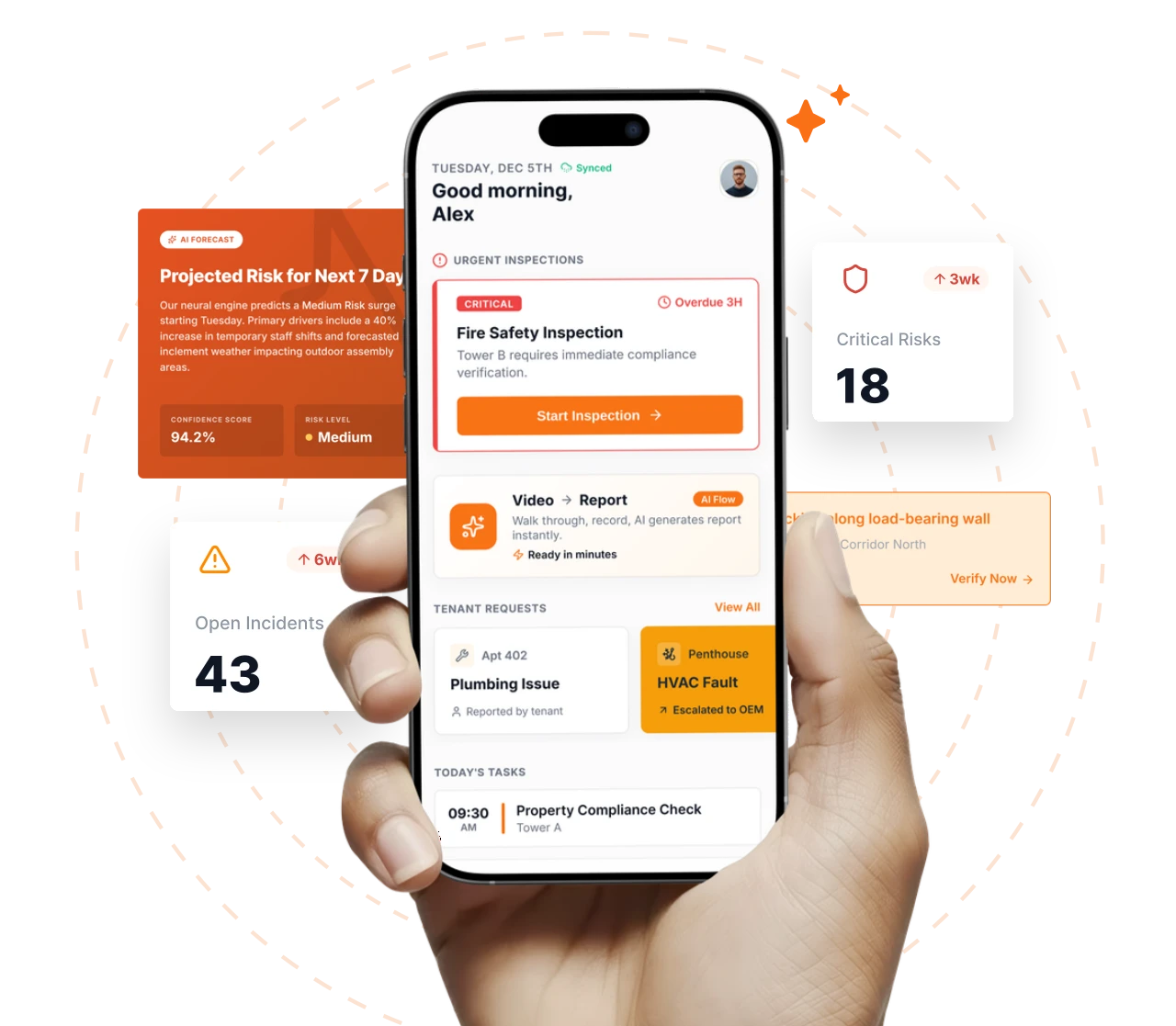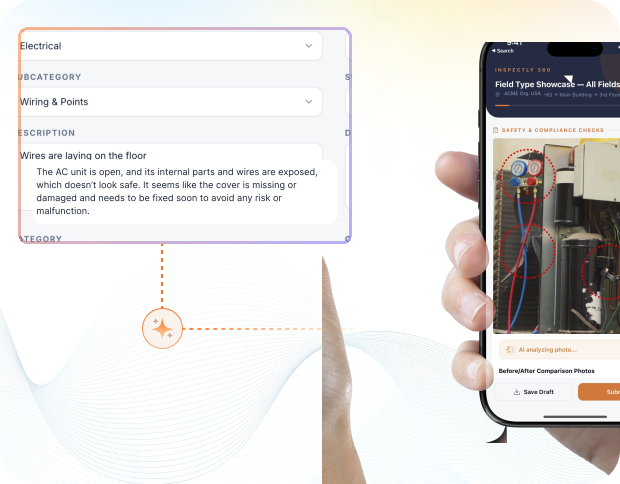
Take a Photo. AI Fills the Form
Your inspector takes a photo of any asset or defect. AI reads it and fills the inspection form automatically. No typing. No manual entry.

Convert your checklist into Mobile App
Scaffolding inspection compliance software is the regulatory-proof layer beside the field scaffold platform: it carries the statutory inspection evidence, the competent-person credential trails, the Stop Work records, and the regulatory documentation that UK Work at Height Regulations 2005, OSHA 1926 Subpart L, NASC TG20:21, BS EN 12811, NBC Part 7, and local work-at-height law each require, structured for retention across the full liability window.
Everything your field team does on paper, Inspectly360 does automatically: faster, more accurate, and without the admin.
Your inspector takes a photo of any asset or defect. AI reads it and fills the inspection form automatically. No typing. No manual entry.
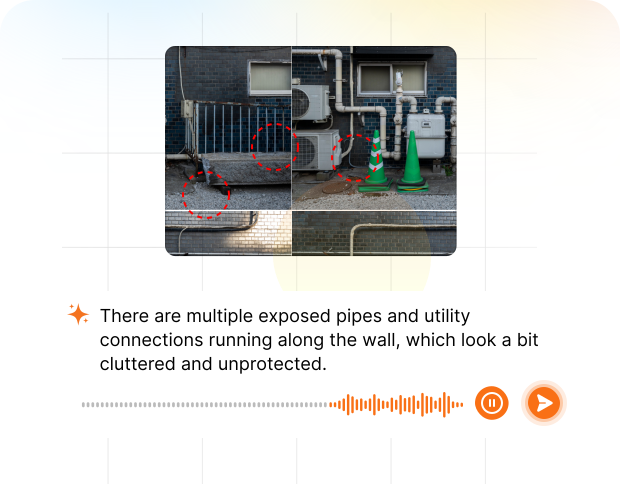
Inspectors speak their observations in any language. AI transcribes and fills the form in real time. Completely hands-free in the field.
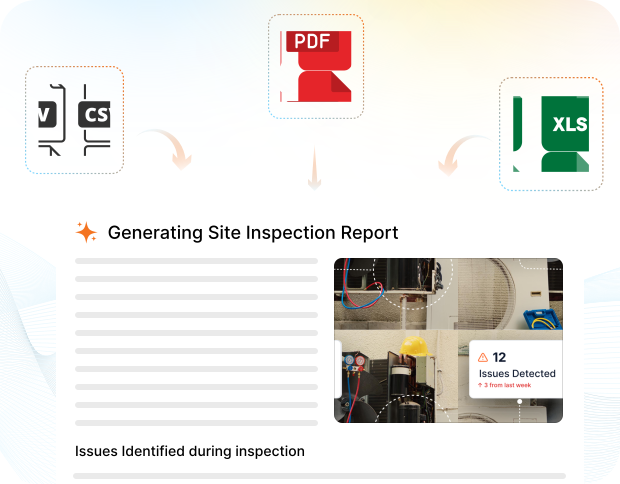
The moment an inspection is submitted, a branded PDF, Excel, or CSV report generates automatically. No manual work. No waiting.

Inspectly360 integrates with the tools your team already uses, including Zoho, Microsoft 365, and SAP. No double entry.
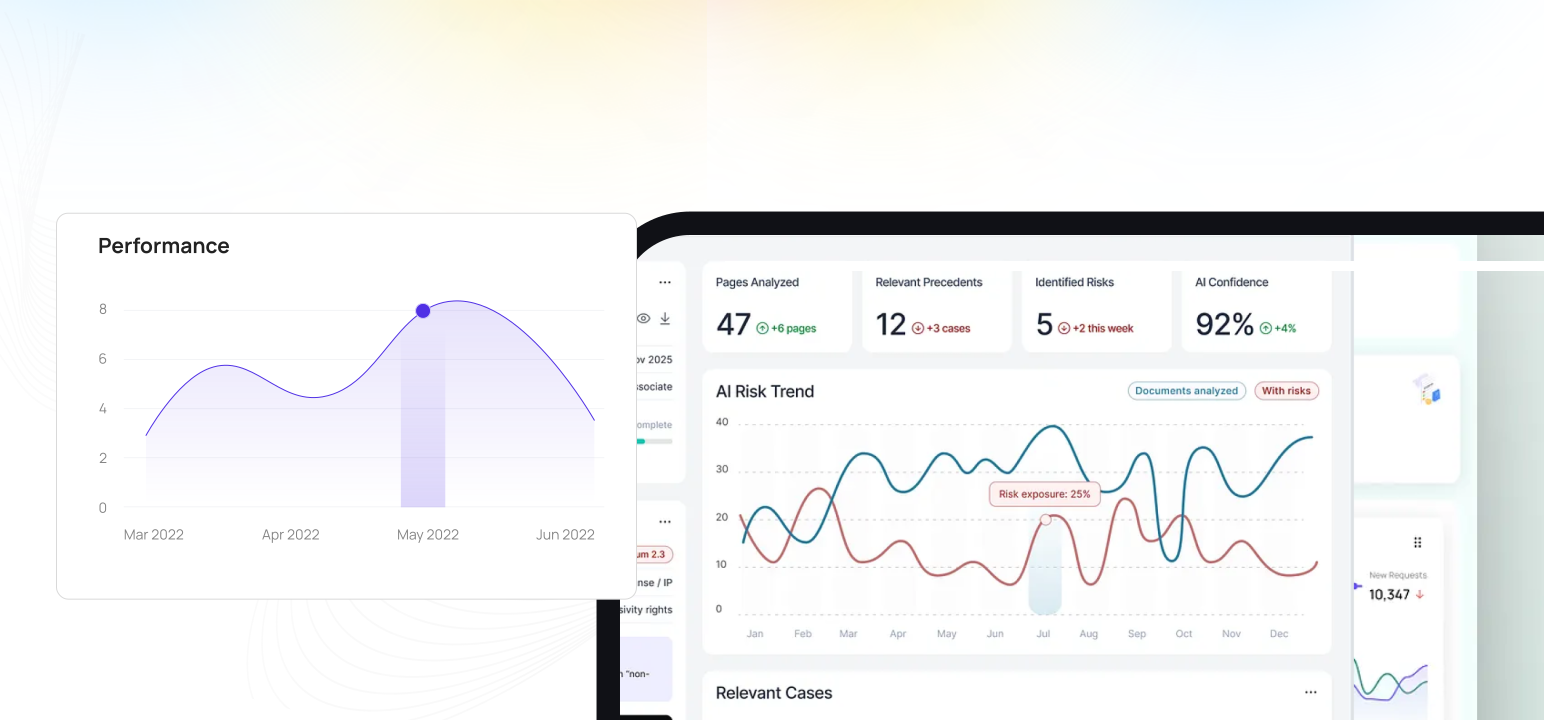
Your operations team sees completion rates, open issues, and compliance scores across all sites in real time. No chasing updates.
What changes once scaffolding inspection compliance software runs on one mobile-first platform with photo proof and live dashboards.
Scaffolding inspection compliance software is the regulatory-proof layer beside the field scaffold platform: it carries the statutory inspection evidence, the competent-person credential trails, the Stop Work records, and the regulatory documentation that UK Work at Height Regulations 2005, OSHA 1926 Subpart L, NASC TG20:21, BS EN 12811, NBC Part 7, and local work-at-height law each require, structured for retention across the full liability window. Inspectly360 is built for principal contractors, HSE directors, and corporate safety leads who carry personal accountability for HSE inspector unannounced visits, FFI fee exposure, and corporate insurance audit obligations.
For compliance programmes, the platform replaces paper scaffold compliance files, PDF statutory folders, and Excel work-at-height trackers with one defensible record aligned to Work at Height Regulations 2005 regulation 12 and Schedule 7, OSHA 1926.451(f)(3) competent-person inspection, NASC TG20:21 compliance sheets, BS EN 12811 structural requirements, and CDM 2015 documentation obligations. Every weekly inspection on a regulated scaffold carries timestamped photos, geofenced location, named competent person, CISRS card validity at submission, and the statutory template version in force at the time of inspection.
For the HSE director, the compliance record survives the full CDM liability window (commonly 6 years under CDM 2015, longer per insurance retention) with audit-grade event logs that survive litigation hold. HSE inspector unannounced visits, corporate insurance audits, and ISO 45001 surveillance open with the same evidence the field captured rather than a reconstruction built years after the fact. FFI exposure drops because evidence gaps stop being the dominant finding pattern.
Scaffold compliance runs a different cadence to field inspection; the five-step loop below is what principal contractors standardise to keep regulatory proof intact across the full liability window.
Tag every scaffold template item with the regulatory framework it satisfies (Work at Height Regulations 2005 regulation 12, OSHA 1926.451(f)(3), NASC TG20:21 compliance sheet items, BS EN 12811 structural requirements, NBC Part 7 sections). The map turns the field scaffold walk into a structured compliance record by design rather than a reconstruction afterward.
Weekly statutory inspections schedule per scaffold against erection date with 7-day window enforcement. Competent-person credentialing binds to CISRS card validity, OSHA qualified-person training records, and equivalent regional certifications. Renewal reminders fire 60 days before expiry.
Compliance scaffold inspections capture timestamped photos, geofenced location, named competent person identity, credential validity at submission, and the statutory template version in force. Mandatory evidence rules apply per regulatory item; submissions that lack required evidence are rejected so the compliance trail stays defensible.
HSE inspector packs, OSHA recordkeeping exports, NASC audit packs, insurance audit submissions, and ISO 45001 surveillance evidence export from the same record in the format each audience accepts. The pack arrives with the inspection rather than after it.
Audit-grade event logs, statutory inspection records, credential validity history, and CAPA closure trails preserve for the configured retention window (6 years CDM 2015, 10 years insurance product liability, longer per regional law). Insurance claims years after a site retires open with the original record intact.
Answers to common long-tail questions, kept on one canonical page to avoid thin duplicate URLs.
Inspectly360 sits as the principal contractor's compliance-evidence layer beside HSE notification systems and CDM document control platforms. HSE's RIDDOR online portal continues to run statutory incident notifications. CDM Compliance Manager, Procore, and Asite continue to hold the construction phase plan, F10 notifications, and document control. Inspectly360 does not replace any of them; it produces the principal contractor's evidence trail that each authority expects to see at inspection time. Statutory inspector packs export in the format each regulator accepts: HSE inspector PDFs, OSHA inspection records, NASC audit packs, insurance audit submissions. The principal contractor arrives at the regulator visit with the evidence already prepared.
Principal contractors should validate seven retention requirements before rollout: configurable retention per regulatory framework (6 years CDM 2015, 10 years insurance product liability, 30 years construction product warranty under certain frameworks); audit-grade event logs that survive litigation hold; encrypted at-rest evidence; regional data residency aligned to GDPR, India DPDP, Singapore PDPA, UAE PDPL, or local privacy law; certified retention expiry with final exports; legal-hold flags that pause retention purges during active claims; and bulk export to corporate archive systems for sites that retire from the active platform after substantial completion. The retention model is the difference between an insurance claim that settles on evidence and one that settles on cost.
Production scaffold compliance programmes carry erection-company supervisor PII, competent-person CISRS data, scaffolder training records, and statutory inspection evidence that HSE inspectors, CDM auditors, and corporate insurance auditors may request years later. Inspectly360 supports configurable retention, audit-grade event logs, encrypted at-rest evidence, regional data residency, and legal-hold flags. RBAC enforcement happens server-side rather than only in the UI, which matters when one principal contractor coordinates multiple erection companies under multiple regulatory frameworks in different jurisdictions.
Existing paper scaffold compliance files, PDF statutory folders, and Excel work-at-height trackers batch-import as searchable evidence against the same site and erection company. Historical statutory inspections carry forward with the original evidence attached. Competent-person CISRS card data, erection-company supervisor records, and scaffold design drawing references seed from the current site record. The corporate compliance template library publishes to active sites on the effective date; sites already in handover continue with the version in force, which is what protects regulatory posture during the transition.
The platform capabilities that power scaffolding inspection compliance software across every site.
Principal contractors and HSE directors comparing Inspectly360 to paper scaffold compliance files, PDF statutory folders, and Excel work-at-height trackers care about five things specific to scaffold compliance: whether weekly statutory inspections survive HSE inspector cross-reference, whether competent-person credentials are valid at the time of every inspection, whether the FFI fee exposure drops because evidence gaps stop being the dominant finding pattern, whether regulatory updates flow into the scaffold inspection library, and whether corporate insurance premium calculations follow scored work-at-height performance.
| Topic | Typical Gaps | With Inspectly360 |
|---|---|---|
| Work at Height Regulations 2005 inspection readiness | Weekly inspection records live in paper scaftags and supervisor diaries. HSE inspectors arrive unannounced and ask for the last 12 weeks; the site team scrambles through clipboards and reconstructs evidence. FFI fees apply, and the principal contractor carries the systemic liability. | Every weekly inspection on a regulated scaffold carries timestamped photos, geofenced location, named competent person, CISRS card validity at submission, and the statutory template version in force. HSE inspector visits open with the same record the site captured, not a reconstruction. |
| Competent-person credential validity at inspection time | CISRS card validity tracked in Excel per site. Expired cards become HSE findings when an inspector cross-references the card number against the CISRS register at the inspection date. Renewal reminders depend on the individual scaffolder. | CISRS card validity binds to inspector identity with 60-day renewal reminders. Weekly inspection submissions reject from expired credentials at submission. The audit trail records credential validity at the time of every inspection, not just current. |
| FFI fee exposure and HSE finding pattern | FFI fees accumulate per HSE finding. Missed-week findings, expired-credential findings, and evidence-gap findings dominate the FFI exposure pattern; one principal contractor reported six-figure annual FFI exposure on a 50-site portfolio before digital scaffold compliance. | Weekly window enforcement, credential validity at submission, and mandatory photo evidence each remove a dominant HSE finding pattern. FFI exposure typically reduces by an order of magnitude within the first year on the platform. |
| Regulatory template updates flow into the scaffold library | TG20:21 amendments, NASC SG4 revisions, OSHA 1926 letters of interpretation, and BS EN 12811 updates reach the site team through industry press; the scaffold inspection template still inspects against the previous version because nobody updated the Excel. | Regulatory template marketplace surfaces updates per framework (TG20:21 amendments, NASC SG4 revisions, OSHA 1926 LOIs, BS EN 12811 updates, NBC Part 7 amendments). Updates publish to the corporate library; the audit trail records when the upgrade happened. |
| Insurance premium calculation on scored work-at-height performance | Corporate insurance premiums calculate from incident history and broad work-at-height narrative. Premium calculations follow lagging indicators (incidents, near-misses) rather than leading indicators (weekly compliance, credential validity, audit scores). | Corporate insurance audits open with scored work-at-height performance: weekly compliance rate per site, credential validity rate, audit pass rate per erection company. Insurers increasingly accept scored leading indicators in premium calculation, which directly affects renewal pricing. |
What changes once scaffolding inspection compliance software is standardised on Inspectly360.
Get started with inspection and audit checklist templates.

Catch defects before handover and generate punch list reports in minutes. Room-by-room finish checks, evidence, and corrective actions.

Pre-handover snagging for new build apartments. Room-by-room finish checks, MEP, and defect tracking before keys.

Utilize this Scaffolding Safety Inspection Checklist to spot hazards, verify stability, and ensure compliance with safety standards before work begins.

Capture job details, measurements, work performed, photos, and sign-offs in one structured field service report form.
Use these apps to run inspections and audits.

by Inspectly360
Manage scaffolding system compliance workflows with statutory test records, evidence capture, and audit-ready documentation.
by Inspectly360
Manage construction compliance workflows with documented evidence and audit-ready records.

by Inspectly360
Track construction compliance obligations, deadlines, and evidence trails across active sites.

by Inspectly360
Run scaffolding inspections on phones and tablets with offline forms, photo and voice capture, and instant reports.

by Inspectly360
Run construction safety checks with hazard tracking, corrective actions, and closure verification.
Every weekly inspection on a regulated scaffold carries timestamped photos, geofenced location, named competent person, CISRS card validity at submission, and the Work at Height Regulations 2005 template version in force. When the HSE inspector visits unannounced, the principal contractor exports the HSE inspector pack in one click rather than scrambling through paper scaftags and supervisor diaries. The inspector sees the same evidence the principal contractor holds; the inspection runs through, and FFI exposure drops because the evidence chain was built from day one rather than reconstructed the day of the visit.
FFI fees accumulate per HSE finding under the Fee for Intervention scheme. The dominant FFI exposure patterns historically come from three sources: missed-week findings (a weekly inspection past the 7-day window), expired-credential findings (a CISRS card past expiry at inspection time), and evidence-gap findings (a finding with no photo evidence). Inspectly360 removes all three by design: weekly window enforcement prevents missed weeks; credential validity at submission prevents expired-credential inspections; and mandatory photo evidence prevents evidence-gap findings. By removing the three dominant finding patterns at source, the platform directly reduces the FFI exposure a principal contractor carries, because the fees follow the findings and the findings stop being generated in the first place.
Retention is configured per regulatory framework: 6 years under CDM 2015 for the principal contractor's documentation obligations, 10 years under product liability for construction products, 30 years for certain construction product warranties under regional product liability law, and longer for corporate insurance retention requirements. Audit-grade event logs survive litigation hold during the full retention window. Legal-hold flags pause retention purges during active disputes. At configured retention expiry, automated retention policies purge the site record with a final certified export delivered to the HSE director and legal if required.
OSHA 29 CFR 1926.451(f)(3) requires inspection by a competent person before each work shift and after any occurrence that could affect a scaffold's structural integrity. The platform supports pre-shift competent-person inspection workflows alongside the weekly statutory cycle for non-OSHA jurisdictions. Qualified-person designations under 1926.451(f)(7) are bound to documented training records. OSHA inspection records export in the OSHA-accepted documentation pattern with photo evidence per finding, qualified-person identity, and the competent-person designation at the time of inspection. The platform handles UK Work at Height Regulations sites and OSHA 1926 sites on the same account with framework-specific configurations.
Yes. Regulatory templates fork per jurisdiction (UK Work at Height Regulations 2005, OSHA 1926 Subpart L, NBC Part 7 for India, NCC for Australia, Section J for US energy, local fire codes). Each site carries the regulatory framework that applies; the corporate template library inherits the global baseline and the regional fork carries jurisdiction-specific items. Audit data lands in the region configured for the site; portfolio-level dashboards aggregate without moving raw data across borders. The HSE director sees aggregated regulatory exposure across jurisdictions without triggering cross-border data transfer obligations.
Legal and risk teams get scoped read-only access to the relevant site record with the audit-grade event log, statutory inspection history, scaffold inspection trail, and original evidence intact. Legal-hold flags pause retention purges so the record cannot be purged during an active claim. Discovery requests export with timestamps, named actors, and IP/device fingerprints preserved. The legal team operates on the same evidence the HSE inspector does, which is what changes work-at-height incident defence from a cost-led negotiation to an evidence-led one.
Scaffolding Inspection Compliance Software on Inspectly360 connects directly to the inspection apps, checklist templates, forms, industries, and adjacent solutions linked below.
See Inspectly360 in action with a live demo tailored to your needs. No credit card required.