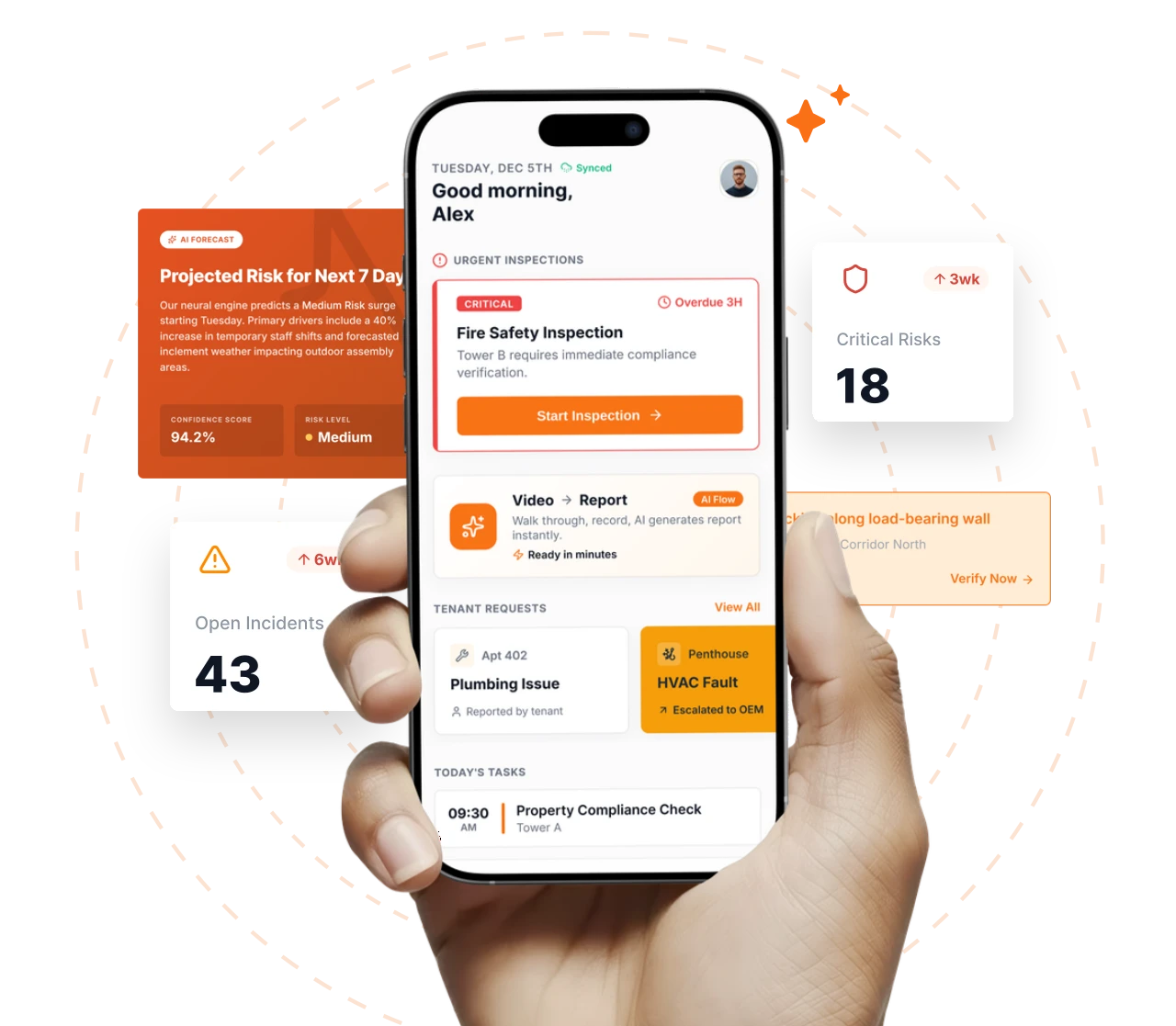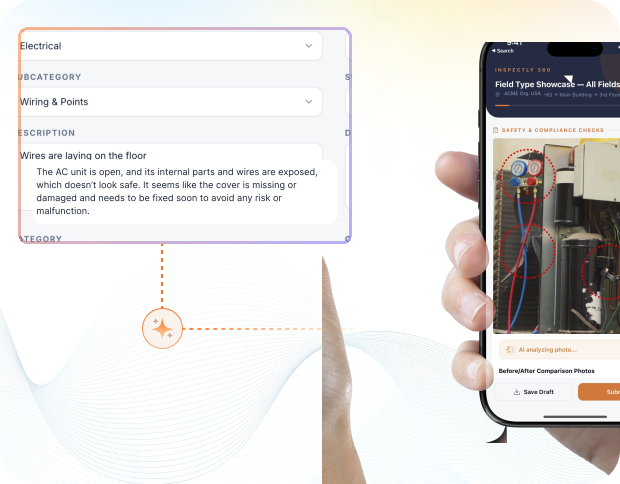
Take a Photo. AI Fills the Form
Your inspector takes a photo of any asset or defect. AI reads it and fills the inspection form automatically. No typing. No manual entry.

Convert your checklist into Mobile App
Site safety inspection management software is the governance layer above the site safety app: it owns the JSA and PTW template library, the multi-site scheduling engine, the operative credentialing system, the closure workflows, and the portfolio rollup that lets an HSE director run safety programmes across multiple concurrent sites without depending on individual site discipline.
Everything your field team does on paper, Inspectly360 does automatically: faster, more accurate, and without the admin.
Your inspector takes a photo of any asset or defect. AI reads it and fills the inspection form automatically. No typing. No manual entry.
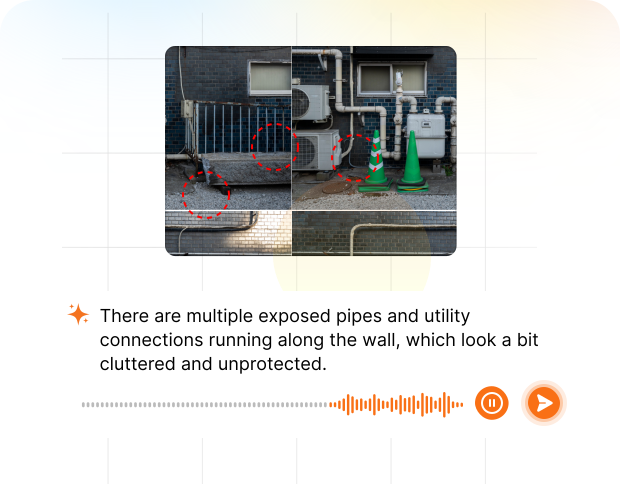
Inspectors speak their observations in any language. AI transcribes and fills the form in real time. Completely hands-free in the field.
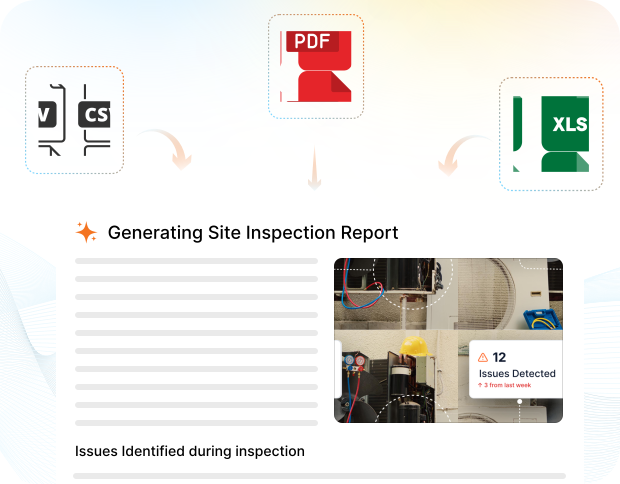
The moment an inspection is submitted, a branded PDF, Excel, or CSV report generates automatically. No manual work. No waiting.

Inspectly360 integrates with the tools your team already uses, including Zoho, Microsoft 365, and SAP. No double entry.
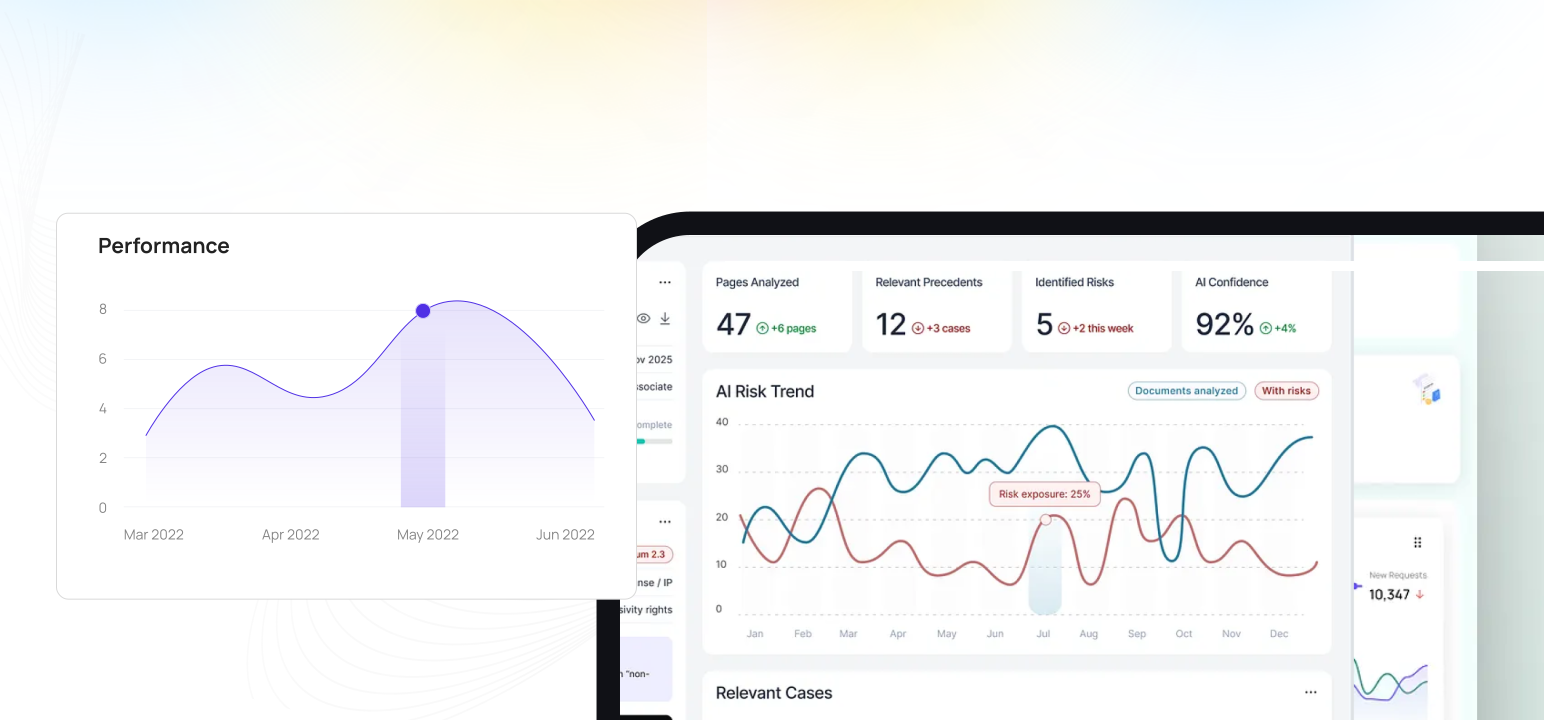
Your operations team sees completion rates, open issues, and compliance scores across all sites in real time. No chasing updates.
What changes once site safety inspection management software runs on one mobile-first platform with photo proof and live dashboards.
Site safety inspection management software is the governance layer above the site safety app: it owns the JSA and PTW template library, the multi-site scheduling engine, the operative credentialing system, the closure workflows, and the portfolio rollup that lets an HSE director run safety programmes across multiple concurrent sites without depending on individual site discipline. Inspectly360 is built for HSE directors, corporate safety leads, and principal contractors managing multi-site portfolios where the same safety standards must apply across construction, industrial maintenance, energy operations, and refurbishment work.
For programme governance, the platform replaces fragmented site-by-site JSA registers, supervisor-discretion templates, and Excel near-miss logs with one versioned library, one scheduling engine, and one credentialing model. Approved templates publish to active sites on version increment; operative credentials sync from corporate HRIS via SCIM; closure rules apply uniformly so a re-opened near-miss on one site counts the same as a re-opened near-miss on another.
For the HSE director, the portfolio view shows JSA completion rate, near-miss rate per 1,000 hours, toolbox attendance, PTW compliance, training validity, and recordable trends. Friday compile cycles end. The board HSE report opens with current data. Procurement, HSE, and operations open the same conversation from the same dashboard.
Site safety programme governance follows a different cadence to field execution; the five-step loop below is what HSE directors standardise before scaling field rollout.
Consolidate every site's JSA, PTW, toolbox talk, and safety walk templates into one versioned corporate library by work type, regulatory framework (OSHA 1926, OSHA 1910, ISO 45001, CDM 2015, NFPA 70E), and contract package. Named approvers gate publication; change audit trail records who edited what and when.
Map the credentialing hierarchy: site safety officer, HSE lead, fire warden, first aider, confined-space attendant, working-at-height competent person, LOTO authorised person, and equivalent regional certifications. SCIM provisioning links operative identity to corporate HRIS with auto-restriction on credential expiry.
Daily pre-shift JSA cycles, work-zone PTW workflows, weekly toolbox talks, monthly safety walks, and contractor inductions schedule per site automatically. Coverage heatmaps surface upcoming and overdue across the portfolio.
Closure workflows differ by hazard severity: critical hazards (life-safety, fatal-risk activities) require qualified-engineer sign-off plus HSE lead approval; major hazards require site safety officer verification; minor hazards require supervisor closure with photo evidence.
Portfolio dashboards aggregate leading indicators (hazard observation rate, near-miss rate, JSA completion, toolbox attendance, PTW compliance) and lagging indicators (recordables, lost-time, fatalities) across every site. Board HSE packs export with the same data the HSE director operates on.
Answers to common long-tail questions, kept on one canonical page to avoid thin duplicate URLs.
Programme governance in Inspectly360 sits as the safety-discipline layer beside the systems of record. SAP EHS, Enablon, Sphera SafetyHub, Cority, and ProcessMAP continue to hold corporate HSE KPI dashboards, incident records, and regulatory reporting. Inspectly360 owns the safety template library, the JSA and PTW workflow governance, the credentialing model, and the portfolio rollup of leading indicators. Failed safety items push to the corporate EHS system as incidents with photo evidence; operative credentials sync from corporate HRIS via SCIM.
Procurement should validate seven enterprise requirements before multi-site safety rollout: SSO via SAML or OIDC with provisioning into Microsoft Entra ID, Okta, or Google Workspace; SCIM-based operative lifecycle management so credential expiry triggers automatic workflow restriction; RBAC granular enough to scope a contractor crew to their permits and work zone only; offline mobile capture verified at real height-adjacent and confined-space work; configurable retention aligned to OSHA 1904 (5 years) and regional law; regional data residency for global operators; and the documented integration path into the corporate EHS platform.
Production safety programmes carry operative PII (training certificates, medical fitness records, incident-related personal data) and contractor data that HSE inspectors, OSHA compliance officers, ISO 45001 surveillance auditors, and corporate insurance auditors may request years later. Inspectly360 supports configurable retention per regulatory framework, audit-grade event logs that survive litigation hold, encrypted at-rest evidence, and regional data residency.
Programme governance rollout starts with consolidation of every site's safety templates into one corporate library. Existing active sites continue with their current site-specific templates while the corporate library is approved, versioned, and published. New sites launch on the corporate library from day one. Active sites migrate at the next safety programme cycle so no work is disrupted mid-execution.
The platform capabilities that power site safety inspection management software across every site.
HSE directors comparing Inspectly360 to corporate EHS scheduling modules, Excel JSA libraries, and generic workflow apps care about five things specific to site safety programme governance: whether JSA and PTW coverage is predictable across every active site, whether operative credentialing is bounded and current, whether the template library survives site-by-site interpretation, whether near-miss capture rate becomes a portfolio metric, and whether leading indicators roll up to corporate HSE without a Friday compile cycle.
| Topic | Typical Gaps | With Inspectly360 |
|---|---|---|
| Multi-site JSA and PTW coverage predictability | JSA and PTW schedules live in supervisor diaries per site. Coverage gaps invisible until an HSE inspector spots a missing permit at the work zone; FFI fees apply, and the principal contractor carries the systemic liability. | Scheduled JSA and PTW workflows publish to every active site automatically. Coverage heatmaps surface missing permits and expired JSAs across the portfolio before any breach. |
| Operative credentialing at portfolio scale | Working-at-height, confined-space, LOTO, and PPE training validity tracked in Excel per site. Expired credentials become HSE findings when an inspector cross-references at the work zone. | Training validity tracked across the portfolio with 60-day expiry reminders. Submissions reject from expired credentials at submission. Expired-credential findings stop being the dominant HSE finding pattern. |
| Template library through region and contractor change | JSA templates differ per site, per contractor, and per region. One site inspects against OSHA 1926, another against legacy site-specific templates; standards drift, and the principal contractor cannot defend consistency at corporate audit. | Versioned safety template library with named approvers, change audit trail, and distribution scope per site, region, and contractor. The corporate safety standard survives contractor change. |
| Near-miss capture rate as a portfolio metric | Near-miss capture is site-discretionary. One site reports 5 near-misses per 1,000 hours; another reports 0.5. Corporate HSE has no visibility into whether the difference is real culture or reporting suppression. | Near-miss rate per 1,000 hours surfaces per site, per contractor, and per work type with portfolio benchmarking. Suppressed reporting surfaces as a leading-indicator anomaly that corporate HSE can act on. |
| Leading-indicator rollup to corporate HSE | Each site produces its own weekly safety report in its own format. Corporate HSE compiles across sites on Friday afternoons; portfolio-wide leading indicators are reconstructed weeks after they happened. | Portfolio dashboards roll up hazard observation rate, near-miss rate, JSA completion, toolbox attendance, PTW compliance, and recordable trends across every site in real time. |
What changes once site safety inspection management software is standardised on Inspectly360.
Get started with inspection and audit checklist templates.

Safety inspections with hazard identification, corrective actions, and compliance reporting. Offline capture and evidence.
Report incidents and near-misses with details, photos, location, and timeline. Ready for safety or quality review.
Use these apps to run inspections and audits.

by Inspectly360
Complete daily and task-specific site safety apps with PPE, plant, and exclusion zone verification on mobile.

by Inspectly360
Schedule construction inspections with recurring plans, reminders, and owner assignment controls.

by Inspectly360
Manage construction safety checks, hazards, incidents, and action closures from one workflow.

by Inspectly360
Run site safety inspections with AI prompts, hazard evidence, and real-time compliance visibility for every project.
by Inspectly360
Run site safety inspections on phones and tablets with offline forms, photo and voice capture, and instant reports.
The safety app on the operative's phone is the capture layer: one operative, one JSA, one near-miss, one record at a time. Site safety inspection management software is the governance layer above it. It owns the template library that every JSA and PTW runs against, the schedule that defines which safety cycles fall due and when, the credentialing model that defines who is allowed to submit, the closure workflows that define how findings resolve, and the portfolio rollup that aggregates leading indicators across every site. An HSE director running 30 active sites buys the management layer for that governance discipline, not for the capture screen, because consistency across sites is what keeps a programme that works at five sites from breaking at thirty.
Operative credentials sync into the platform through SCIM provisioning from the corporate HRIS (Workday, SAP SuccessFactors, ADP) or from specialised training-record systems such as Cority and the Enablon LMS. Each record carries the training type, certification body, issue date, and expiry date. Renewal reminders are sent 60 days before expiry to both the operative and the HSE team, so a lapse is corrected before it ever reaches site. If an operative with an expired credential tries to submit a JSA or PTW, the submission is rejected automatically rather than flagged after the fact. The corporate HSE director sees credential validity across the whole portfolio in one view, which turns certification tracking from a spreadsheet chase into a live gate.
Safety templates fork per regional framework: OSHA 1926 and 1910 for the US, CDM 2015 and HSE guidance for the UK, the WSH Regulations for Singapore, NBC Part 7 for India, the NCC for Australia, and EU Directive 89/391/EEC for the EU. Each site carries the regulatory framework that actually applies to it, while the corporate template library still provides a single global baseline that every region inherits. Audit data lands in the region configured for the site, and portfolio-level dashboards aggregate the leading indicators without moving raw records across borders, which keeps the programme aligned with data-residency obligations. When a framework is updated, the change is versioned against the affected templates, so each region moves to the new requirement on a controlled date rather than silently.
Near-miss rate is calculated as near-misses captured divided by hours worked, multiplied by 1,000. Hours worked sync from the time-and-attendance system, and near-miss capture comes straight from the platform, so the figure is consistent rather than estimated. Portfolio dashboards then show the rate per site, per contractor, per work type, and per region, with benchmarking across the estate. A site reporting 5 near-misses per 1,000 hours and one reporting 0.5 are usually showing either a different safety culture or different reporting completeness, and that gap is the leading-indicator signal HSE directors act on. Read alongside JSA completion and recordable rate, it tells a director where reporting has gone quiet long before a lagging number confirms a problem.
Yes. Severity-class closure workflows attach to the hazard type, so the rigour of closure matches the risk. Critical hazards, meaning life-safety and fatal-risk activities such as working at height, confined-space entry, and energised electrical work, require qualified-engineer sign-off plus HSE-lead approval; the workflow auto-routes to the named engineer and stays open until they sign. Major hazards require site-safety-officer verification with photo evidence. Minor hazards, such as housekeeping or signage gaps, can be closed by a supervisor with photo evidence. The severity definitions are configured once to the corporate standard and then applied uniformly across every site, so a critical finding is never quietly closed on a supervisor's say-so on one site while it demands engineer sign-off on another.
JSA completion rate is calculated as the percentage of scheduled JSAs completed before the work-start trigger, measured per site and per work zone. Portfolio dashboards show that rate per site, per region, per contractor, and per work type, with trend analysis over time. A site running 95% completion looks very different from one running 75%, and that difference is exactly where the HSE director focuses corporate attention. Missed-JSA findings feed into corporate HSE reporting alongside the lagging indicators, so a site whose completion rate is slipping is visible before the missed step becomes an incident. Because the measure is taken at the work-start trigger rather than self-reported later, it reflects whether the control actually ran, not whether someone remembered to tick it.
Site Safety Inspection Management Software on Inspectly360 connects directly to the inspection apps, checklist templates, forms, industries, and adjacent solutions linked below.
See Inspectly360 in action with a live demo tailored to your needs. No credit card required.