
“Inspectly360 transformed how we manage site safety inspections. The offline capability alone saved us countless hours. Our compliance rate jumped from 72% to 96% in just three months.”
Sarah Mitchell
Meridian Construction Group

Convert your checklist into Mobile App
Looking for ESG reporting software built around how your team collects data? We provide it. Inspectly360 delivers a tailored ESG data and reporting solution on our mobile platform, configured to your metrics and integrated with your systems. Book a demo to scope it.
ESG reporting software collects environmental, social, and governance data across an organisation and turns it into consistent, audit-ready disclosures. Inspectly360 provides an ESG data and reporting solution tailored to your operation, built on our mobile data-capture, validation, and reporting platform and configured to the metrics you report, integrated with the systems that feed them.
The pain is rarely a lack of data. It is that the data sits in dozens of spreadsheets held by different people, collected in different units, with no record of where a number came from. When a framework requires a disclosure or an assurance provider asks for the underlying support, teams spend weeks reassembling figures and cannot always prove them.
Sustainability teams standardise this loop before reporting against a framework.
Set the environmental, social, and governance metrics to track, the unit each is measured in, the period it covers, and the person accountable for supplying it.
Site teams and system feeds submit figures on structured forms with the supporting document attached, so each number arrives with evidence rather than as a bare value.
Validation rules flag missing periods, unit mismatches, and outliers against prior periods, so data quality issues surface during collection instead of at assurance.
Validated figures aggregate by site, region, and reporting period into dashboards, so the team sees the emerging position long before the reporting deadline.
Metrics export into disclosure formats with a trail back to each source, so an assurance provider can trace any reported figure to the evidence behind it.
Inspectly360 is the ESG data collection and reporting layer. It gathers, validates, and traces the metrics your sites produce, then exports disclosures and evidence into the sustainability or finance systems that consume them. Where you already run a carbon or utility platform, those feeds can supply activity data into the same record. The aim is one traceable dataset that serves your disclosures, rather than several disconnected spreadsheets that each need reconciling before a report can be trusted.
Validate four things in the pilot. First, that the metric definitions, units, and periods match how your frameworks expect the data. Second, that the conversion factors you rely on are configured and recorded, not hidden. Third, that the source-to-disclosure trail satisfies your assurance provider's evidence expectations. Fourth, that owners across sites can submit their figures on a phone or from a system feed without friction. Run one full reporting metric end to end so the traceability is proven on a real disclosure before scaling to the full metric set.
ESG data can be commercially sensitive and is increasingly subject to external scrutiny, so integrity matters as much as access. Inspectly360 enforces role-based access so each owner submits and sees only their metrics while the sustainability lead sees the whole set. Submissions and changes are logged, so a figure's history is auditable for the retention window your assurance and governance teams require. Validation rules and recorded conversions mean the reported number and its basis stay defensible under challenge.
Start with the metrics that matter most to your primary framework and the sites that produce the largest share of them, then extend. Prove the collection, validation, and traceability on that core set for one reporting period, so the team experiences a clean close rather than a scramble. Historical figures can be loaded to give trend context for outlier detection. Because metric definitions and owners are configuration, the model extends to new metrics and sites without rebuilding the process each period.
What ESG Reporting Software covers for your team.
Sustainability leads comparing Inspectly360 to spreadsheets and shared drives see the difference on five points: data traceability, unit consistency, gap detection, roll-up speed, and assurance readiness.
| Capability | Without Inspectly360 | With Inspectly360 |
|---|---|---|
| Data traceability | Reported figures come from spreadsheets with no record of where each number originated, so a challenged figure cannot be traced to its source. | Every reported metric links back to the source submission, the supporting document, and the owner who supplied it, so any figure can be traced on request. |
| Unit consistency | Sites report the same metric in different units and formats. Someone converts them by hand at consolidation, and conversion errors slip through. | Each metric has a defined unit and period at collection, so figures arrive comparable and conversions are recorded rather than done in a hidden cell. |
| Gap and outlier detection | Missing months and implausible values are found late, often by the assurance provider, and the team scrambles to fill or explain them. | Validation rules flag missing periods, unit mismatches, and outliers during collection, so quality issues are resolved before the reporting run. |
| Roll-up speed | Consolidation is a manual merge of many files that takes weeks and freezes the moment anyone finds a late correction. | Validated figures roll up by site and period automatically, so the current position is visible continuously rather than rebuilt each cycle. |
| Assurance readiness | An assurance request triggers a hunt for the underlying support across inboxes and drives, and some evidence can no longer be found. | Each disclosure carries its evidence trail, so an assurance provider traces a reported figure to its source in the record rather than by email. |
Manage every checklist in one connected workspace, capture evidence on mobile at the point of work, and let AI turn field inputs into clear, stakeholder-ready reports in minutes.


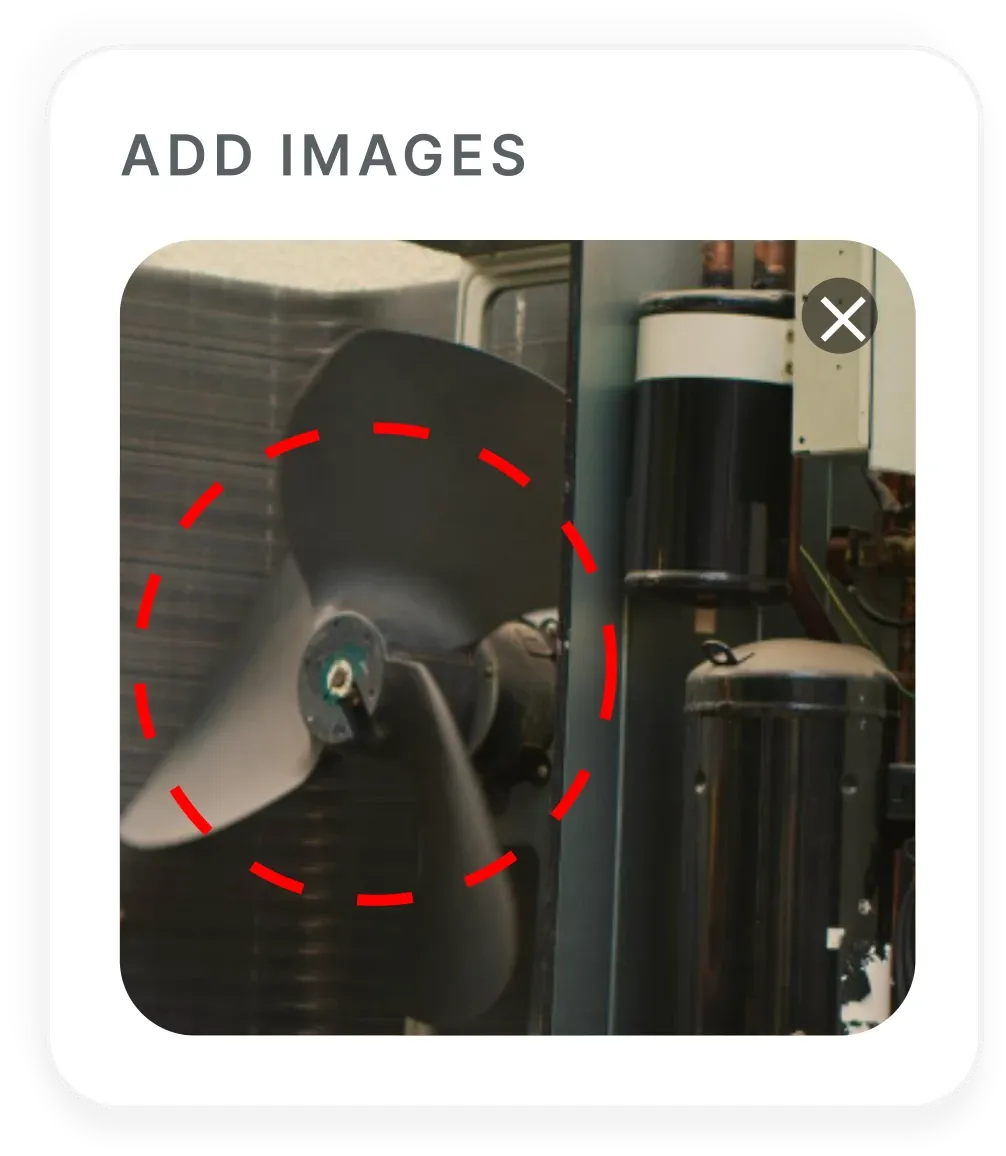
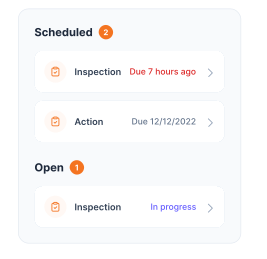
See which checklists your team has in progress across every site, jump into the same inspection with one tap, and keep field, supervisor, and back-office views in sync without sending screenshots on WhatsApp.


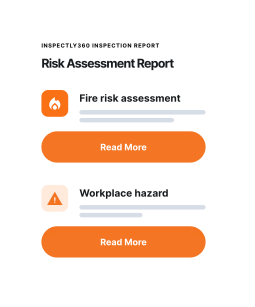


Every team reports differently. Build the report your operations, quality, or compliance leads actually want to read, share it as a branded PDF, and schedule delivery to the stakeholders who need it.


See completion, pass rate, and recurring findings across every checklist and every site, without pulling spreadsheets together at the end of the month.
What changes once esg reporting software is standardised on Inspectly360.






“Inspectly360 transformed how we manage site safety inspections. The offline capability alone saved us countless hours. Our compliance rate jumped from 72% to 96% in just three months.”
Sarah Mitchell
Meridian Construction Group

“The AI-powered defect detection has changed how we work. Our inspectors capture photos and the system flags issues we'd have missed. It's like having an expert reviewer on every site visit.”
James Chen
Pacific Manufacturing Co.
“Rolling out digital checklists across multiple projects gave us instant visibility into recurring safety issues. We now resolve critical findings in hours instead of days.”
Olivia Carter
Northbridge Infrastructure
Get started with inspection and audit checklist templates.

Assess and document an organization's carbon footprint: reporting period and boundaries, energy and fuel consumption, Scope 1, Scope 2, and relevant Scope 3 emissions, data sources, emission factors, calculation and validation, and reduction opportunities.
Measure and improve diversion of waste from landfill: waste streams, recycling and composting availability, reusable materials, sorting and contamination checks, bin labeling, landfill-bound quantities, diversion-rate calculations, hauler documentation, and corrective actions.
Use these apps to run inspections and audits.

by Inspectly360
Simplify facilities inspections with forms, photos, and reports.

by Inspectly360
Building condition and compliance inspections with evidence and follow-ups.

by Inspectly360
Digitize building inspection apps workflows with forms, evidence capture, and automated reporting.

by Inspectly360
Run building inspections on phones and tablets with offline forms, photo evidence, and instant reports.

by Inspectly360
Audit buildings with structured scoring, photo evidence, and corrective action tracking across portfolios.
Inspectly360 collects, validates, and reports the data your operations produce, and applies the conversion factors you configure, but it does not invent results. For a metric such as energy-related emissions, you define the activity data to collect, for example fuel or electricity use, and the emission factor to apply, and the software records both the input and the calculated figure with a trail back to the source. This keeps the number defensible, because an assurance provider can see the activity data, the factor used, and who supplied each. The software makes the calculation consistent and traceable across sites and periods; it does not produce figures your inputs do not support.
A compliance or EHS platform manages obligations, incidents, and safety processes across many regulatory areas. ESG reporting software has a narrower, deeper job: collect environmental, social, and governance metrics and turn them into consistent, traceable disclosures. The two overlap, because some ESG data comes from EHS activity, but the reporting discipline is distinct. Inspectly360 focuses on the data path from site collection through validation to disclosure, with traceability as the priority. If your need is managing safety incidents and regulatory tasks, an EHS tool fits better. If your need is producing defensible ESG figures and disclosures from data spread across sites, this is the closer match, and the two can feed each other.
Yes, and this is a core reason teams adopt it. Each metric is defined once with a required unit and period, so when sites submit figures they are captured in a comparable form rather than in whatever unit each site happens to use. Where a conversion is needed, it is applied by a recorded rule rather than in a hidden spreadsheet cell, so the original value and the converted value both remain visible. Validation flags a submission that arrives in the wrong unit before it reaches a report. The result is that consolidation across many sites produces comparable figures, and any conversion can be explained to an assurance provider on request.
Every reported metric keeps a link back to the submission that produced it, the supporting document attached at collection, and the owner who supplied it. When an assurance provider selects a figure to test, the team opens the record and traces it to its source rather than searching inboxes and drives. This matters because assurance timelines are often gated by how fast the underlying support can be produced, and evidence that cannot be found weakens the whole disclosure. Because the trail is built during collection rather than reconstructed at reporting, the evidence pack for a disclosure is assembled continuously, and an assurance request becomes a review of existing records instead of a recovery exercise.
Inspectly360 is framework-neutral at the data layer. It collects and validates the underlying environmental, social, and governance metrics and holds them with their units, periods, and evidence, so the same clean dataset can feed the disclosure format a given framework requires. Because reporting requirements change and organisations often report against more than one framework, keeping the data traceable and well structured is what makes it reusable across them. You configure which metrics and disclosure outputs you need. The value is in a defensible dataset that maps to your chosen frameworks rather than a fixed template that only serves one and breaks when requirements move.
Every metric is assigned to a named owner who is accountable for supplying it each period, with reminders as the deadline approaches. This is deliberate, because ESG data most often slips where responsibility is vague and a figure falls between two people. A site energy manager might own utility data, an HR lead own workforce metrics, and a governance lead own policy and controls data. Each sees only what they are responsible for, submits it with evidence, and is prompted when it is due. The sustainability lead sees the whole picture and where collection is behind, so the reporting run starts from a known, on-time dataset rather than a last-minute chase.
See Inspectly360 in action with a live demo tailored to your needs. No credit card required.