
“Inspectly360 transformed how we manage site safety inspections. The offline capability alone saved us countless hours. Our compliance rate jumped from 72% to 96% in just three months.”
Sarah Mitchell
Meridian Construction Group

Convert your checklist into Mobile App
Looking for field service management software built around how your service team works? We provide it. Inspectly360 delivers a tailored field service solution on our mobile platform, configured to your jobs and technicians and integrated with the scheduling, dispatch, and CRM tools you already run. Book a demo to scope it.
Field service management software is what service teams use to run field operations: scheduling, work orders, technician assignment, and job tracking. Inspectly360 provides a field service solution tailored to your operation, built on our mobile platform, connecting the office and the field so a job is scheduled, completed with evidence, and recorded, integrated with the dispatch and CRM tools you already run.
Without it, field service runs on phone calls and paper job sheets. Scheduling is a whiteboard, technician dispatch is ad hoc, job tracking is a series of calls asking where the engineer is, and service history is lost. Customers chase updates the office cannot give.
Service teams standardise this loop before scaling across regions.
Service requests enter one queue with the customer, location, and issue, so a job starts from a clear record rather than a phone note.
Field service scheduling and technician dispatch assign the right engineer with route planning, so the office sends the nearest available skill.
The mobile workforce completes work orders on the app with mobile forms, photos, and signatures, capturing evidence with offline data collection.
Job tracking shows status from dispatched to on-site to complete, so the office answers a customer without calling the technician.
Service history builds per customer and asset, and field reporting rolls up completion, first-time-fix, and technician activity.
Inspectly360 is the field operations layer. It runs scheduling, dispatch, work orders, mobile field capture, and service history, and connects to the CRM that holds customers and the ERP that handles billing and parts. Job and service data flow to those systems, so field service is coordinated end to end without replacing the customer or finance systems of record.
Validate four things in the pilot. First, that scheduling and dispatch match your skills and territories. Second, that mobile work orders capture what your technicians need in the field. Third, that offline capture holds in your job environments. Fourth, that service history and reporting fit how you manage the operation. Run one region end to end so the field loop is proven before it scales.
Field service records support billing, warranty, and customer relationships, so their integrity matters. Inspectly360 enforces role-based access so technicians see their jobs and managers see the operation. Jobs, evidence, and history are logged and retained, so a completed job can always be traced to its record for a customer, a warranty claim, or a dispute.
What Field Service Management Software covers for your team.
Service managers comparing Inspectly360 to phones and paper see the difference on five points: scheduling, dispatch, job visibility, field capture, and service history.
| Capability | Without Inspectly360 | With Inspectly360 |
|---|---|---|
| Scheduling | Field service scheduling is a whiteboard, so the wrong technician is sent and travel is wasted. | Scheduling assigns the right skill with route planning, so the nearest available technician is dispatched. |
| Dispatch | Technician dispatch happens by phone, so jobs are missed and the office cannot see who is where. | Technician dispatch and assignment run through the system, so the office sees the whole field at a glance. |
| Job visibility | Job tracking is a series of calls asking where the engineer is, so customers chase updates. | Job tracking shows live status, so the office answers a customer from the record, not a phone call. |
| Field capture | Paper job sheets lose photos and readings, and data is re-keyed in the office days later. | Mobile forms capture evidence and signatures offline, so the job record is complete at completion. |
| Service history | Service history is scattered, so a returning technician has no record of what was done before. | Service history builds per customer and asset, so every job starts with the full context. |
Manage every checklist in one connected workspace, capture evidence on mobile at the point of work, and let AI turn field inputs into clear, stakeholder-ready reports in minutes.


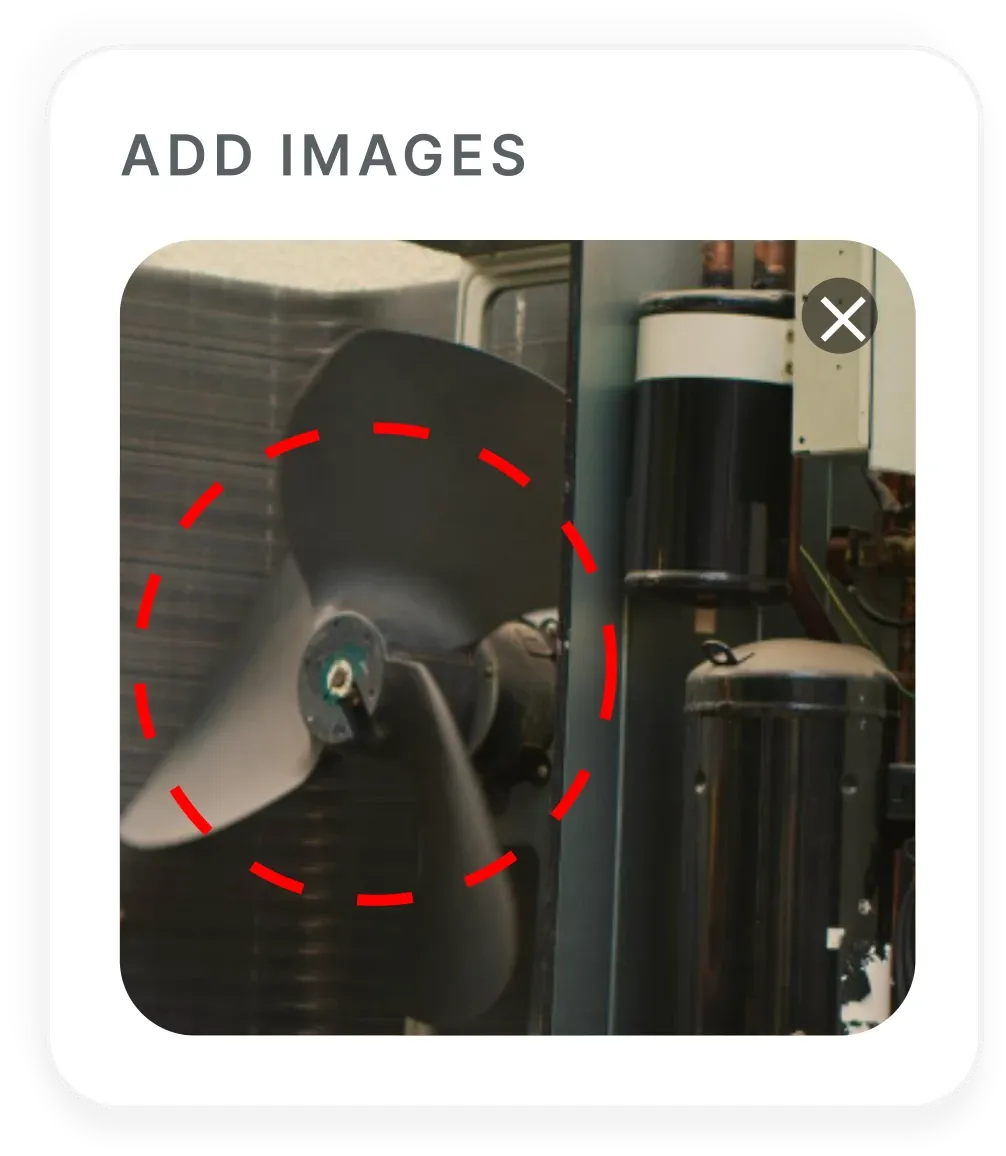
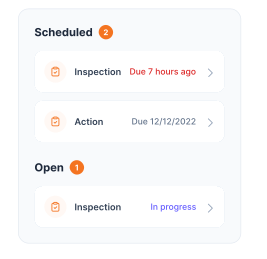
See which checklists your team has in progress across every site, jump into the same inspection with one tap, and keep field, supervisor, and back-office views in sync without sending screenshots on WhatsApp.


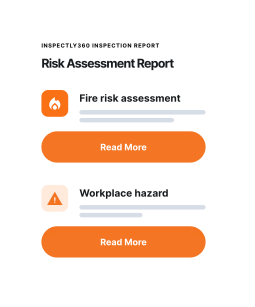


Every team reports differently. Build the report your operations, quality, or compliance leads actually want to read, share it as a branded PDF, and schedule delivery to the stakeholders who need it.


See completion, pass rate, and recurring findings across every checklist and every site, without pulling spreadsheets together at the end of the month.
What changes once field service management software is standardised on Inspectly360.






“Inspectly360 transformed how we manage site safety inspections. The offline capability alone saved us countless hours. Our compliance rate jumped from 72% to 96% in just three months.”
Sarah Mitchell
Meridian Construction Group

“The AI-powered defect detection has changed how we work. Our inspectors capture photos and the system flags issues we'd have missed. It's like having an expert reviewer on every site visit.”
James Chen
Pacific Manufacturing Co.
“Rolling out digital checklists across multiple projects gave us instant visibility into recurring safety issues. We now resolve critical findings in hours instead of days.”
Olivia Carter
Northbridge Infrastructure
Get started with inspection and audit checklist templates.

Standard site-level inspections for construction, safety, and compliance. Capture conditions, photos, and follow-ups in one place.

Inspect assets and equipment: condition, location, photos, and maintenance history. Track condition over time.

Complete work orders with checklist items, photos, and sign-off. Track completion and proof of work.

Preventive and corrective maintenance inspections. Log repairs, parts, and condition with photos and follow-ups.
Use these apps to run inspections and audits.

by Inspectly360
Simplify facilities inspections with forms, photos, and reports.

by Inspectly360
Building condition and compliance inspections with evidence and follow-ups.

by Inspectly360
Digitize building inspection apps workflows with forms, evidence capture, and automated reporting.

by Inspectly360
Run building inspections on phones and tablets with offline forms, photo evidence, and instant reports.

by Inspectly360
Audit buildings with structured scoring, photo evidence, and corrective action tracking across portfolios.
It is a field service management tool, where inspection is one supporting use case within a job rather than the whole point. Field service management covers the end-to-end operation: taking service requests, scheduling and dispatching technicians, managing work orders, tracking jobs, capturing work in the field, and recording service history. A technician might perform an inspection as part of a job, and Inspectly360 supports that, but the page is about running the service operation, not conducting inspections in isolation. If your need is coordinating technicians, jobs, and customers across the field, this is the right page. If your need is purely conducting and recording inspections, the dedicated inspection tools are a closer fit, and they connect to field service where a job includes an inspection step.
Field service scheduling and technician dispatch assign jobs based on the skills required, technician availability, and location, with route planning to minimise travel. This directly attacks the largest hidden costs in field service: sending a technician who lacks the right skill and has to return, and wasting hours in avoidable travel between jobs. Intelligent dispatch sends the nearest available technician with the right capability, so more jobs are completed per day and first-time-fix rates rise. Over a team of technicians, small improvements in routing and skill matching compound into significant gains in productivity and reductions in fuel and overtime, which is why scheduling and dispatch are usually where field service software pays back first.
No. Field service happens in basements, plant rooms, rural sites, and buildings with poor reception, so the mobile app works fully offline. Technicians complete work orders, capture photos, readings, and signatures, and record job details with offline data collection, and everything syncs when the device reconnects. Nothing is re-keyed, and the completion time and technician identity are preserved. This is essential because the jobs that most need a complete record are frequently in exactly the locations where connectivity fails, and a system that stalled offline would push technicians back to paper job sheets, which lose photos and detail and create the office re-keying and disputes that field service software is meant to eliminate.
Customers most often complain about not knowing when a technician will arrive and having to chase updates. Real-time job tracking lets the office see and communicate status without calling the technician, so customers get accurate answers. Service requests are captured properly so nothing is lost, and service history means a technician arrives with the full context of previous work rather than starting cold. Faster, better-matched dispatch means shorter waits and higher first-time-fix rates, so problems are resolved in one visit more often. Together these turn field service from an opaque process the customer experiences as unreliable into a transparent, informed operation, which is a major driver of customer satisfaction and retention in service businesses.
Yes. Every job is recorded against its customer and, where relevant, the specific asset serviced, building a complete service history over time. When a technician is dispatched to a returning customer or a known asset, they arrive with the record of what was done before, what parts were used, and what issues recurred, rather than starting from nothing. This improves diagnosis and first-time-fix, avoids repeating work, and supports warranty and maintenance obligations tied to an asset. Service history is also valuable for the business, showing which assets are problematic and which customers need attention, and it turns each service visit into part of a continuous record rather than an isolated event that leaves no institutional memory.
See Inspectly360 in action with a live demo tailored to your needs. No credit card required.