Convert your checklist into Mobile App

Contact Now

Extend Equipment Life WithPreventive Maintenance

One maintenance platform for reliability engineers and plant managers running PPM, predictive, and condition-based programs across multi-site asset portfolios. Every round attaches photo evidence to a unique asset, every failed item raises a work order in the CMMS, and every AMC clock is visible before renewal becomes a fire drill.

Quick Answer

Asset and equipment maintenance software is a mobile-first system that runs preventive maintenance (PPM), condition-based inspections, predictive maintenance scoring, and AMC tracking across every asset in a portfolio. It replaces handwritten PPM cards, asset registers in Excel, and standalone CMMS data entry with one defensible field layer that pushes work orders into IBM Maximo, SAP PM, ServiceNow, Fiix, UpKeep, or the corporate CMMS in use.

AI-Powered Features for Your Field Workflows

Everything your field team does on paper, Inspectly360 does automatically: faster, more accurate, and without the admin.

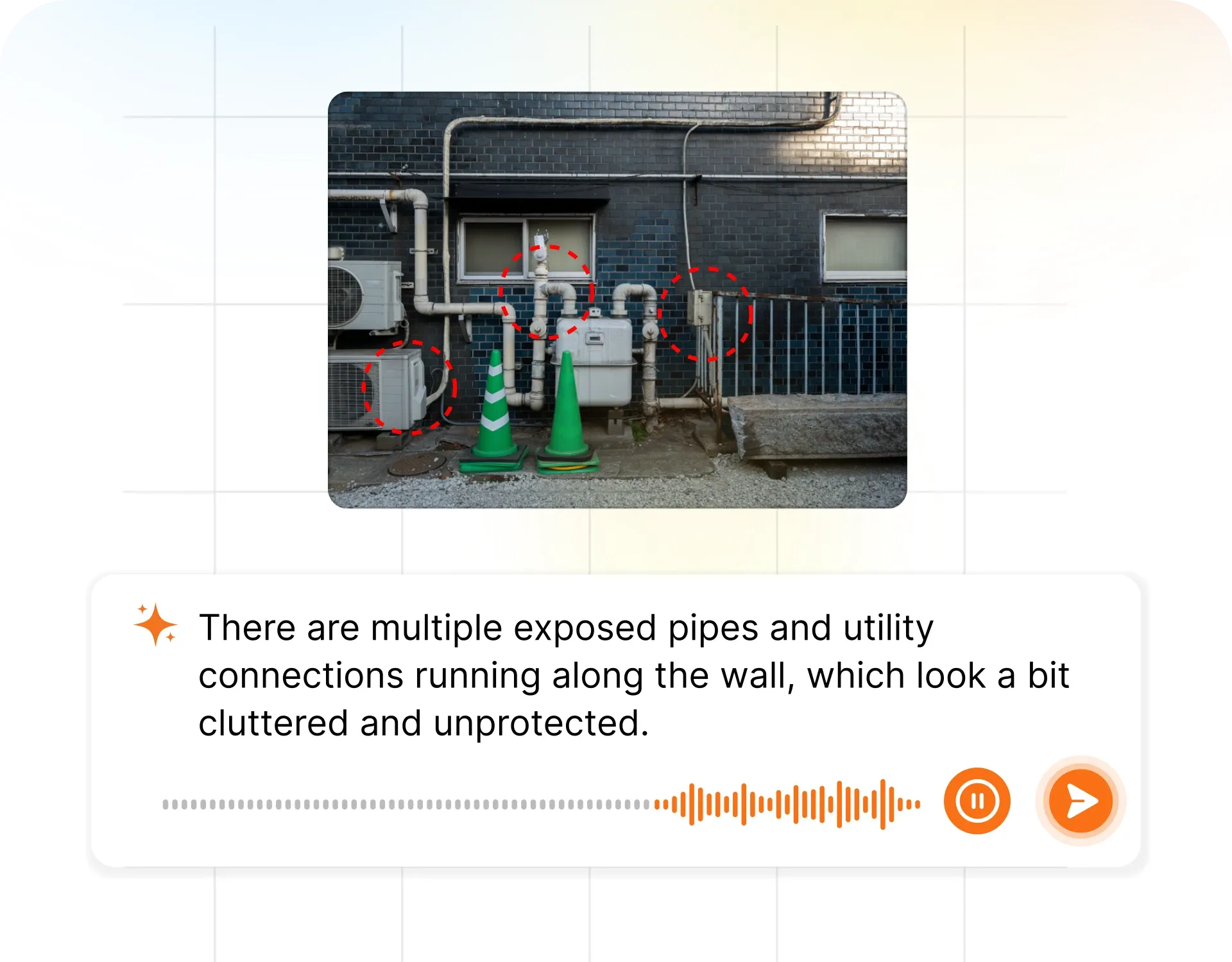
Take a Photo. AI Fills the Form illustration

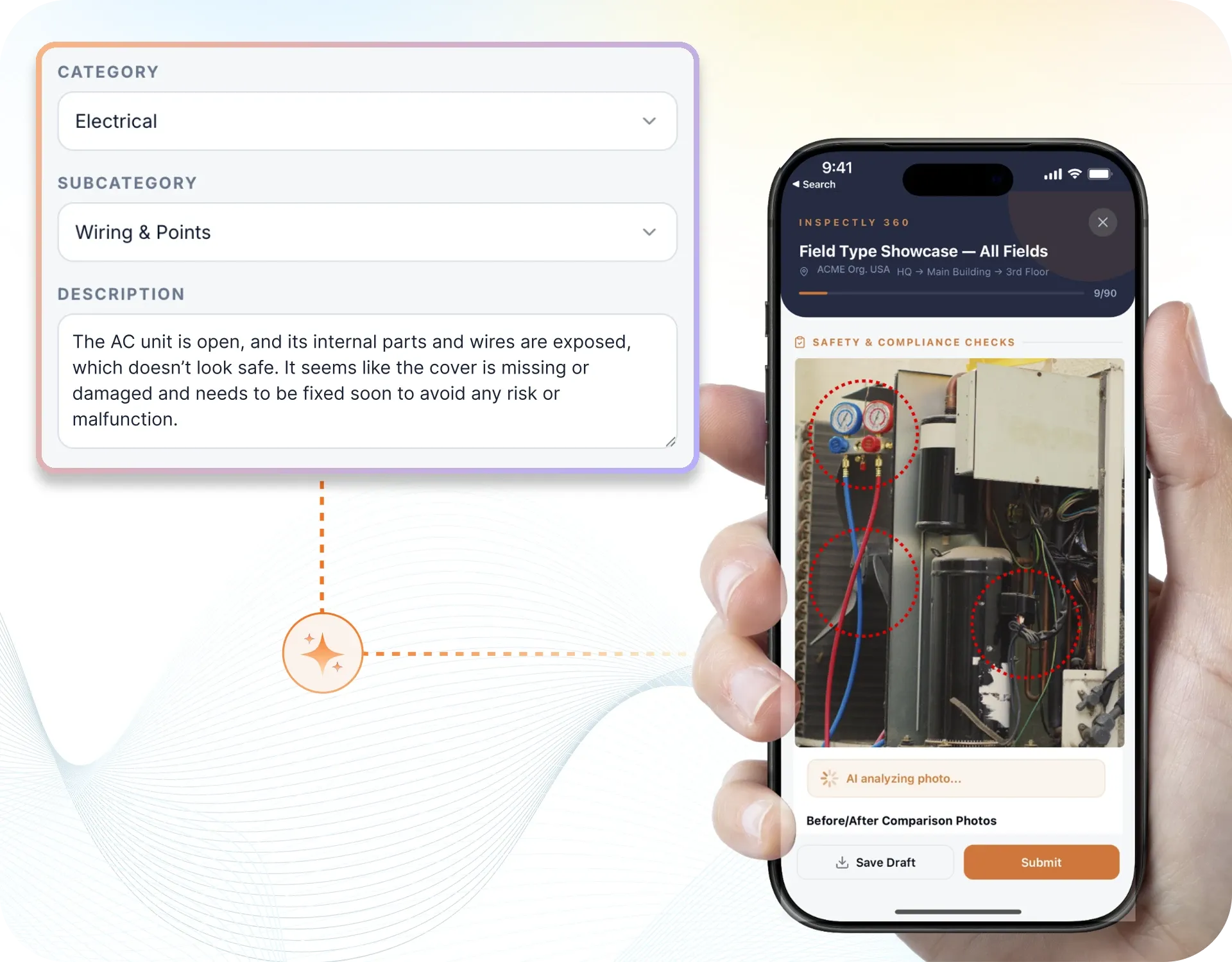
Take a Photo. AI Fills the Form

Your inspector takes a photo of any asset or defect. AI reads it and fills the inspection form automatically. No typing. No manual entry.

Speak. AI Writes It Down illustration

Speak. AI Writes It Down.

Inspectors speak their observations in any language. AI transcribes and fills the form in real time. Completely hands-free in the field.
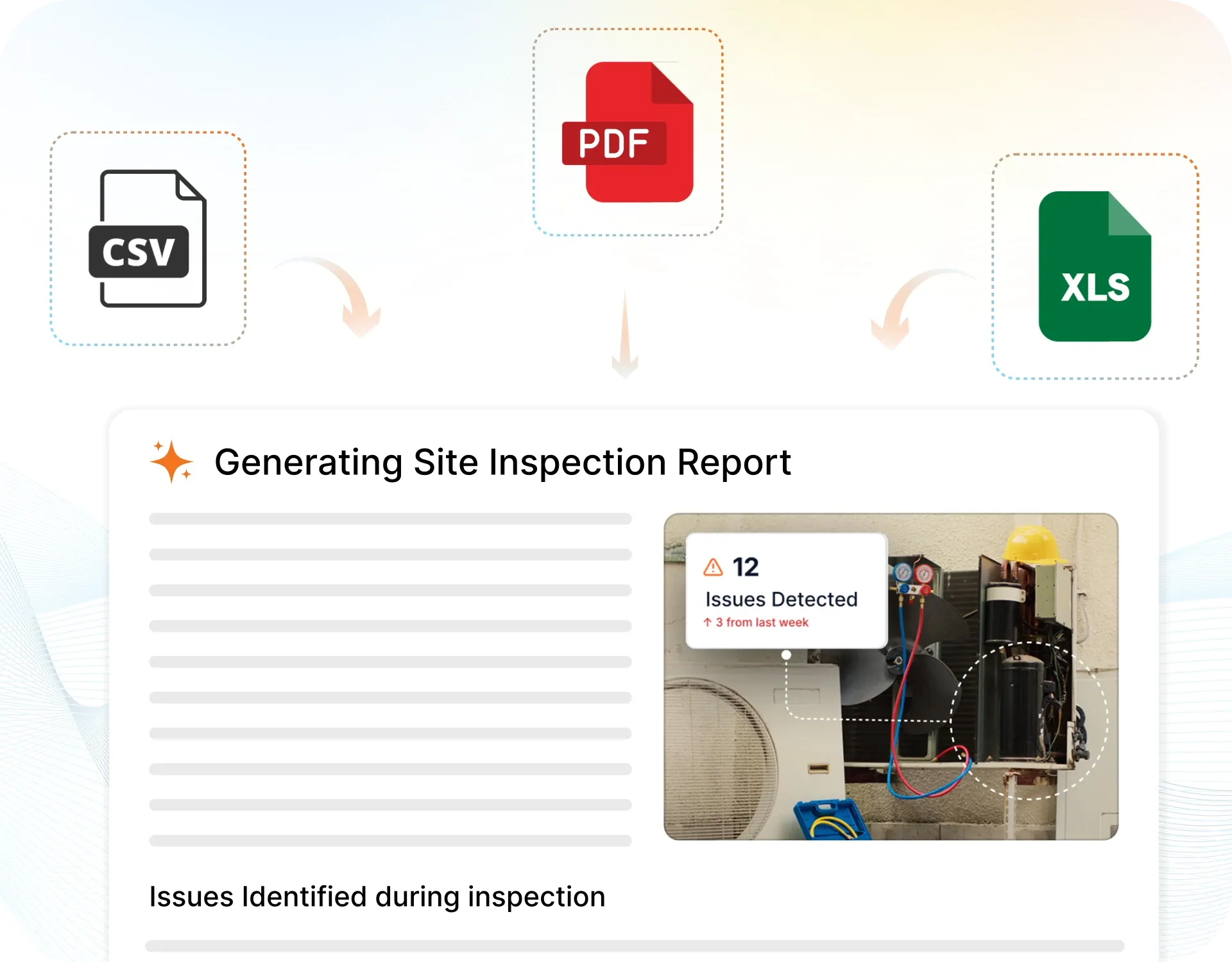
Inspections Done. Report Ready illustration

Inspections Done. Report Ready.

The moment an inspection is submitted, a branded PDF, Excel, or CSV report generates automatically. No manual work. No waiting.
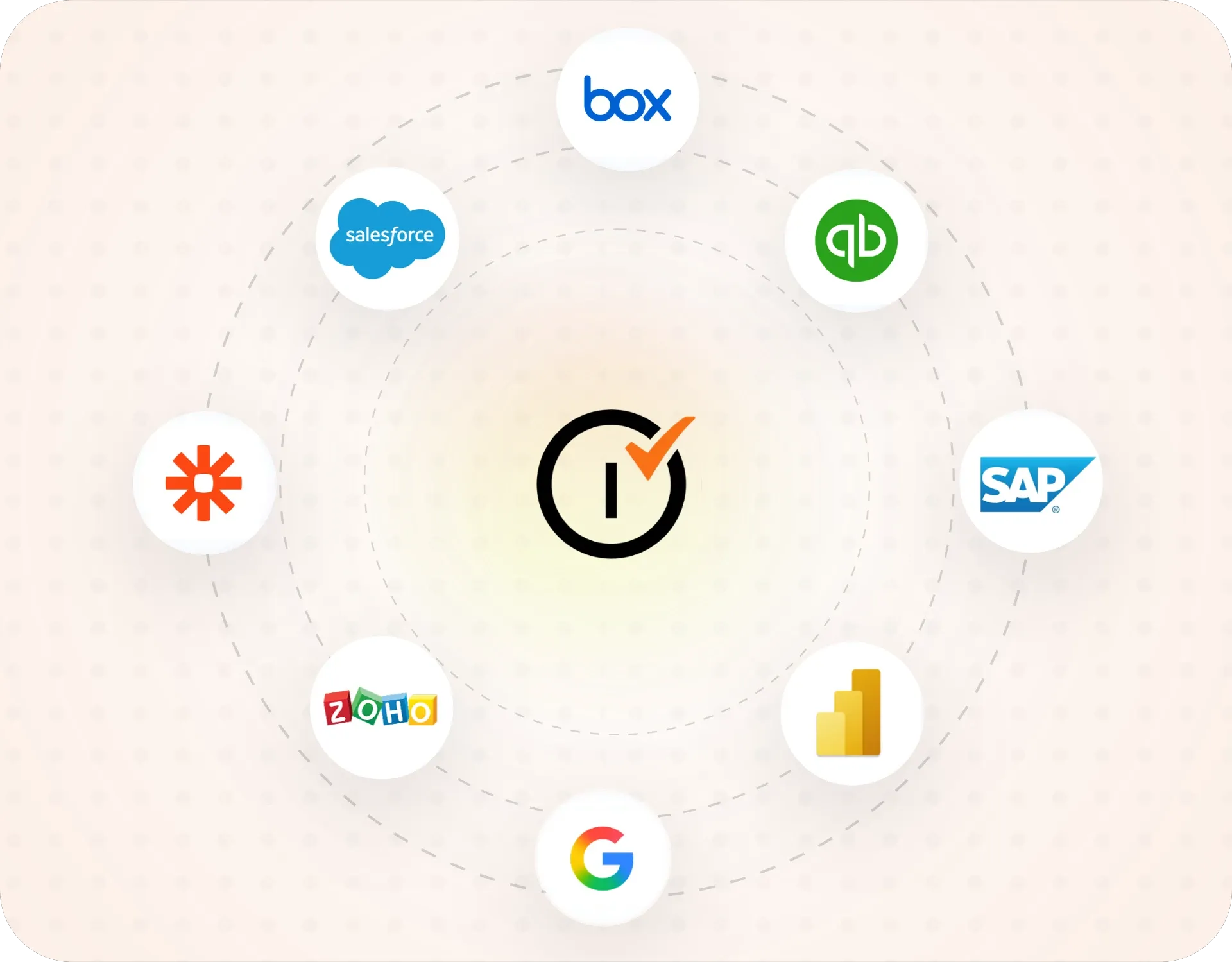
Connect Your Existing Tools illustration

Connect Your Existing Tools.

Inspectly360 integrates with the tools your team already uses, including Zoho, Microsoft 365, and SAP. No double entry.
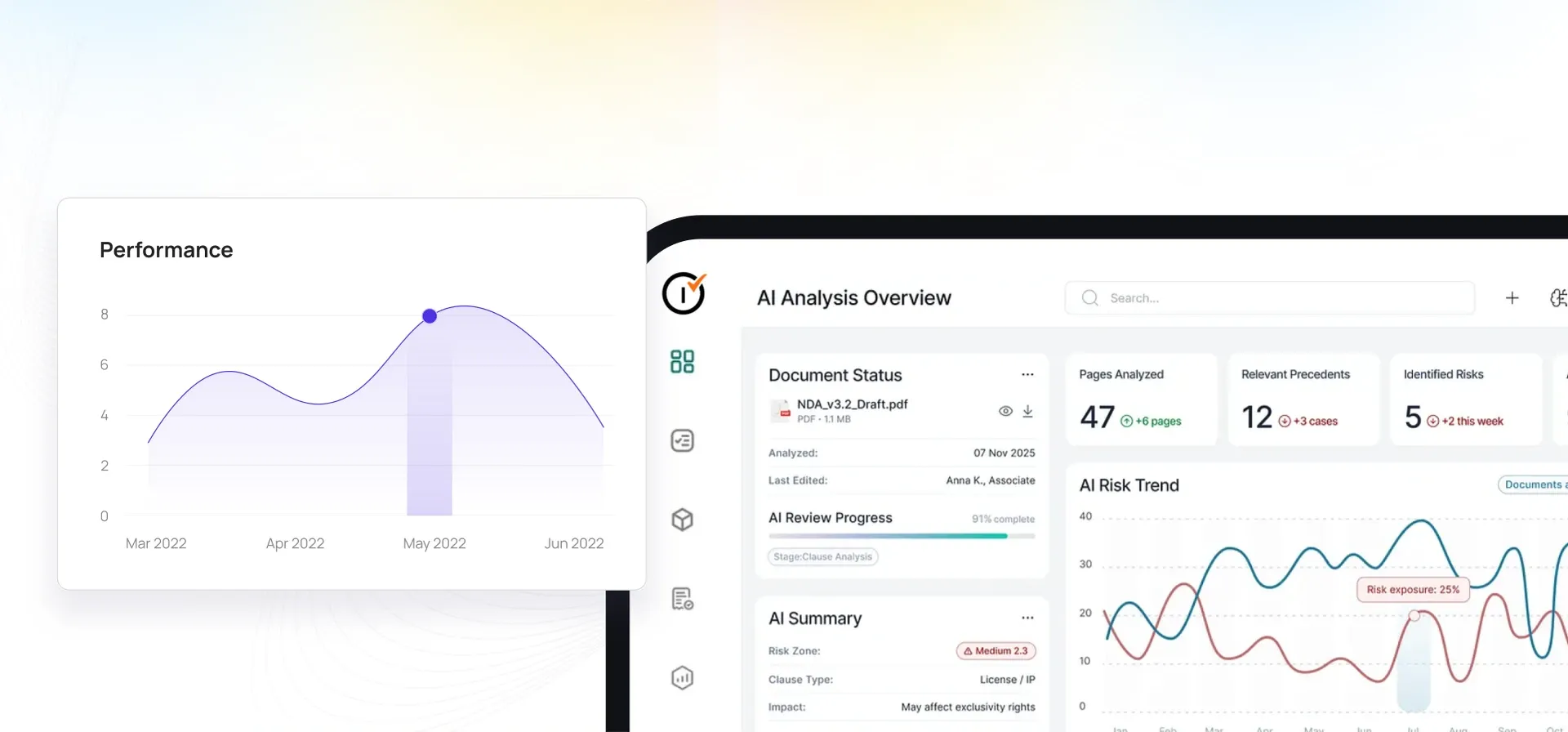
Live Dashboard. Every Site. Always On illustration

Live Dashboard. Every Site. Always On.

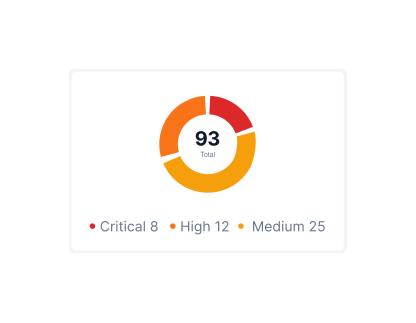
Your operations team sees completion rates, open issues, and compliance scores across all sites in real time. No chasing updates.

Before and After Inspectly360

What changes once asset & equipment maintenance runs on one mobile-first platform with photo proof and live dashboards.

Before Inspectly360

  • PPM dates live in Excel or the CMMS PM module that nobody updates. Compliance is asserted in monthly reports and reconstructed when the auditor asks. Asset-level PPM completion drifts between what was scheduled, what was logged, and what actually happened.
  • Predictive maintenance is a slide in the strategy deck. Reliability engineers know which assets misbehave but have no risk-scored data layer to defend the capital decision. Condition monitoring sensors stream data into an isolated tool that nobody opens.
  • AMC vendors live in a procurement spreadsheet. Renewals surface the week the contract expires. Vendor performance is the relationship manager's opinion because response time, fix quality, and re-open rate were never measured.
  • Spare-parts availability is checked after the work order is raised; calibration certificates live in the metrology binder. Maintenance teams break for parts and inspectors take readings with out-of-cal instruments because nobody flagged it.
  • Field inspection findings sit in one tool, CMMS work orders in another, and asset master data drifts between them. Inspectors recreate part numbers and asset IDs at capture and the resulting work order is missing the context the technician needed.

After Inspectly360

  • Every asset carries its own PPM cadence with calendar, runtime, and condition triggers. Completion is logged at capture with inspector identity, photo evidence, and asset confirmation. PPM compliance per asset is a number with a denominator on the live dashboard, not a story.
  • Risk scoring per asset combines inspection history, PPM compliance, AMC currency, runtime, and IoT condition readings into a Low / Medium / High / Critical band. The asset-criticality matrix overlays risk, so the reliability project portfolio aligns to the same data the CFO sees.
  • Each AMC vendor record carries contract dates, scope, response-time SLA, fix-quality score, and re-open rate. Renewal alerts fire at 90, 60, and 30 days; vendor scorecards drive renewal conversations; underperforming AMC is replaced on data, not memory.
  • Spare-parts integration with the CMMS inventory module checks availability before the work order leaves the screen. Calibration certificates attach to the instrument record with expiry alerts that auto-restrict inspection assignments when calibration lapses.
  • Bidirectional integration with IBM Maximo, SAP PM, ServiceNow Operations, Fiix, UpKeep, and the corporate EAM. Failed items push as work orders with photo evidence; asset master, PM history, and parts data pull back so the technician scans context, never recreates it.

What Is Asset and Equipment Maintenance Software, and How Do Reliability Teams Use It Across Multi-Site Portfolios?

Asset and equipment maintenance software is a mobile-first system that runs preventive maintenance (PPM), condition-based inspections, predictive maintenance scoring, and AMC tracking across every asset in a portfolio. It replaces handwritten PPM cards, asset registers in Excel, and standalone CMMS data entry with one defensible field layer that pushes work orders into IBM Maximo, SAP PM, ServiceNow, Fiix, UpKeep, or the corporate CMMS in use. Inspectly360 is built for Maintenance Managers, Reliability Engineers, and Plant Managers who carry MTBF, MTTR, and asset-availability targets on assets that fail expensively when their compliance clock slips.

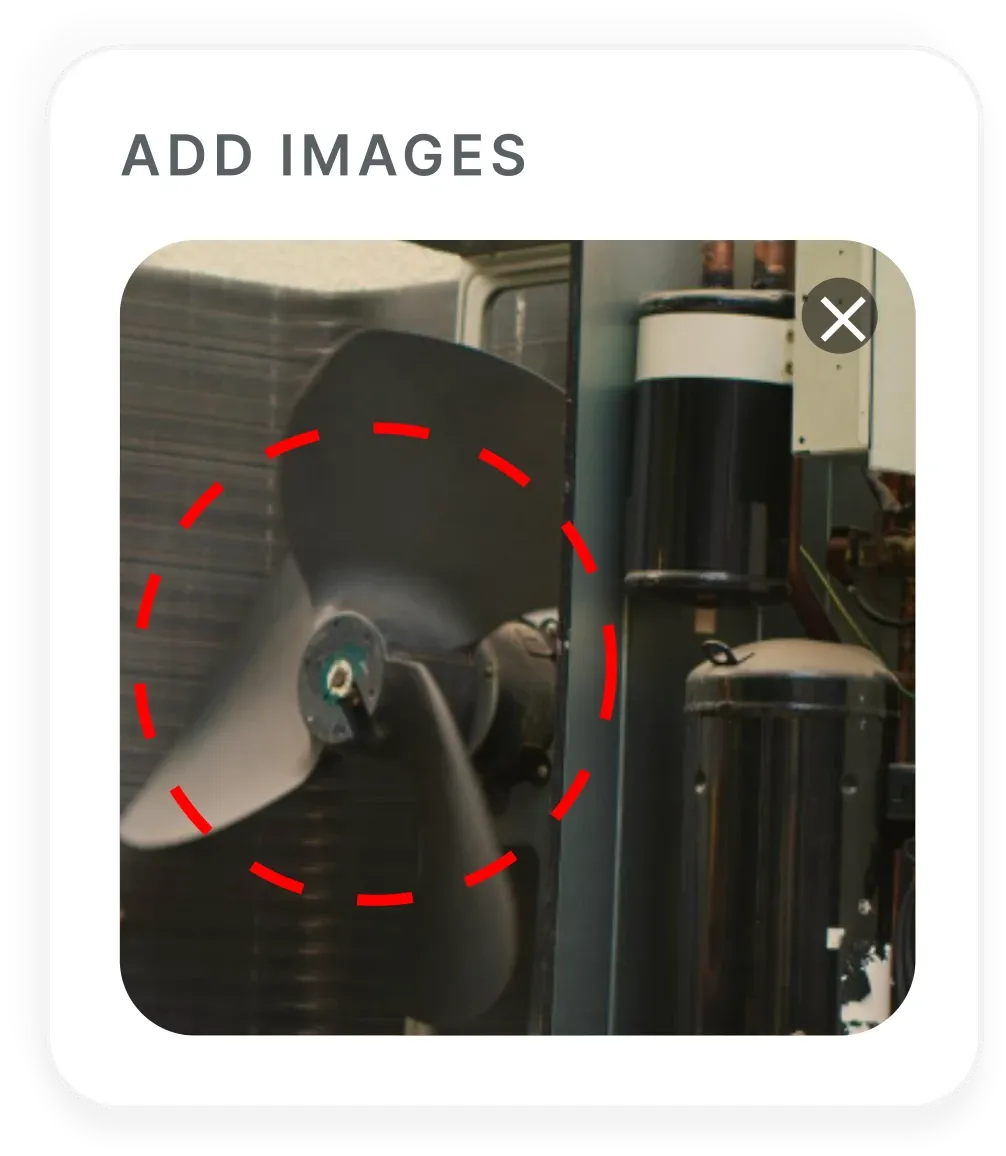
For technicians, the platform replaces clipboard PPM cards and CMMS keyboard entry with offline-first capture on Android and iOS. The technician scans an asset QR or NFC tag, the right checklist opens with last service date and AMC vendor visible, AI Visual Inspection compares the photo against the asset's own baseline for corrosion, wear, and leakage progression, and Voice AI captures the observation while their hands are still on the asset.

For reliability leadership, every failed item, condition reading, and AMC obligation feeds the same data model. Predictive scoring combines inspection history, runtime hours, IoT readings, and PPM compliance into a risk band per asset. The asset-criticality matrix drives where the next reliability project goes. MTBF, MTTR, OEE component data, calibration currency, and AMC exposure render on one dashboard so reliability conversations open on data instead of intuition.

How Does a Maintenance Program Run from PPM Cards to Predictive Scoring?

Reliability programs come up site by site: prove the inspection and asset-binding layer first, then layer predictive scoring, AMC governance, and the deeper CMMS integration once the field data is trusted.

  1. 1

    Build the Asset Register with Criticality and QR

    Define the portfolio asset hierarchy (region, plant, line, asset, sub-component) with QR or NFC tags, criticality band (A, B, C), and the AMC vendor of record. The asset record becomes the source of truth that field technicians scan into rather than recreate.

  2. 2

    Translate PPM and Condition Inspection Plans

    Convert paper PPM cards, OEM service manuals, and existing CMMS PM tasks into versioned digital programs with required photo evidence, calibration checkpoints, runtime triggers, and AMC contract tasks. The plan library locks the maintenance standard across plants.

  3. 3

    Wire Runtime, IoT, and Condition Triggers

    Beyond calendar PPM, plans trigger on runtime hours (from MES or PLC), vibration thresholds (from condition-monitoring sensors), temperature drift, or oil-analysis result. The asset tells the system when to inspect it; the inspector stops chasing a calendar that no longer matches reality.

  4. 4

    Integrate the CMMS and EAM Stack

    Failed items push to IBM Maximo, SAP PM, ServiceNow, Fiix, UpKeep, or the corporate EAM as work orders with photo evidence, asset context, and priority attached. Spare-parts integration with the CMMS inventory module checks part availability before the work order leaves the technician's screen.

  5. 5

    Run Predictive Scoring and Capital Planning

    AI risk-scores assets from inspection history, PPM compliance, AMC currency, IoT readings, and prior failure intervals. The asset-criticality matrix overlays risk, so the next reliability project, the next condition-monitoring deployment, and the next capital replacement decision rest on the same number.

How Should Reliability Engineers Pilot, Validate, and Scale Without Stalling Production?

Answers to common long-tail questions, kept on one canonical page to avoid thin duplicate URLs.

How Should Reliability Engineers Pilot Without Stalling Production?

Start at one plant with a single asset class that hurts most today (typically rotating equipment or critical-utility assets). Convert the OEM-recommended PPM card into a digital plan with QR-tagged assets, run it for two cycles in parallel with the paper backup, and measure PPM compliance, work-order accuracy, and technician cycle time. Layer the CMMS push integration once the inspection signal is trusted, switch on AMC governance for vendors on the same asset class, and connect IoT condition streams only after the baseline reliability data has stabilised. This sequencing keeps production uptime unbroken during transition.

What Should Maintenance and IT Validate During Procurement?

Validate SSO via SAML or OIDC, RBAC scoped to plant, area, and asset class, offline mobile capture verified in a real plant room rather than a demo room, configurable retention windows that match the customer and regulatory record-retention requirements, and a documented integration path into IBM Maximo, SAP PM, ServiceNow Operations, Fiix, UpKeep, or whichever CMMS and EAM already sits in the stack. AMC vendor and contractor scoping is enforced server-side, which matters when an external vendor performs the asset work.

Migration from Excel PPM Trackers, Paper Cards, and Legacy CMMS Modules

Historical PPM records, scanned service reports, and Excel asset registers import as searchable evidence attached to the same asset, AMC vendor, or plant record. Active PMs, open work orders, AMC contract dates, and calibration certificates seed from the legacy source and are validated against the asset register during onboarding. Technicians keep the paper PPM card for the first two inspection cycles by design, so adoption is built on technician confidence rather than mandate.

Which Capabilities Help Maintenance Managers Run PPM, AMC, and Predictive Programs Consistently?

The platform capabilities that power asset & equipment maintenance across every site.

Ready to Move Asset & Equipment Maintenance Off Paper?

Book a Free Demo

How Is This Different from IBM Maximo, SAP PM, Generic CMMS, or a Spreadsheet PPM Tracker?

Maintenance Managers comparing Inspectly360 to IBM Maximo, SAP PM, ServiceNow Operations, generic CMMS, and spreadsheet PPM trackers care about five things: whether asset-level PPM compliance is defensible, whether predictive maintenance produces a score the reliability engineer trusts, whether AMC vendor performance is measured rather than asserted, whether spare-parts and calibration data stay synchronised with the maintenance event, and whether the platform fits beside the CMMS and EAM already in place rather than replacing them.

TopicTypical GapsWith Inspectly360
PPM scheduling and compliance per assetPPM dates live in Excel or the CMMS PM module that nobody updates. Compliance is asserted in monthly reports and reconstructed when the auditor asks. Asset-level PPM completion drifts between what was scheduled, what was logged, and what actually happened.Every asset carries its own PPM cadence with calendar, runtime, and condition triggers. Completion is logged at capture with inspector identity, photo evidence, and asset confirmation. PPM compliance per asset is a number with a denominator on the live dashboard, not a story.
Predictive maintenance scoringPredictive maintenance is a slide in the strategy deck. Reliability engineers know which assets misbehave but have no risk-scored data layer to defend the capital decision. Condition monitoring sensors stream data into an isolated tool that nobody opens.Risk scoring per asset combines inspection history, PPM compliance, AMC currency, runtime, and IoT condition readings into a Low / Medium / High / Critical band. The asset-criticality matrix overlays risk, so the reliability project portfolio aligns to the same data the CFO sees.
AMC vendor evaluation and renewalAMC vendors live in a procurement spreadsheet. Renewals surface the week the contract expires. Vendor performance is the relationship manager's opinion because response time, fix quality, and re-open rate were never measured.Each AMC vendor record carries contract dates, scope, response-time SLA, fix-quality score, and re-open rate. Renewal alerts fire at 90, 60, and 30 days; vendor scorecards drive renewal conversations; underperforming AMC is replaced on data, not memory.
Spare-parts and calibration synchronisationSpare-parts availability is checked after the work order is raised; calibration certificates live in the metrology binder. Maintenance teams break for parts and inspectors take readings with out-of-cal instruments because nobody flagged it.Spare-parts integration with the CMMS inventory module checks availability before the work order leaves the screen. Calibration certificates attach to the instrument record with expiry alerts that auto-restrict inspection assignments when calibration lapses.
Fit with IBM Maximo, SAP PM, ServiceNow, and EAMField inspection findings sit in one tool, CMMS work orders in another, and asset master data drifts between them. Inspectors recreate part numbers and asset IDs at capture and the resulting work order is missing the context the technician needed.Bidirectional integration with IBM Maximo, SAP PM, ServiceNow Operations, Fiix, UpKeep, and the corporate EAM. Failed items push as work orders with photo evidence; asset master, PM history, and parts data pull back so the technician scans context, never recreates it.

Who Benefits from a Digital Maintenance Platform, and What Does Each Role Get?

What changes once asset & equipment maintenance is standardised on Inspectly360.

  • Maintenance Managers: One portfolio view of PPM compliance, MTBF, work-order backlog, AMC exposure, and calibration currency, ready for the operations review without a Friday compile cycle.
  • Reliability Engineers: Predictive risk scoring per asset overlays the criticality matrix, so the next reliability project goes to the asset that earns the spend, not the asset with the loudest noise.
  • Plant Managers: Asset-availability targets defended on data; unplanned-downtime root causes traceable to the inspection, work order, and AMC vendor in one click.
  • Field Technicians: Offline QR scan opens the right checklist with last service date and AMC vendor visible; the technician stops carrying the asset register in their head.
  • AMC and Maintenance Vendors: Scoped mobile access to their assigned assets only, with photo-verified closure and a scorecard the vendor can see; renewal conversations open on the same numbers both sides know.
  • Procurement Teams: AMC renewal alerts at 90, 60, and 30 days with vendor performance data, so contract negotiation opens earlier and on better evidence.
  • Finance and Capital Planning: Lifecycle analytics (overhaul vs replace vs retire) supported by MTBF, MTTR, condition trend, and total cost of maintenance per asset.

Which PPM and Asset Maintenance Templates Should Reliability Teams Pilot First?

Get started with inspection and audit checklist templates.

View All Checklist Templates
Site Inspection Checklist
Inspections

Site Inspection Checklist

Standard site-level inspections for construction, safety, and compliance. Capture conditions, photos, and follow-ups in one place.

41,000+GET
Asset Inspection Checklist
Asset Management

Asset Inspection Checklist

Inspect assets and equipment: condition, location, photos, and maintenance history. Track condition over time.

28,900+GET
Work Order Checklist
Work Orders

Work Order Checklist

Complete work orders with checklist items, photos, and sign-off. Track completion and proof of work.

31,800+GET
Maintenance Checklist
Maintenance

Maintenance Checklist

Preventive and corrective maintenance inspections. Log repairs, parts, and condition with photos and follow-ups.

27,400+GET

Frequently Asked Questions About Asset & Equipment Maintenance

How does PPM scheduling logic combine calendar, runtime, and condition triggers in one plan?

Each PPM plan defines a primary cadence (calendar interval, runtime hours pulled from MES or a PLC, or measurable condition such as vibration band, temperature, or oil-analysis result) plus optional secondary triggers that fire whichever earlier limit is reached. A turbine PPM might be scheduled at 4,000 runtime hours or 12 calendar months, whichever comes first, with an interrupt trigger on vibration crossing the ISO 10816 alarm threshold. The plan is asset-specific (one cadence per asset record) so a 24/7 critical asset and an intermittent backup carry different cadences for the same nominal task. Compliance is logged at the inspection and rolled to the plant dashboard per asset, not per plan.

What inputs feed the predictive maintenance risk score, and is the model explainable to a reliability engineer?

Risk score inputs are explicit: inspection history (defects logged, severity), PPM compliance (on-time, late, missed), AMC currency, runtime hours, IoT condition readings where instrumented (vibration, temperature, current, oil quality), and prior failure intervals. Each input carries a configurable weight per asset class so a centrifugal pump weights vibration heavily and an HVAC chiller weights superheat. The output is a Low / Medium / High / Critical band with the contributing factors visible on the asset record, so the reliability engineer can defend the score to the plant manager and to capital review. Predictive maintenance fails when the model is a black box; transparency is the design constraint.

How are AMC vendors evaluated, and what does the scorecard measure?

AMC vendor records hold contract dates, scope coverage, response-time SLA, and rate card. Performance metrics calculate continuously: response time vs SLA, first-time fix rate, re-open rate within 30 / 60 / 90 days, scheduled visit completion, and technician training currency. Each metric carries a configurable weight that varies by asset criticality (a critical-utility AMC weights response time heavily; a low-criticality cosmetic AMC weights scheduled visit completion). Renewal alerts fire at 90, 60, and 30 days with the current scorecard attached so procurement opens the conversation on data. Vendors can see their own scorecard in their scoped portal, which is what mature programs find drives behaviour faster than discipline alone.

How does spare-parts integration with the CMMS inventory module work?

When a failed item raises a work order, the platform queries the CMMS inventory module (Maximo, SAP PM MM-WM, ServiceNow Operations, Fiix, UpKeep) for the recommended spare part against the asset BOM. Availability status (on-hand, allocated, on-order, lead time) returns to the technician's screen before the work order leaves the device, so the technician knows immediately whether the repair starts now or waits for the part. Parts consumption logged at job completion updates the inventory record so the next PM that needs the same part sees an accurate on-hand. The CMMS remains the inventory system of record; the field layer stops being the broken link that makes inventory data drift.

How does the asset-criticality matrix drive PPM frequency and reliability project prioritisation?

Every asset carries a criticality band (A / B / C or 1-5) derived from safety, environmental, production, and quality consequence of failure. Criticality is reviewed during onboarding and on a documented cadence afterward. PPM frequency, condition-monitoring depth, AMC investment, and spare-parts holding all flex against criticality automatically rather than relying on memory. The reliability project portfolio overlays criticality on the predictive risk score, so the next project goes to the asset that is both high-criticality and high-risk, not the asset with the loudest stakeholder. ISO 55001 management-system audits look for exactly this discipline; the platform produces it as a property of the data model.

What does calibration tracking look like for instruments used in maintenance inspections?

Calibration certificates attach to the instrument record with expiry date, calibrating laboratory, accreditation scope (ISO/IEC 17025 traceability), and the measurement uncertainty statement. Expiry alerts fire at the configured window (commonly 60 and 30 days) and auto-restrict inspections that depend on the instrument once calibration lapses. The audit trail shows which calibrated instrument took each measurement so a quality auditor or regulator can trace measurement data back to a calibrated and in-scope source. For instruments owned by AMC vendors, the same record applies with vendor-side visibility through the scoped portal.

Less Paperwork. More Visibility.

See Inspectly360 in action with a live demo tailored to your needs. No credit card required.

  • 30 Days Free Trail
  • 1000+ Templates
  • Unlimited Integration